



On the morning of 18 March 2026, the Federal Open Market Committee voted unanimously to hold the federal funds rate in the 4.25 to 4.5 per cent range. The decision itself was unremarkable. What made the accompanying statement extraordinary was a single sentence buried in the final paragraph: Jerome Powell confirmed he would remain as chairman pro tempore until his successor was confirmed by the Senate, a formulation that acknowledged, for the first time publicly, that the most powerful monetary policy position on earth was effectively in transition.
Markets had been pricing this uncertainty for months. Bond traders, equity portfolio managers, and corporate treasurers watching the yield curve understood what the statement confirmed: the Federal Reserve was entering a leadership transition at precisely the moment when its policy decisions carried their highest stakes in two decades. The question of who would chair the Fed, and what they would do with that authority, had become a material variable in every major financial model in the world.
The Succession Battle and What It Signals
Jerome Powell was appointed Fed Chair by President Trump in 2017 and reappointed by President Biden in 2022. His term as chair was set to expire in May 2026, though his position on the FOMC board extends to January 2028. The nominee to succeed him is Kevin Warsh, a former Fed governor and Morgan Stanley investment banker who served on the FOMC during the 2008 financial crisis.
Warsh’s policy outlook differs from Powell’s in ways that matter enormously to markets. He has been publicly critical of the Fed’s 2021 and 2022 inflation response, arguing that the central bank waited too long to begin tightening and that its credibility was damaged by the delay. Analysts at Capital Economics project that Warsh and the Trump administration will be ‘at loggerheads almost immediately’, Warsh is expected to prioritise inflation credibility and Fed independence, while the White House has consistently pressured for lower rates to support growth and reduce the cost of refinancing the US national debt.
The Senate confirmation process adds its own uncertainty. A contested confirmation hearing for a Fed Chair nominee is historically rare and inherently market-moving. Every statement Warsh makes during confirmation, every senator’s question about the Taylor Rule or quantitative tightening, will be parsed by fixed-income traders for clues about the future path of the federal funds rate.
Adding a further complication, reports emerged in early 2026 of a Department of Justice inquiry touching on aspects of Powell’s tenure, a development with no clear precedent in the Fed’s 112-year history. The inquiry’s scope and implications remain unclear, but the effect on institutional confidence was immediate and negative.
What Markets Are Pricing In
The FOMC’s March 2026 Summary of Economic Projections showed 12 of 19 officials projecting at least one rate cut before year-end, but with a dispersion in forecasts that was unusually wide. The median projection pointed to rates ending 2026 at 4.0 per cent, but the range extended from 3.25 to 4.75 per cent, reflecting genuine disagreement about the inflation trajectory.
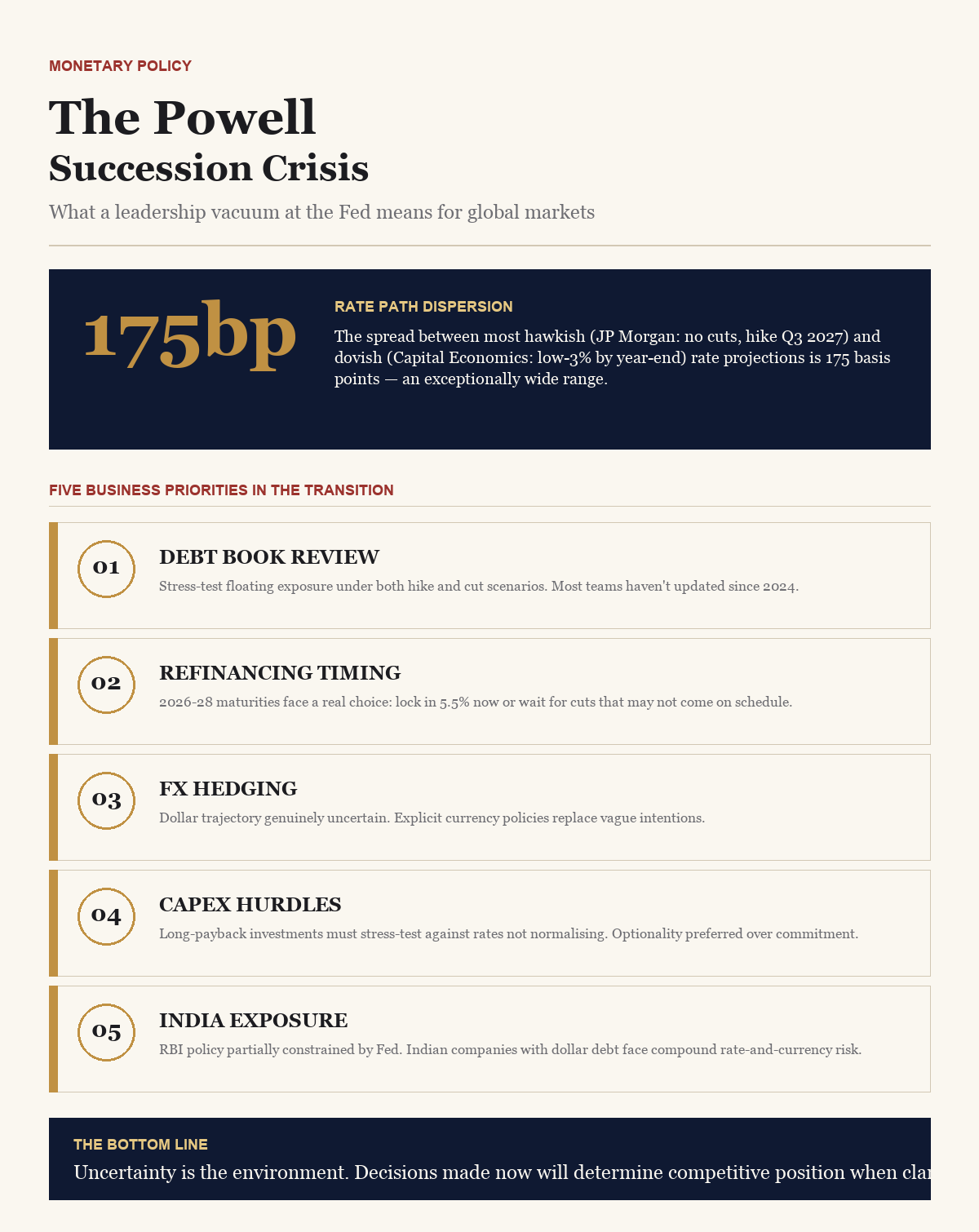
J.P. Morgan‘s rates team, in a note circulated to institutional clients in April 2026, laid out a base case that diverged sharply from the FOMC median: they projected no rate cuts in 2026 and saw the next policy move as a 25 basis point hike in Q3 2027, driven by a second inflation impulse from tariff-driven goods price increases and persistent services sector wage pressures. Capital Economics, meanwhile, projected rates drifting toward the low 3 per cent range by year-end if the new chair prioritised growth accommodation over inflation credibility.
The spread between these projections, roughly 175 basis points in the implied rate path, is not an analytical footnote. For any business with variable-rate debt, rate-sensitive capital expenditures, or cross-border cash flows exposed to dollar movements, that range represents a material difference in planning assumptions. The cost of capital, the attractiveness of acquisition financing, the economics of refinancing, all of these decisions are being made, right now, in an environment where the central bank’s own projections carry unusually wide error bars.
Historical Precedents: What Leadership Transitions Tell Us
The Fed’s modern history includes four major leadership transitions that offer partial analogies. Paul Volcker’s departure in 1987 and Alan Greenspan’s appointment introduced a period of ‘testing’ during which markets probed the new chair’s resolve, the 1987 stock market crash, which occurred eight weeks after Greenspan took office, was the defining test. Greenspan’s decisive response, flooding the system with liquidity, established his credibility, but the transition period itself was volatile (see our analysis in Real Estate in a High-Rate World).
Ben Bernanke’s 2006 appointment after Greenspan’s eighteen-year tenure generated significant market anxiety about continuity. Bernanke’s early months were marked by communication miscues that briefly roiled bond markets, as traders recalibrated their models for a chair whose style differed meaningfully from his predecessor’s. The lesson from these transitions is consistent: markets price elevated uncertainty during the appointment and early tenure of a new Fed chair, and that uncertainty premium tends to be highest when the incoming chair’s policy preferences are not well-established through prior FOMC dissents or published academic work (see our analysis in The Great Liquidity Migration).
Kevin Warsh’s policy views are more publicly documented than most incoming chairs, he has been vocal in opinion pieces and conference speeches, but the question of how he will exercise those views in the institutional context of the FOMC, with its committee dynamics and its obligations to the dual mandate, remains genuinely open (see our analysis in Inflation’s Persistence).
Implications for Corporate Finance Strategy
For CFOs and treasurers, the Powell succession creates a specific set of action items that should be on the agenda regardless of which rate scenario materialises.
First, the composition of the debt book matters more than usual. Businesses with significant floating-rate debt exposure are carrying a risk that is currently priced by markets that disagree about the direction of the next move. Reviewing the fixed-to-floating ratio and stress-testing the debt service cost under both the J.P. Morgan hike scenario and the Capital Economics cut scenario is a basic hygiene measure that many finance teams have not updated since 2024.
Second, refinancing timing deserves deliberate attention. Companies with debt maturing in the 2026 to 2028 window face a genuine decision: refinance now at current rates, accepting certainty at 4.25 to 4.5 per cent, or wait on the assumption that Warsh-era policy will be more accommodative. The historical experience of Fed transitions suggests that ‘waiting for lower rates’ during a leadership change is a strategy with a poor track record.
Third, dollar-exposed businesses need explicit hedging policies. The combination of Fed leadership uncertainty, US tariff policy volatility, and geopolitical risk has made the dollar’s near-term trajectory genuinely unpredictable. Indian exporters benefiting from a weaker rupee and Indian importers exposed to dollar-denominated commodity costs are both operating with more currency risk than their hedge books may reflect.
Fourth, capital expenditure decisions with horizons beyond 18 months should be stress-tested against a rate environment that does not assume Fed policy normalisation. The base case planning assumption of ‘rates lower by 2027’ is not wrong, but it is not certain, and for projects with multi-year payback periods, the difference between 3.5 per cent and 4.5 per cent cost of capital is the difference between a compelling IRR and a marginal one.
The India Dimension
For Indian businesses and investors, the Powell succession matters through three channels. The Reserve Bank of India‘s own rate decisions are partially constrained by Fed policy, a more hawkish Fed, or prolonged US rate uncertainty, limits the RBI’s room to cut rates without triggering rupee depreciation that feeds back into import-driven inflation. The RBI held its repo rate at 6.5 per cent through much of 2025 and 2026; the path to lower rates depends partly on the Fed’s trajectory.
Indian companies with US dollar debt, and there are hundreds of them, across infrastructure, energy, and technology, are directly exposed to the rate uncertainty. A higher-for-longer Fed scenario increases their refinancing costs; a rapid-cut scenario provides relief. Building explicit scenarios into treasury planning is not optional in this environment.
Finally, foreign institutional investors allocating to Indian equities and debt markets are making those allocation decisions partly on the basis of relative rate differentials. A more hawkish Fed makes US fixed income relatively more attractive and can trigger FII outflows from emerging markets including India. The portfolio flows that have supported Indian equity valuations are, in part, a function of the rate spread between US Treasuries and Indian government bonds, a spread that the Powell succession is now making less predictable.
Looking Ahead
The Federal Reserve’s independence from political direction is a constitutional convention rather than a legal certainty, and the current moment is testing that convention more directly than any period since the early 1980s. The institution’s credibility, its most valuable and least tangible asset, is the product of decades of demonstrated willingness to make politically inconvenient decisions in pursuit of price stability.
That credibility is not going to be destroyed by a single leadership transition, however contested. But it can be eroded by a period of visible conflict between the central bank and the executive, by communication that markets perceive as politically influenced, or by a policy pivot that prioritises short-term growth over the inflation anchor. Business leaders who are waiting for the succession to resolve before updating their planning assumptions are already behind. The uncertainty is the environment. The decisions being made now, in that environment, will determine competitive position when clarity eventually returns.
