



Commercial real estate is a leveraged business in which interest rates determine almost everything. When rates were near zero from 2009 to 2022, capital flooded the sector, valuations expanded steadily, and yields compressed to levels that assumed the cheap-money environment would continue indefinitely. That assumption proved expensive when the Federal Reserve raised rates by 525 basis points in 18 months starting in March 2022. The cumulative valuation impact across global commercial real estate has been substantial, Green Street‘s All-Property Index, which tracks listed commercial real estate values, is approximately 19 per cent below its 2022 peak as of early 2026, with much wider variation by sector and geography.
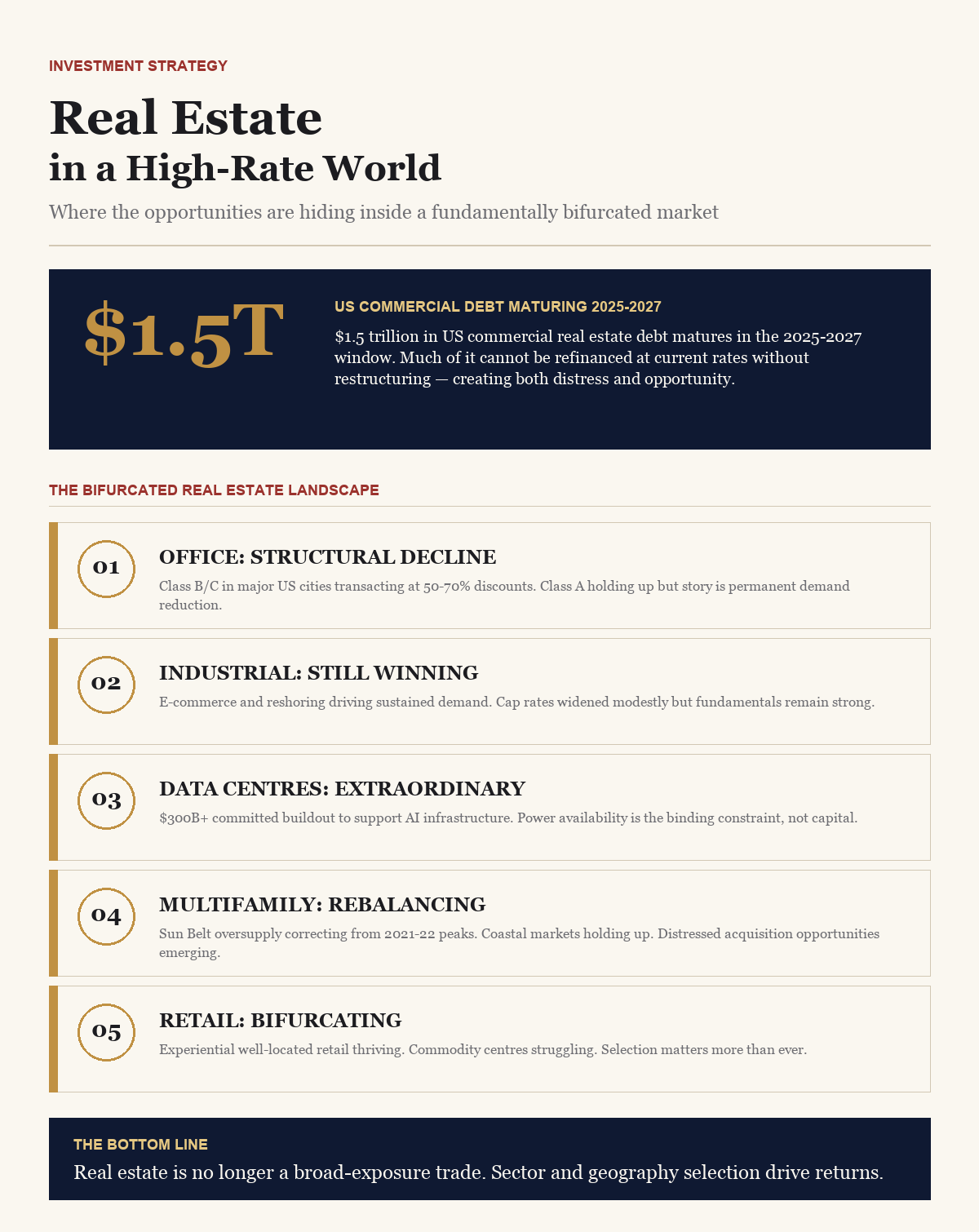
The conventional reading is that commercial real estate is a sector in distress, and at the aggregate level that reading is accurate. But the more interesting picture emerges when the sector is disaggregated. Office property is in genuine secular decline, particularly in the central business districts of major North American and European cities. Industrial and logistics property continues to perform well despite the higher rate environment. Multifamily housing is rebalancing after a hot 2021-2022 period. Data centres are experiencing extraordinary demand growth. Retail is bifurcating between high-quality experiential locations that are thriving and commodity centres that are struggling. The aggregate distress narrative obscures the substantial opportunity that the dispersion has created.
Office: The Hardest Case
Office property has experienced the most severe and visible disruption. Hybrid and remote work arrangements have permanently reduced demand for office space in most knowledge-economy markets. Occupancy data from Kastle Systems, which tracks office building access in major US cities, shows that midweek occupancy levels remain at approximately 55 to 65 per cent of pre-pandemic levels three years into the post-COVID adjustment. The structural reduction in office demand has produced vacancy rates in central business districts that exceed 25 per cent in several major cities, with absorption rates that suggest the oversupply will persist for years.
The valuation consequences have been severe. Class B and C office buildings in major US cities have transacted at discounts of 50 to 70 per cent to their 2019 valuations, when transactions have occurred at all. Many properties cannot be financed at any rate that supports the current debt stack, leading to defaults, foreclosures, and conversions to alternative uses. Office-to-residential conversion has been pursued aggressively in New York, Washington DC, and Chicago, with mixed economic results depending on building configuration and local incentives.
Class A office property in well-located buildings with modern amenities and strong tenant rosters has held up substantially better, in some markets remaining near pre-pandemic valuations. The bifurcation reflects a tenant flight to quality: companies that need office space are concentrating it in their best buildings, which are doing well, while their secondary spaces are abandoned. For investors, the implication is clear: not all office property is impaired, but the average outcome is unfavourable, and pricing risk requires specific building-level analysis rather than category-level assumptions.
Industrial and Logistics: The Quiet Outperformer
Industrial and logistics property has been the strongest commercial real estate category through the high-rate period. The e-commerce demand expansion that accelerated through COVID-19 has continued, with online retail penetration rising steadily in major markets. The supply chain reshoring trend has added incremental demand for distribution and manufacturing facilities in markets that previously saw limited industrial development. The result is consistently low vacancy rates, rent growth that has continued even as rate increases pressured other property types, and capital flows that have remained robust.
The geographic patterns matter. Industrial demand has been particularly strong in markets serving the southern United States, Texas, Florida, Tennessee, Georgia, where population growth and reshoring investment have created sustained demand. Mexican border markets have seen extraordinary growth as nearshoring has accelerated. European logistics markets have performed well but with more variation by country, with markets serving the largest population centres seeing the strongest performance.
The cap rate compression in industrial property had limits, however. After several years of yields below 4 per cent in prime US markets, industrial cap rates have widened to 5 to 6 per cent in 2025-2026 as financing costs have made the previous yield levels unsustainable. The widening represents a rebalancing rather than a distress event, and industrial property remains a category in which fundamental demand is genuinely strong even in a higher-rate environment.
Data Centres: The Extraordinary Story
The data centre property segment has experienced a demand surge that has effectively decoupled it from the broader commercial real estate environment. The build-out of cloud computing infrastructure had already produced years of strong data centre growth, but the additional demand from artificial intelligence model training and inference has accelerated requirements significantly. Hyperscale cloud providers, Amazon, Microsoft, Google, Meta, and the AI infrastructure companies like OpenAI and Anthropic have committed to data centre capacity expansion programmes that collectively exceed $300 billion over the period 2024 to 2028.
The constraint on data centre expansion is not capital, capital is flowing into the sector aggressively, but power. The power infrastructure required to support modern data centres, particularly those used for AI workloads, exceeds what is available in many traditional data centre markets. The shift in geography reflects this: data centre development is moving toward markets with available baseload power, including unexpected locations in the central United States, Nordic countries with hydroelectric and geothermal capacity, and Middle Eastern markets with abundant cheap energy. The power constraint will continue to shape the geography of data centre real estate for years.
For investors, data centre property offers fundamentally different return characteristics than traditional commercial real estate. Long-term leases with creditworthy hyperscale tenants, predictable cash flows, and structural demand growth produce a return profile that resembles infrastructure investment more than traditional property. The category has attracted infrastructure-style capital, sovereign wealth funds, infrastructure funds, large pension systems, that previously did not participate in commercial real estate at scale (see our analysis in Inflation’s Persistence).
Multifamily Housing: Rebalancing After a Bubble
Multifamily residential property had an extraordinarily strong 2021-2022 period, with rent growth exceeding 15 per cent in many markets and aggressive capital deployment from institutional investors. The subsequent rebalancing has been painful for investors who bought at peak valuations with floating-rate or short-term debt structures. New supply that was approved during the 2021-2022 boom has continued to deliver in many markets, putting downward pressure on rents at the same time as financing costs have risen (see our analysis in Private Equity & Mid-Market).
The pattern is most visible in Sun Belt US markets that experienced both the strongest pandemic-era growth and the largest supply response, Austin, Phoenix, Charlotte, Nashville. Rents in these markets have declined modestly from 2022 peaks, and some submarkets have experienced larger corrections. Coastal markets that did not experience the same supply expansion have generally held up better, though they were also more expensive to begin with (see our analysis in The Great Liquidity Migration).
The investment opportunity in multifamily property is now in the rebalancing rather than the growth. Distressed or stressed properties, where the original capital stack does not work in the current rate environment, can be acquired at meaningful discounts by investors with patient capital and active management capabilities. The structural demand for housing, which exceeds supply across most major US markets and many international markets, supports the long-term thesis, but the path through the current rebalancing requires capability that not all investors possess.
The Refinancing Wall
The most consequential near-term dynamic in commercial real estate is the refinancing wall, the volume of commercial real estate debt that matures in the 2025-2027 window and must be refinanced at substantially higher rates than the debt originally carried. The Mortgage Bankers Association estimates approximately $1.5 trillion in US commercial real estate debt maturing in this window. A significant fraction of this debt cannot be refinanced at current rates without additional equity or debt restructuring.
The refinancing wall is producing transactions and value transfer at scale. Properties that cannot support refinancing are being sold at distressed prices, foreclosed, or recapitalised with new equity that wipes out the original equity position. The process is not concentrated in a single quarter or year, it is spreading across the maturity window, but the cumulative effect is a meaningful transfer of property and value from over-leveraged owners to better-capitalised buyers.
India’s Real Estate Cycle
Indian commercial real estate has performed differently from Western markets, reflecting different underlying dynamics. The Indian office market has not experienced the structural demand reduction seen in Western markets, because Indian companies and the Indian operations of multinationals have continued to use office space at high rates. Demand has been particularly strong for high-quality office space in technology corridors of Bengaluru, Hyderabad, Pune, and Gurugram, where Global Capability Centres and Indian IT services firms have expanded significantly.
Indian residential real estate has been in a substantial cycle. After several years of moderate growth, the post-pandemic period saw strong demand particularly in the luxury and ready-to-move segments, with significant price appreciation in most major markets. The cycle has been supported by genuine demand fundamentals, urbanisation, household formation, rising incomes, rather than primarily by speculative dynamics, suggesting more durability than Western markets experienced.
What This Means for Investors
For investors evaluating commercial real estate exposure in the current environment, the practical implications are clear. Sector and geography matter much more than they did in the easy-money era, when broad commercial real estate exposure generally produced good returns. Disciplined property type selection, industrial, data centres, and high-quality multifamily over office and commodity retail, is now a primary determinant of returns.
The opportunity created by the refinancing wall and the broader rate-driven adjustment will not last indefinitely. Distressed acquisitions, recapitalisations of stressed properties, and conversions of underperforming assets are time-limited opportunities that will be exploited over the next 24 to 36 months by investors with the capital, operating capability, and patience to execute them. By 2028, the cycle dynamics will have shifted, and the value will have been captured by those who acted during the window.
Commercial real estate has always been a cyclical asset class in which the best returns are generated by acquiring during periods of distress and holding through recovery. The current cycle is more bifurcated than past cycles, with some segments distressed and others outperforming simultaneously, but the underlying logic of distressed acquisition and patient hold continues to apply. Investors who can navigate the segment-level dynamics with discipline have the opportunity to generate strong returns from a sector that, in aggregate, is in challenged condition.
