



The narrative around environmental, social, and governance investing has shifted dramatically over the past three years. The hyperbolic enthusiasm that characterised ESG investing through 2021, when ESG-themed funds attracted record inflows and asset managers competed to demonstrate ESG credentials, has been replaced by a more critical assessment. Multiple studies have questioned whether ESG-labelled investments actually produced superior environmental, social, or financial outcomes. Political backlash, particularly in the United States, has produced legislation in over 20 states aimed at restricting ESG considerations in public pension investment decisions. Major asset managers including BlackRock, State Street, and Vanguard have moderated their public positioning on ESG and have withdrawn from some industry initiatives.
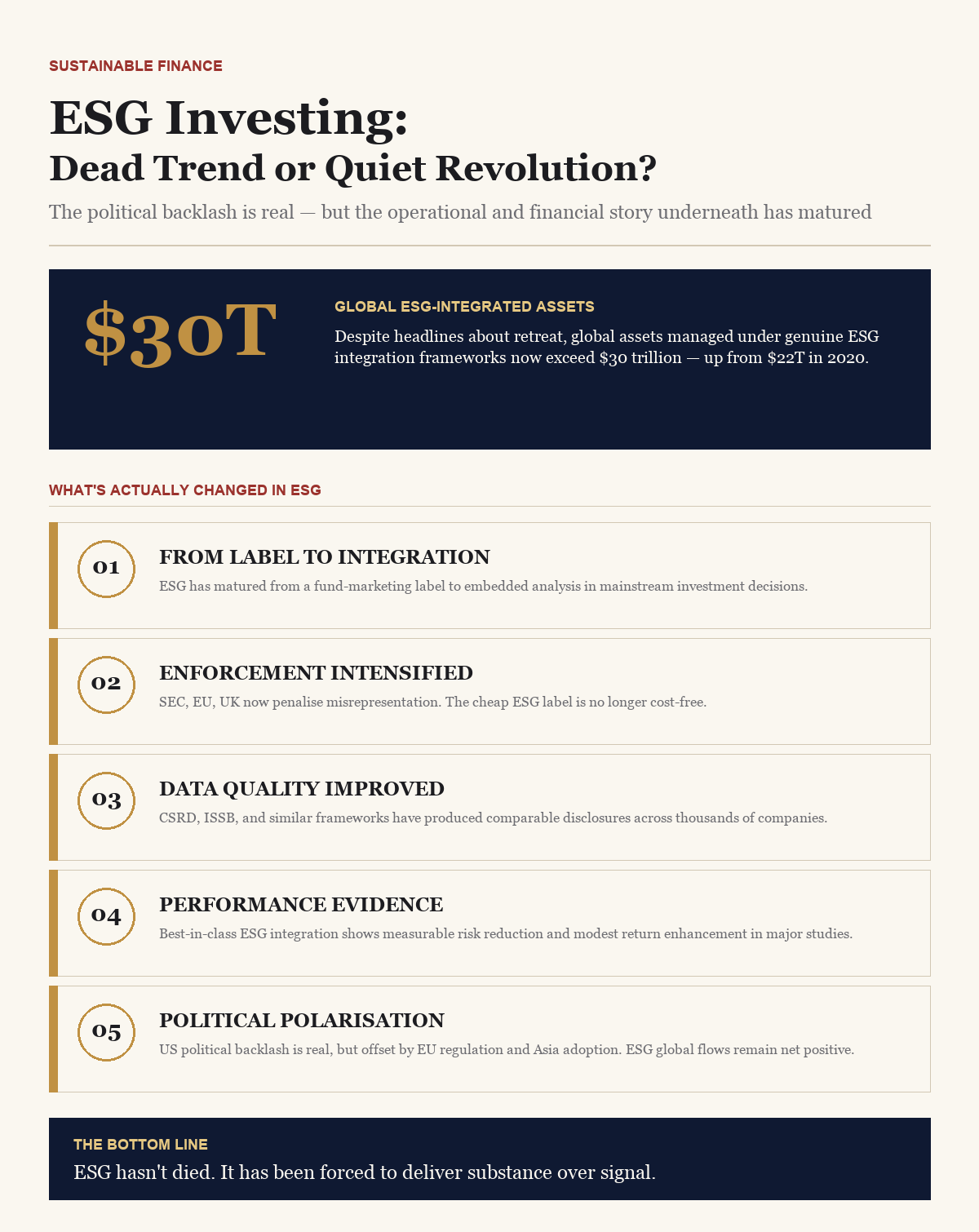
The retreat of ESG as a marketing category has obscured the more durable underlying trend: the integration of environmental and social considerations into investment processes has continued, often without explicit ESG labelling. The substance of what ESG investing was meant to accomplish, the systematic incorporation of factors beyond traditional financial metrics into investment decisions, has become more deeply embedded in mainstream investment practice even as the explicit branding has receded. Understanding both the retreat of ESG as a category and the continued integration of its substance is essential for an accurate picture of where investment practice actually stands in 2026.
Why the Backlash Was Inevitable
The retreat from explicit ESG positioning reflects several factors that were predictable in retrospect but were not always anticipated during the peak of ESG enthusiasm. The performance issue was the most consequential. ESG-themed funds, particularly those concentrated in clean energy and technology sectors that had been favourites during the 2020 to 2021 period, experienced significant underperformance in 2022 and 2023 as interest rates rose and as the technology sector corrected from its peak valuations. Investors who had been told that ESG investing would produce better returns alongside better environmental outcomes were disappointed when the performance pattern reversed.
The methodology issue compounded the performance problem. Multiple studies and journalism efforts identified inconsistencies in how ESG ratings were calculated, conflicts of interest in the rating process, and cases where companies with poor environmental or social records received high ESG ratings while companies with strong records received lower ones. The variation in ESG ratings across major providers, sometimes producing essentially opposite conclusions about the same company, undermined confidence in the methodology supporting the category.
The political dimension intensified the retreat from explicit ESG positioning. The framing of ESG investing as a political position rather than a methodological approach produced political opposition that asset managers could not easily address. The combination of state-level legislation restricting ESG considerations, congressional investigations, and public pressure from political figures created reputational and legal risks for asset managers that the marketing benefits of ESG positioning no longer justified.
What Has Persisted: The Integration of Material ESG Factors
Despite the retreat from explicit ESG positioning, the substantive integration of environmental and social factors into investment processes has continued and in some ways deepened. The Sustainability Accounting Standards Board, the Task Force on Climate-related Financial Disclosures, and various other frameworks have produced increasingly standardised approaches to identifying which environmental and social factors are material to specific industries and companies. The integration of these factors into mainstream investment analysis has progressed substantially, often without explicit reference to ESG branding.
Climate risk assessment has become standard practice for institutional investors, with both physical climate risk (the direct effects of climate change on operations and assets) and transition risk (the effects of policy and technology changes related to climate response) routinely incorporated into investment analysis. The European Union’s Sustainable Finance Disclosure Regulation, which requires asset managers to disclose how they consider sustainability risks, has effectively institutionalised climate risk assessment as a mandatory rather than discretionary element of investment processes.
Governance assessment, which has the longest history of integration into investment analysis, has continued to develop with more systematic consideration of board composition, executive compensation, ownership structure, and capital allocation discipline. The data and methodology supporting governance assessment have improved, and the recognition that governance quality affects long-term financial performance has been validated by accumulated empirical evidence.
The Regulatory Architecture That Continues to Develop
Despite the retreat of ESG as a marketing category, the regulatory infrastructure requiring ESG-related disclosure and behaviour has continued to expand globally. The EU’s Corporate Sustainability Reporting Directive, fully effective in 2025, requires comprehensive sustainability reporting from approximately 50,000 companies. The UK’s Sustainability Disclosure Standards apply similar requirements to UK-listed and large UK-domiciled companies. The Securities and Exchange Commission‘s climate disclosure requirements, despite legal challenges, have established a baseline for US climate reporting. Singapore, Japan, and other jurisdictions have implemented comparable requirements (see our analysis in Greenwashing Crackdowns).
The cumulative effect is that comprehensive sustainability data is becoming available across major economies in standardised formats that support investment analysis. The data infrastructure that ESG investing was building informally is now being constructed formally through regulatory requirements that apply to companies and the asset managers that invest in them. The data quality, consistency, and availability are improving in ways that support more rigorous ESG analysis than was possible during the earlier ESG enthusiasm period (see our analysis in The Green Premium).
Where the Capital Has Actually Gone
The flows of investment capital into sustainability-related categories provide an interesting picture that does not always match the headline narrative. Green bond issuance has continued to grow, exceeding $700 billion globally in 2025. Climate-focused private equity funds have continued to attract capital commitments, with the largest climate-focused funds reaching scales comparable to traditional private equity funds. Infrastructure investment in renewable energy has continued to grow as the economics of solar and wind generation have improved (see our analysis in Carbon Markets Explained).
The retreat has been concentrated in retail-facing ESG-labelled funds and in the most public elements of ESG marketing. Institutional capital deployment toward sustainability-related categories has continued at high levels, suggesting that the substantive integration of sustainability into investment decisions continues even as the marketing category has lost momentum.
The Distinction Between Climate Investment and ESG Investment
One of the more important distinctions that has emerged from the recent ESG experience is the difference between climate-focused investment and broader ESG investment. Climate investment, investment in clean energy infrastructure, climate technology companies, electric vehicle development, sustainable agriculture, and related categories, has continued strongly and has produced specific commercial outcomes that are independent of the broader ESG narrative. The economics of renewable energy, the policy support for climate-related investment, and the long-term capital deployment requirements of the climate transition have continued to support substantial investment.
Broader ESG investment, which incorporated environmental, social, and governance factors across all investment categories, has been more affected by the recent retreat. The methodological challenges of assessing social factors across diverse industries, the political contestation of specific social issues, and the difficulty of producing consistent ESG scoring have all contributed to the broader category’s challenges. The capital that continues to be deployed with ESG considerations is often more focused on specific sustainability themes, climate, water, biodiversity, than on comprehensive ESG approaches.
The Indian ESG Context
India’s regulatory and investment environment for ESG has continued to develop, with the Securities and Exchange Board of India’s Business Responsibility and Sustainability Reporting framework now applying to the top 1,000 listed Indian companies. The framework requires comprehensive disclosure on environmental and social performance and has supported the development of more systematic ESG assessment of Indian companies.
Indian ESG investment has grown substantially, with multiple Indian asset managers offering ESG-themed funds and with international ESG-focused investors taking positions in Indian companies that meet their criteria. The Indian green bond market has developed with substantial issuance from major Indian corporates and infrastructure entities. The integration of ESG considerations into Indian institutional investment processes has progressed, supported by both regulatory requirements and the increasing engagement of international institutional investors with Indian markets.
What This Means for Investors and Business Leaders
For investors evaluating their approach to ESG, several principles emerge from the recent experience. The substantive integration of environmental, social, and governance factors into investment processes remains valuable and is increasingly required by regulatory frameworks. The explicit ESG marketing positioning is more contested and carries political and reputational risks that did not exist five years ago. Distinguishing between these two dimensions, the substantive integration that is valuable and the marketing positioning that is contested, is essential for investors who want to capture the benefits without the costs.
For business leaders, the ESG environment provides both pressures and opportunities. The pressure comes from increasing disclosure requirements, customer expectations, and capital market evaluation that all incorporate sustainability considerations. The opportunity comes from the differentiation available to companies that have genuinely integrated sustainability into their operations rather than addressing it as a communications matter. The companies that have built genuine sustainability capability typically capture both operational benefits and capital market advantages that compound over time.
ESG investing is not dead, despite the retreat of the marketing category. The substantive practices that ESG was meant to institutionalise, systematic consideration of material environmental and social factors in investment and business decisions, have continued to develop and have become embedded in mainstream practice in ways that the ESG marketing controversy has obscured. The quiet revolution continues, even as the loud movement has moderated. For investors and business leaders, understanding this distinction is now central to navigating the sustainability-related dimensions of investment and business strategy effectively.
