



In January 2026, BlackRock’s BUIDL fund, a tokenised money market fund operating on the Ethereum blockchain, crossed $5 billion in assets under management. It had taken just eighteen months to reach that figure, making it the fastest-growing product in BlackRock’s history measured by pace of adoption. Around the same time, Franklin Templeton’s tokenised US government money fund passed $700 million on the Stellar and Polygon networks. JPMorgan‘s Onyx platform had processed more than $1.5 trillion in short-duration repo transactions over its blockchain rails since 2020. These are not experiments. They are live, operating financial infrastructure, and they are only the most visible part of a shift that has already moved more than $19 billion in real-world assets onto distributed ledgers.
Real-world asset tokenisation, RWA tokenisation, refers to the creation of blockchain-based digital representations of traditional financial assets: bonds, equities, real estate, private credit, commodities, and funds. Each token represents ownership of an underlying asset, with legal agreements and smart contracts governing settlement, yield distribution, and transfer. The promise is not merely technological novelty. It is a fundamental restructuring of how assets are issued, held, traded, and settled, with implications that span liquidity, access, compliance, and systemic risk.
The Scale of What Has Already Happened
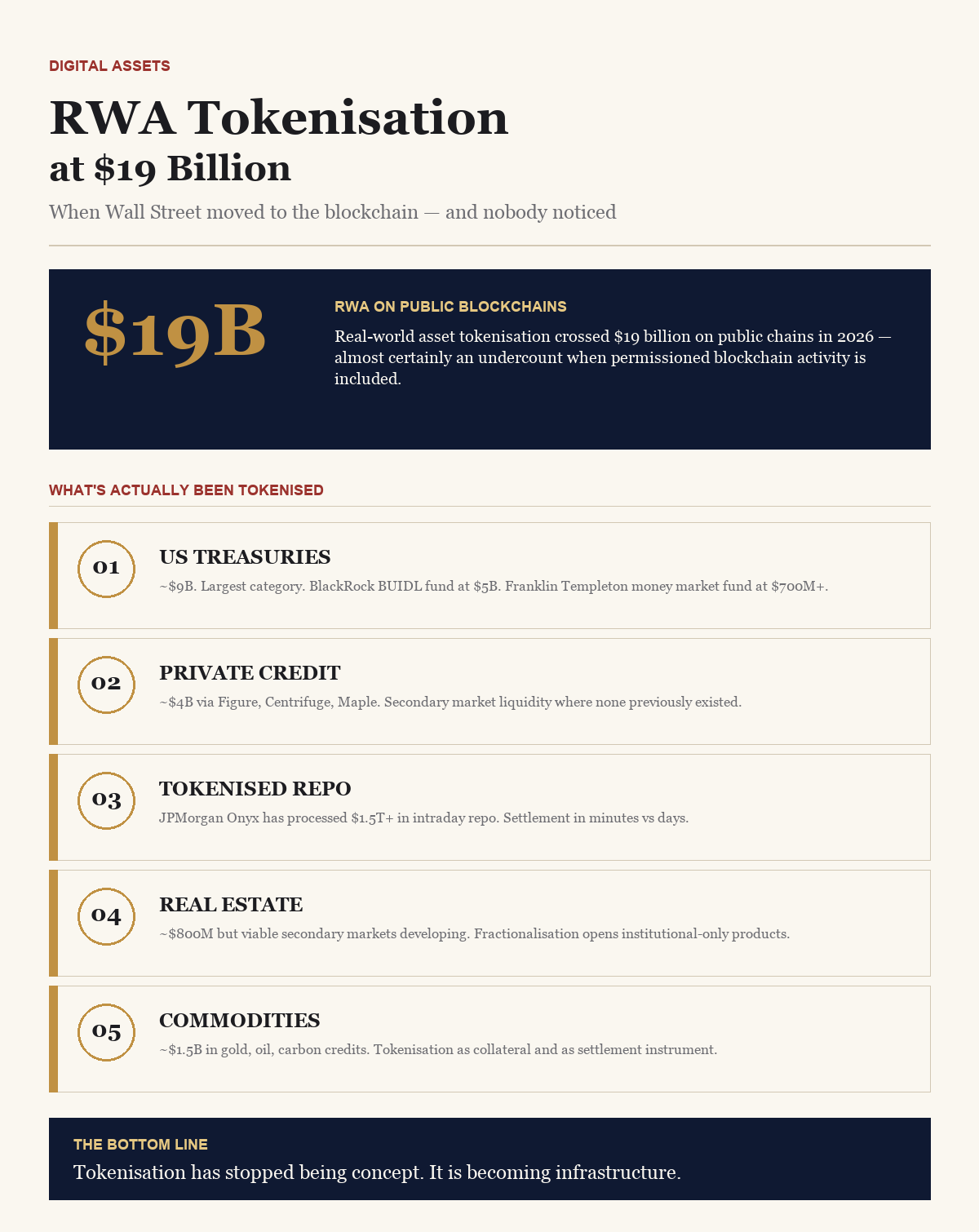
The $19 billion figure, compiled by RWA.xyz and corroborated by data from Coin Metrics and Dune Analytics, covers tokenised assets across public blockchains as of April 2026. It is almost certainly an undercount. Permissioned blockchain activity, JPMorgan’s Onyx, Goldman Sachs’ GS DAP, HSBC’s Orion platform, sits largely off public ledgers and is not captured in on-chain analytics. Industry estimates from Boston Consulting Group place the realistic total, including permissioned networks, at closer to $40 billion when repo and short-duration instruments are included.
The composition of tokenised assets has also matured significantly. As recently as 2023, the bulk of RWA tokenisation was concentrated in US Treasury instruments, straightforward, liquid, and legally unambiguous. That remains the largest category, with tokenised Treasuries accounting for roughly $9 billion of the public-chain total. But the asset class has broadened considerably. Private credit tokenisation, loans originated by non-bank lenders and represented on-chain, has grown to approximately $4 billion, led by platforms including Figure Technologies, Centrifuge, and Maple Finance. Tokenised real estate, while smaller at roughly $800 million, has developed viable secondary market infrastructure for the first time. Tokenised commodities, gold, oil, carbon credits, account for a further $1.5 billion.
The institutional roster is no longer confined to crypto-native firms. Citi, Deutsche Bank, Societe Generale, Standard Chartered, and BNY Mellon have each launched or invested in tokenisation infrastructure over the past 18 months. The Swift network, the backbone of international interbank messaging, completed successful pilots in late 2025 connecting tokenised asset platforms across multiple chains to its existing infrastructure, a development that would have seemed implausible three years earlier.
Why Now: The Convergence That Changed the Calculus
Three factors converged in 2024 and 2025 to transform RWA tokenisation from an interesting concept to an active institutional priority. The first was regulatory clarity, partial, imperfect, but sufficient. The EU’s Markets in Crypto-Assets regulation provided a framework for tokenised securities that large institutions could plan around. The UK’s Financial Conduct Authority published guidance on digital securities that gave banks a compliance pathway. In the United States, the SEC’s approval of spot Bitcoin ETFs in January 2024 was followed by staff guidance that implicitly accepted the legitimacy of tokenised traditional securities on registered platforms, even as the agency’s formal rulemaking remained incomplete.
The second factor was yield. In a high interest rate environment, tokenised money market funds and short-duration instruments offered institutional-grade returns with blockchain-native settlement advantages, specifically, the ability to use tokenised cash or tokenised Treasuries as collateral in DeFi protocols or for instant margin settlement. When capital efficiency matters, the ability to move collateral in seconds rather than days becomes a genuine competitive advantage.
The third factor was infrastructure maturity. Ethereum’s shift to proof-of-stake in 2022 addressed energy consumption concerns that had given ESG-focused institutions pause. Layer 2 networks, Polygon, Arbitrum, Base, brought transaction costs down to levels where tokenising smaller-denomination assets became economically viable. Institutional-grade custody solutions from Anchorage, Fireblocks, and Copper gave compliance teams the security frameworks they needed to approve participation.
The Settlement Revolution Hidden in Plain Sight
The most consequential near-term implication of RWA tokenisation is not asset democratisation, it is settlement efficiency. Traditional securities settlement operates on T+1 or T+2 cycles: a bond trade executed today settles tomorrow or the day after. During that window, both counterparties carry credit risk, and capital must be reserved against potential settlement failure. The Bank for International Settlements estimated in a 2024 working paper that global financial institutions collectively hold approximately $800 billion in settlement-related collateral at any given time, capital that is economically idle, serving only as a buffer against the lag built into legacy systems.
Atomic settlement, the simultaneous, instantaneous exchange of asset and payment that blockchain enables, eliminates that lag and the capital requirement it generates. JPMorgan’s repo platform already demonstrates this at scale: $1.5 trillion in intraday repo transactions have settled in minutes rather than days, with corresponding reductions in intraday credit lines and collateral requirements. As more assets migrate to tokenised rails, the aggregate capital released from settlement buffers could represent one of the largest single improvements in financial system efficiency in decades.
Private Credit and the Access Question
The tokenisation of private credit is drawing particular attention because it addresses a structural limitation that has frustrated institutional allocators for years: illiquidity. Private credit, direct lending to corporations by non-bank lenders, has grown into a $1.7 trillion asset class globally, offering yield premiums over public bonds that have attracted pension funds, sovereign wealth funds, and endowments. But private credit investments are characteristically illiquid: investors commit capital for five to seven years with minimal ability to exit early (see our analysis in The Great Liquidity Migration).
Tokenisation creates a secondary market where none previously existed. Platforms including Centrifuge and Maple Finance allow loan originators to tokenise credit portfolios and offer fractional interests to accredited investors who can then trade those interests on regulated secondary markets. The liquidity premium, the additional yield investors demand for accepting illiquidity, begins to compress as exit options improve. For borrowers, this could mean lower funding costs. For investors, it means the ability to manage private credit exposures actively rather than being locked in for the duration (see our analysis in Cryptocurrency Regulation).
The risks are real and not fully resolved. Secondary market liquidity for tokenised private credit remains thin: the existence of a secondary market does not guarantee a buyer when one is needed. Valuations of underlying loans are still determined by originators with limited independent verification. And the legal frameworks governing token-holder rights in insolvency scenarios remain untested in most jurisdictions.
What This Means for Asset Managers and CFOs
For asset managers, RWA tokenisation presents both competitive pressure and opportunity. The pressure comes from margin compression: if tokenised money market funds can replicate the yield of traditional funds at lower operational cost and with better liquidity terms, the management fee premium of traditional structures erodes. BlackRock’s BUIDL fund charges 50 basis points annually, competitive with traditional institutional money market funds, but with settlement and composability advantages that traditional funds cannot match.
The opportunity lies in product innovation. Tokenised fund structures allow for programmable distributions, yield payments that execute automatically via smart contract rather than requiring manual processing. They allow for fractionalisation that opens previously institutional-only products to a broader investor base. And they allow for composability: tokenised assets can be used as collateral, combined into structured products, or integrated into automated portfolio management strategies in ways that traditional securities cannot.
For CFOs considering corporate treasury strategy, the practical implications are arriving sooner than many expect. Tokenised money market funds are already accessible to institutional treasuries through platforms including Ondo Finance and Superstate. The yield advantage over traditional bank deposits is often marginal, but the settlement speed, instant versus same-day or next-day for traditional instruments, has operational value for businesses managing intraday liquidity actively.
The India Angle
India’s position in the RWA tokenisation landscape is in formation rather than established. The Reserve Bank of India‘s Central Bank Digital Currency pilot, the Digital Rupee, has processed over 5 million transactions since its phased launch in 2022, but its integration with tokenised asset infrastructure remains limited. SEBI issued a consultation paper in late 2025 on regulatory sandboxes for tokenised securities, signalling awareness of the trend without yet committing to a framework.
Indian corporates accessing international capital markets are already encountering RWA tokenisation as counterparties shift settlement preferences. Indian asset managers with global ambitions, HDFC AMC, Nippon India, Mirae India, are evaluating tokenised fund structures as a route to expanding international distribution without the costs of traditional cross-border fund establishment. The opportunity is clear; the regulatory prerequisite is the outstanding variable.
The Road to $10 Trillion
Boston Consulting Group’s oft-cited projection that tokenised assets could reach $16 trillion by 2030 is ambitious, but the direction is not seriously disputed. The question is pace and composition. Regulatory harmonisation, particularly the development of frameworks that allow tokenised securities to be legally recognised across jurisdictions, remains the primary constraint. A tokenised bond issued under English law that can be freely traded by investors in Singapore, the UAE, and the United States requires not just compatible technology but compatible legal recognition. That remains a work in progress.
The infrastructure debate, public chains versus permissioned chains versus hybrid approaches, will also shape the trajectory. The institutional preference, for now, is permissioned or hybrid: controllable environments where KYC and AML requirements can be enforced at the protocol level. But the composability advantages of public chain infrastructure are significant, and the regulatory clarity emerging in the EU and UK may tip the balance further toward public chain solutions over the next two to three years.
What is no longer debatable is whether this is happening. The $19 billion already on-chain, the $1.5 trillion in tokenised repo already processed, and the roster of global institutions now operating blockchain-based financial infrastructure answer that question definitively. The more pressing question for finance professionals is not whether to engage with tokenised assets, it is how quickly their organisations can develop the literacy and infrastructure to participate in a market that is moving from experiment to institution at a pace that few predicted.
