



Edge computing, the practice of processing data near where it is generated rather than transmitting it to centralised cloud infrastructure for processing, was for years described as a future technology approaching commercial relevance. That description is now obsolete. Edge computing is operational infrastructure in industries ranging from manufacturing to retail to healthcare, and the volume of compute resources deployed at the edge has grown to rival traditional cloud infrastructure in many use cases. The shift is consequential because it changes what is possible in terms of real-time analytics, automated decision-making, and the integration of artificial intelligence into operational systems. It is also reshaping the competitive landscape among cloud providers, hardware manufacturers, and the systems integrators that connect these capabilities into deployed solutions.
Why Compute Is Moving to the Edge
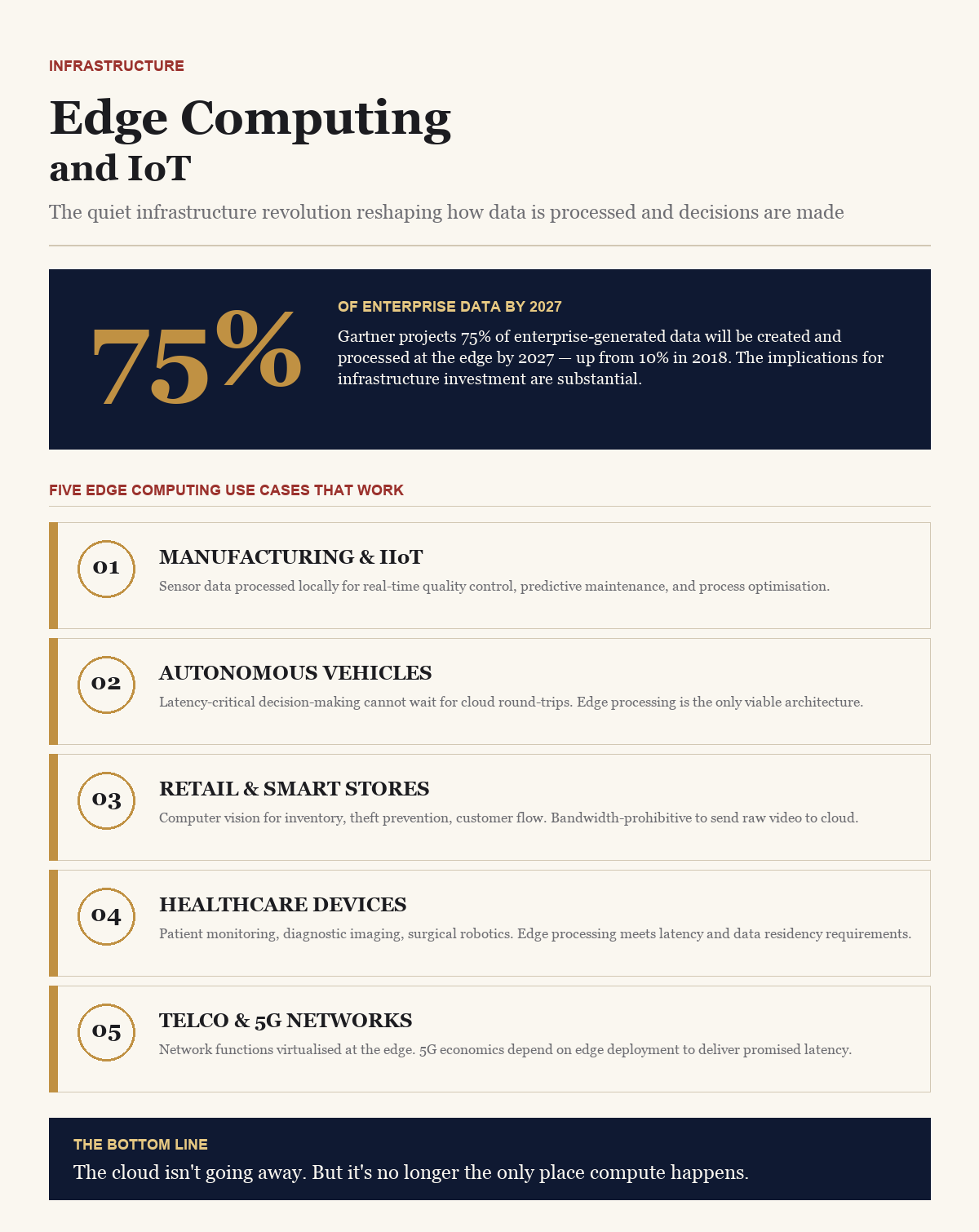
The fundamental drivers of edge computing deployment are physical and economic. Latency, the time between when data is generated and when a system can respond to it, is constrained by the speed of light and the physical distance between data sources and processing infrastructure. A factory floor automation system that needs to respond to sensor data within milliseconds cannot rely on processing in a distant cloud data centre; the round-trip time alone makes that architecture untenable. Similar latency constraints apply to autonomous vehicles, real-time medical monitoring, augmented reality applications, and a growing range of operational systems.
Bandwidth economics also drive edge processing. Modern operational systems generate enormous volumes of data, high-resolution video from security cameras, dense sensor outputs from industrial equipment, location and status data from logistics fleets. Transmitting all of this raw data to centralised cloud infrastructure for processing is economically impractical and often physically impossible given available bandwidth in the locations where the data is generated. Edge processing allows raw data to be analysed locally, with only relevant insights or summarised information transmitted to centralised systems.
Privacy and regulatory requirements add another driver. Healthcare data subject to HIPAA, EU personal data subject to GDPR, financial transaction data subject to various regulatory regimes, and operational data subject to corporate confidentiality requirements often face restrictions on cross-border transmission or centralised aggregation. Processing this data at the edge, within the facility where it is generated, or within the jurisdiction where the relevant regulations apply, addresses compliance requirements that would otherwise constrain operations.
The Industries Where Edge Has Made the Biggest Impact
Manufacturing has been the most concrete and successful adopter of edge computing infrastructure. The Industry 4.0 transformation that has been pursued across global manufacturing depends fundamentally on edge processing of sensor and equipment data, with cloud infrastructure providing higher-level analytics, planning, and reporting. Predictive maintenance systems that anticipate equipment failures, quality control systems that identify defects in real time, and automated production lines that adjust based on continuous operational data all depend on edge computing infrastructure that did not exist at meaningful scale a decade ago.
Retail has integrated edge computing extensively into store operations. Smart shelving that tracks inventory in real time, loss prevention systems that combine video analytics with point-of-sale data, customer analytics that optimise store layout and product placement, and increasingly cashier-less checkout systems all rely on edge processing infrastructure. The leading retailers, Amazon Go, Walmart’s connected store initiatives, Carrefour’s smart store investments, have built operational capabilities that distinguish them from competitors who have not made comparable edge investments.
Healthcare delivery has integrated edge computing across multiple care settings. Real-time patient monitoring in intensive care units, surgical decision support systems, medical imaging analysis at the point of acquisition, and increasingly home-based monitoring of chronic conditions all use edge computing infrastructure. The combination of patient privacy requirements, latency requirements for real-time clinical decision support, and bandwidth constraints in many medical facilities makes edge processing operationally essential rather than merely advantageous in many healthcare applications.
The IoT Foundation
The Internet of Things, the deployment of network-connected sensors and devices throughout physical environments, provides the data input for edge computing applications. The IoT device population has grown to estimates exceeding 30 billion connected devices globally, with sustained growth driven by industrial applications, smart city deployments, consumer electronics, and connected infrastructure. The maturation of cellular IoT connectivity through 5G networks and the proliferation of low-power wide-area network technologies has made IoT deployment economically viable in many applications where it previously was not.
The integration of IoT and edge computing is the architectural pattern through which many of the operational improvements of the past five years have been delivered. Connected agriculture combines soil and weather sensors with edge processing to enable precision input application. Connected logistics combines vehicle telematics with edge processing to optimise route management and fuel efficiency. Connected energy infrastructure combines grid sensors with edge processing to enable real-time grid management as distributed renewable generation has complicated traditional grid operations.
The security implications of widely deployed IoT and edge infrastructure are substantial and have not been fully resolved. IoT devices have historically had weak security, with default passwords, unpatched vulnerabilities, and insecure communication protocols common across deployed devices. Edge computing infrastructure expands the attack surface that organisations must defend, requiring security capabilities that many operational technology teams have not historically developed. The convergence of IT security disciplines with OT operational requirements has been one of the difficult organisational adjustments accompanying edge and IoT adoption (see our analysis in The Space Economy).
The Role of AI at the Edge
The deployment of artificial intelligence capabilities at the edge has become one of the most active areas of edge computing development. AI inference, running trained models against new data to produce predictions or classifications, is increasingly being deployed at the edge rather than in centralised cloud infrastructure, particularly for applications with latency or privacy requirements that prevent cloud-based processing. Computer vision applications in manufacturing and retail, voice processing in consumer devices, anomaly detection in operational systems, and natural language interfaces for industrial systems all increasingly use edge-deployed AI capabilities (see our analysis in The $1.3T Chip Economy).
The hardware infrastructure supporting AI at the edge has improved substantially. Specialised AI inference chips, including Google’s Edge TPU, NVIDIA‘s Jetson family, Qualcomm’s AI engines, and Apple’s Neural Engine, provide AI processing capability at power and cost levels that support deployment in operational environments. The combination of hardware capability improvements and AI model efficiency improvements has made edge AI deployment economically viable in many applications that previously required cloud processing (see our analysis in Predictive Analytics).
The Competitive Landscape
The competitive landscape among providers of edge computing infrastructure and services has consolidated around a small number of major players competing across multiple dimensions. The major cloud providers, Amazon Web Services, Microsoft Azure, Google Cloud, have built comprehensive edge offerings including hardware, software, and services. AWS Outposts, Azure Stack Edge, and Google Distributed Cloud each provide variations of the basic value proposition: bringing the cloud provider’s services to customer premises or to telecommunications operator locations.
Telecommunications operators have become important participants in edge computing infrastructure, leveraging their footprint of network locations to host edge computing resources for enterprise customers. The 5G network deployment cycle has been accompanied by edge computing investments at major operators, with the strategic rationale that edge computing services are higher-value than traditional connectivity services and provide differentiation in increasingly commoditised connectivity markets.
Specialised edge computing companies, including Dell Technologies’ edge offerings, HPE’s edge portfolio, and growing specialists like Vapor IO and EdgeConneX, provide alternatives to the major cloud providers, often with stronger physical infrastructure capabilities or more specialised industry expertise. The competitive dynamics among these various provider categories will continue to shape the edge computing market over the next several years.
The India Edge Opportunity
India’s edge computing opportunity is substantial and is supported by several specific factors. The growth of digital services across the Indian economy generates substantial data processing requirements that often face the latency, bandwidth, and connectivity constraints that drive edge deployment globally. India’s manufacturing development, supported by the Production Linked Incentive schemes and the broader Make in India initiative, creates demand for edge computing infrastructure in industrial settings.
The 5G deployment in India, with substantial coverage now operational across major cities and increasing geographic coverage, provides the connectivity infrastructure that supports edge computing services. Indian telecommunications operators including Reliance Jio, Bharti Airtel, and Vi have made edge computing investments that are positioned to serve Indian enterprises with services that did not previously exist domestically.
Strategic Considerations for Business Leaders
For business leaders evaluating edge computing investment, several principles emerge from the deployment patterns of recent years. The starting point is identifying specific operational applications where edge processing offers genuine value rather than treating edge computing as a general infrastructure investment. Applications with latency requirements, bandwidth constraints, privacy obligations, or operational reliability requirements that make centralised cloud processing impractical are the natural starting points for edge deployment.
The integration of edge computing with existing IT infrastructure and operational technology requires capability that many organisations do not naturally possess. The convergence of these previously separate disciplines has been one of the difficult organisational adjustments accompanying edge adoption. Building the integrated team, combining IT, OT, security, and business operations expertise, is often the critical capability constraint rather than the technology selection.
Edge computing is now part of the operational infrastructure that supports modern business operations across multiple industries. The companies that have integrated it most effectively have done so deliberately, with specific operational objectives and supporting organisational capabilities. The quiet nature of edge computing’s commercial development should not be mistaken for its lack of impact: the operational improvements it enables are real, and the competitive positioning that comes from getting it right is significant.
