



If you read corporate mission statements, every major company in the world is committed to innovation. If you ask their employees, the picture is more mixed. McKinsey‘s State of Organizations 2025 survey found that only 26 per cent of employees at large companies believe their organisation effectively translates good ideas into operational reality. The gap between stated innovation commitment and lived employee experience is one of the most consistent findings in organisational research, and it points to something important: building a culture of innovation is harder than declaring one, and the difference between companies that succeed and those that fail lies in specific practices that are often unfashionable, demanding, and resistant to easy adoption.
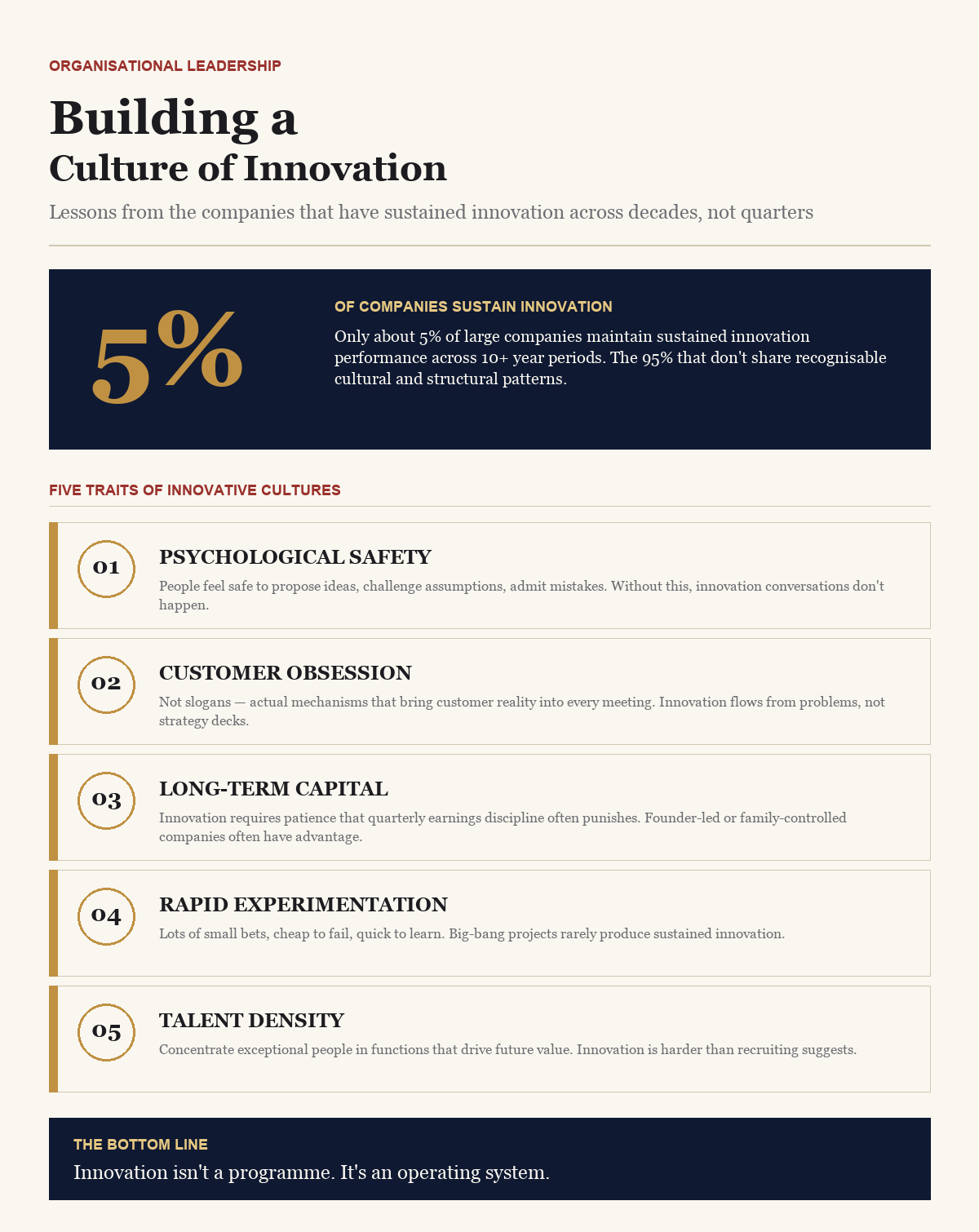
The companies that have built sustained innovation capability over multiple decades, Apple in product design, Toyota in manufacturing process, Procter & Gamble in consumer goods, Amazon in operational systems and customer experience, share patterns that distinguish them from less innovative competitors. Understanding these patterns matters not because every company can or should become Apple or Amazon, but because the underlying mechanisms that produce sustained innovation are identifiable, learnable, and applicable across a wide range of business contexts.
What Innovation Cultures Actually Look Like
The first observation about successful innovation cultures is that they are far less casual and free-flowing than the popular image suggests. The image of innovation as Google-style office spaces with foosball tables and unstructured time is largely a marketing artifact rather than a description of what produces innovation. The companies that consistently innovate well typically operate with substantial discipline around how new ideas are generated, evaluated, developed, and scaled. The discipline is often invisible from outside the organisation, which is why the casual image persists.
Effective innovation cultures combine high tolerance for early-stage experimentation with high rigour about which experiments deserve scaling investment. Amazon’s leadership principles include both ‘Invent and Simplify’ (which encourages broad experimentation) and ‘Insist on the Highest Standards’ (which demands rigour in evaluation). The combination is not contradictory, it is the operational expression of how serious innovation actually works. Easy entry to experimentation, hard evaluation of which experiments justify continued investment.
Time horizons matter substantially. Companies that consistently innovate well typically combine short-term operational discipline with long-term strategic patience. Quarterly earnings cycles cannot accommodate the development of genuinely new categories of business, which often require years of investment before commercial returns become visible. The companies that have built durable innovation cultures have either insulated their innovation activities from quarterly pressure through clear governance structures or have communicated to their investors that long-term innovation investment is a core element of their strategy.
The Role of Leadership
Innovation cultures cannot be delegated to innovation departments. The most consistent finding across studies of innovative organisations is that senior leadership behaviour, what executives actually do, not what they say, is the most important determinant of innovation outcomes. Leaders who personally engage with innovation projects, allocate their own attention to long-term initiatives, tolerate failure of well-designed experiments, and protect innovation activity from short-term operational pressure produce different organisational outcomes than leaders who delegate innovation as a separate workstream.
Steve Jobs’s deep involvement in product development at Apple is the most famous example of this pattern, but the principle applies more broadly. Jeff Bezos’s continued engagement with Amazon’s most significant operational and strategic decisions even as the company scaled to hundreds of thousands of employees was a critical element in the company’s continued innovation. Satya Nadella’s articulation of Microsoft’s transformation toward a ‘learn-it-all’ culture has been operationally supported by his personal engagement with specific innovation initiatives.
The CEOs who treat innovation as someone else’s responsibility typically produce organisations that struggle to innovate consistently, regardless of how much investment is allocated to innovation activities. The signal from senior leadership behaviour about what is genuinely valued by the organisation overrides the signal from formal innovation programmes and structures.
Organisational Design Choices That Support Innovation
Beyond leadership behaviour, several specific organisational design choices have been demonstrated to support sustained innovation. The first is the separation of exploration activities from exploitation activities. Companies that try to manage early-stage innovation projects with the same processes, metrics, and reporting requirements as mature operating businesses typically suffocate the innovation projects. Innovation activities need different planning horizons, different success metrics, different reporting cadences, and different staffing approaches than mature operations.
The classic organisational expression of this principle is the separate innovation unit, a team or division operating with distinct governance, freed from the operational requirements of the core business, charged with developing new capabilities or business categories. The implementation of this principle has varied widely. Google X (now X, the moonshot factory) operates as a separate organisational unit pursuing very long-term innovation projects. Amazon’s leadership development centre and various ‘two-pizza team’ structures embed innovation within operational organisation but with specific protections. The right structure depends on what is being innovated and how, but some form of separation is consistently associated with successful long-term innovation (see our analysis in Business Turnarounds).
Cross-functional team structures are another consistent feature of effective innovation organisations. Innovation typically requires combining capabilities that exist in different functional silos, technology, marketing, operations, finance, customer support. Organisations that structure innovation work in cross-functional teams from the beginning typically produce results that organisations that try to coordinate innovation across functional teams do not. The cross-functional structure trades efficiency in functional execution for effectiveness in integrated problem-solving, which is the right trade for innovation but the wrong trade for operations (see our analysis in The CEO Playbook Has Changed).
Psychological Safety: The Foundation Layer
Amy Edmondson’s research on psychological safety, the belief that one will not be punished or humiliated for speaking up with ideas, questions, concerns, or mistakes, has consistently emerged as a foundational requirement for innovation cultures. Teams in which members feel safe to express dissent, challenge senior colleagues, share half-formed ideas, and acknowledge failures produce different innovation outcomes than teams in which these behaviours are punished or simply absent (see our analysis in Middle Management Is Undervalued).
Building psychological safety is harder than it sounds and is often actively undermined by management practices that organisations otherwise consider productive. Aggressive performance management that punishes failures regardless of their educational value, cultures of public criticism rather than private development, hierarchical decision-making that suppresses dissent from less senior contributors, and reward systems that focus on individual achievement rather than team contribution all reduce psychological safety in ways that compound over time. Many organisations that have invested heavily in innovation programmes have simultaneously undermined the cultural conditions that allow innovation to flourish (see our analysis in Remote vs Hybrid vs Office).
The leaders who build psychologically safe teams tend to model the behaviours they expect from team members. They share their own uncertainties, acknowledge their own mistakes, ask for input from team members on issues outside their own expertise, and respond constructively when team members surface concerns. These behaviours, performed consistently over time, build the cultural foundation that supports innovation. They are not optional supplements to innovation activity; they are prerequisites.
Innovation Metrics That Actually Matter
How an organisation measures innovation determines what kind of innovation it produces. Many companies use metrics that incentivise the appearance of innovation activity, number of ideas submitted, number of projects in the pipeline, percentage of revenue from new products, without distinguishing between innovation that produces durable business value and innovation that produces activity without outcomes. The companies that consistently produce valuable innovation typically use metrics that focus on outcomes rather than inputs and that track innovation over time horizons that match the actual development cycles of substantive new capabilities.
Customer-validated metrics tend to produce better outcomes than internally generated metrics. The number of customers that have adopted a new product, the retention rate of new product users, the price premium achieved by innovative product features, and the customer satisfaction differential between innovative and standard offerings all provide signals about whether innovation activity is producing customer value rather than internal activity. These metrics are harder to manipulate than internal metrics and produce more reliable signals about innovation effectiveness.
The Patience Question
Perhaps the most underestimated requirement for innovation cultures is patience. Substantive innovation, the development of new categories of business, the transformation of operational systems, the creation of products that customers have not previously imagined wanting, takes longer than corporate planning cycles naturally accommodate. The companies that have produced the most consequential innovations have typically been able to sustain investment in innovation activities through periods when those activities did not produce visible financial returns.
Amazon Web Services took years of investment before it became the operating profit engine that supports the rest of Amazon’s operations. Apple’s investment in mobile phone development began years before the iPhone reached commercial relevance. Tesla‘s investments in electric vehicle technology spanned multiple capital-raising cycles before the company achieved profitability. The patience required is not philosophical patience but operational patience, the willingness to maintain investment, attention, and senior support for innovation activities through periods when those activities cannot yet justify themselves with financial returns.
The companies that have built sustained innovation cultures have typically combined operational discipline in their existing businesses (which generates the cash flow that funds innovation) with strategic patience in their innovation investments (which allows those investments to develop into value). The combination is rare. Many companies have one or the other but not both, and the absence of either undermines the conditions for serious innovation.
Building It in Your Organisation
For business leaders attempting to build or strengthen innovation cultures in their organisations, the practical advice is to focus on what specifically distinguishes innovative organisations from less innovative ones, rather than on the broader cultural attributes that are often described as foundational. Specific governance structures that protect innovation from quarterly pressure. Specific organisational designs that separate exploration from exploitation. Specific leadership practices that model the behaviours expected from team members. Specific measurement approaches that focus on customer-validated outcomes rather than activity metrics.
Innovation cultures are built through accumulated specific decisions about how the organisation works, not through declarations about how it should work. The accumulated specific decisions are typically less exciting and more demanding than the cultural declarations, which is why most organisations talk about innovation more effectively than they practice it. The companies that have closed this gap, between what they say about innovation and what they actually do, are the ones that produce sustained competitive advantage from their innovation activity. That is achievable, but only through the unglamorous work of organisational design and leadership behaviour that the topic ultimately requires.
