


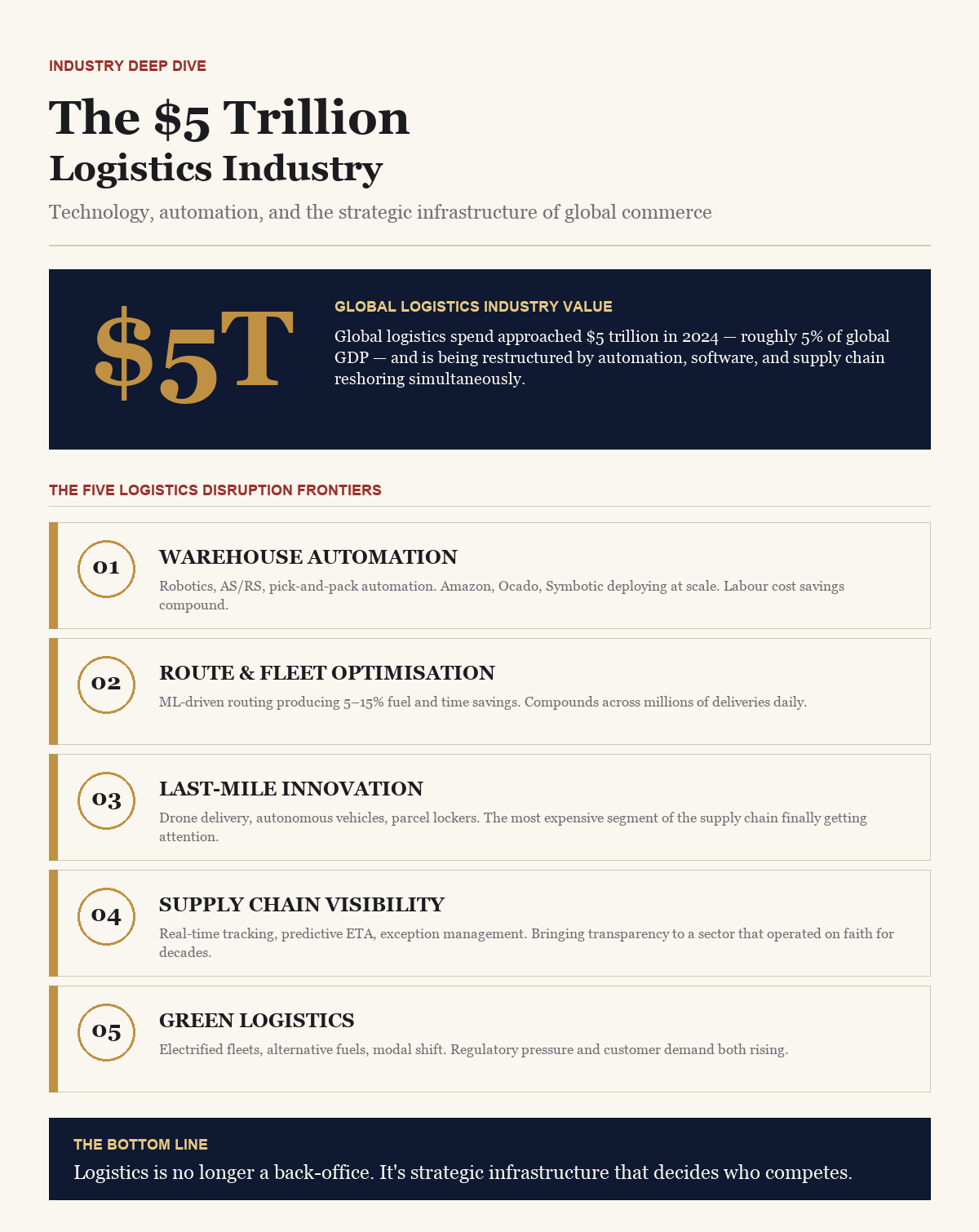
Global logistics, the movement, storage, and management of goods through the supply chain, represents approximately $5.2 trillion in annual industry revenue across freight transportation, warehousing, parcel delivery, and supporting services. For most of its history, logistics has been a relatively low-margin, capital-intensive industry characterised by slow technology adoption, fragmented ownership, and intense competitive pressure on price. That description still applies to large segments of the industry, but a growing portion of the logistics economy now operates differently, with substantial technology integration, premium pricing for differentiated service, and operational sophistication that distinguishes leaders from laggards.
The transformation has been driven by several converging pressures and opportunities. E-commerce growth has shifted volume and complexity in ways that traditional logistics infrastructure was not built to handle. Supply chain disruption during and after the pandemic exposed vulnerabilities that motivated investment in resilience and visibility. Reshoring and nearshoring of manufacturing has shifted the geography of logistics flows. Artificial intelligence has enabled operational improvements that were previously impractical to deploy at scale. The companies that have led the response to these dynamics have generated returns that compare favourably with leading sectors in the broader economy.
The Structural Shifts Reshaping the Industry
The e-commerce volume shift is the most visible structural change in the industry over the past decade. Online retail penetration, which was approximately 8 per cent of total retail in 2015, has grown to over 20 per cent across major economies. The associated logistics requirements are different in character from traditional retail logistics: smaller package sizes, residential delivery rather than store delivery, fragmented destination networks rather than concentrated retail hubs, and customer expectations for delivery speed that were unimaginable in earlier eras. The infrastructure investment required to serve this volume profile has been substantial, and the companies that have built it have captured competitive advantages.
Last-mile delivery, the final stage from local distribution facility to customer, has emerged as both the most cost-intensive and most strategically important segment of e-commerce logistics. The cost per package of last-mile delivery in dense urban areas can exceed the cost of all other logistics stages combined. The companies that have built efficient last-mile capabilities, Amazon’s own delivery network, FedEx’s residential delivery optimisation, China’s complex network of regional couriers, have captured volume and pricing advantages that earlier-generation logistics providers cannot easily match.
Warehousing has been transformed in parallel with the e-commerce shift. The fulfilment centre, designed to pick and pack individual orders for direct shipment to consumers, has substantially different requirements than the distribution centre designed to receive and ship pallet quantities to retail stores. The shift has driven investment in automated storage and retrieval systems, robotic picking technology, and warehouse management software that has materially improved productivity in modern fulfilment operations.
The Automation Wave
Automation has been a long-promised but slowly delivered feature of logistics operations. The pace of automation deployment has accelerated substantially over the past five years, supported by improvements in robotics technology, computer vision, and the economics of automation investment relative to rising labour costs in major logistics markets.
Amazon’s fulfilment centre robotics, originally developed through the company’s acquisition of Kiva Systems in 2012, have evolved into one of the most sophisticated warehouse automation systems in commercial operation. The company has deployed over 750,000 mobile robots across its fulfilment network as of 2025, with human workers increasingly focused on tasks that require dexterity and judgement rather than walking and carrying. The productivity differential between modern automated fulfilment centres and traditional manual operations is substantial.
Autonomous trucking has progressed more slowly than the most aggressive predictions suggested but more reliably than the most sceptical ones. Several companies, Waymo, Aurora, Kodiak Robotics, TuSimple, have demonstrated commercial autonomous freight operations on specific routes, with growing operational hours and improving reliability. The technology has not yet displaced human drivers at scale, but commercial deployment in specific applications has reached the stage where it is producing genuine operational value rather than primarily demonstrating future potential.
Drone delivery has progressed in specific high-value, specific-geography applications but has not achieved the broad consumer delivery role that early visions projected. Medical supplies, time-sensitive parts deliveries, and certain remote-area deliveries have established drone logistics as a real commercial service, with companies including Zipline, Wing (Alphabet), and Manna providing operations in multiple countries. The economic case for drone delivery in dense urban consumer applications remains less compelling than ground-based alternatives, but specific industrial and remote-area applications have established sustainable commercial activity.
The Software Transformation
The software layer of logistics operations has been transformed alongside the physical infrastructure. Transportation management systems, warehouse management systems, route optimisation engines, and the broader category of supply chain visibility and analytics software have evolved into capability that materially affects competitive position. The companies that have invested in best-in-class software, both built and bought, typically operate with margin advantages and customer service capabilities that less software-mature competitors cannot easily match (see our analysis in Africa’s Business Boom).
Real-time visibility has become the defining capability of modern logistics operations. Customers, both consumer e-commerce recipients and B2B shippers, expect real-time information about where their shipments are, when they will arrive, and what is happening if delays occur. Providing this visibility requires integration across multiple systems, IoT-enabled tracking infrastructure, and analytics capabilities that translate operational data into customer-meaningful information. The companies that have built end-to-end visibility have captured market share from competitors that have not (see our analysis in EV Wars: Beyond Tesla).
Artificial intelligence applications in logistics have moved from experimental to operational. Route optimisation that incorporates real-time traffic, weather, and operational constraints. Demand forecasting that improves inventory positioning. Pricing optimisation that balances utilisation and yield. Anomaly detection that identifies operational issues before they propagate. These applications, individually modest in their impact, accumulate into substantial operational improvements when deployed across the breadth of a logistics operation (see our analysis in The Rise of the Gig Economy).
The Sustainability Pressure
Logistics is one of the more carbon-intensive sectors of the global economy, with transportation alone accounting for approximately 16 per cent of global greenhouse gas emissions. The pressure to decarbonise logistics has come from multiple directions: regulatory requirements in major markets, customer expectations from both consumer and enterprise customers, and shareholder pressure on the public companies that operate large logistics networks. The response has shaped substantial investment in fleet electrification, fuel efficiency, and operational improvements that reduce emissions intensity.
Fleet electrification has progressed unevenly across logistics segments. Last-mile delivery vehicles, vans and small trucks operating predominantly in urban environments, have been the most successful electrification application, with major operators including UPS, FedEx, Amazon, and DHL deploying significant electric vehicle fleets. Long-haul trucking electrification has been more challenging given the energy density requirements and charging infrastructure constraints, but progress is being made through both battery electric solutions and hydrogen fuel cell development. Air cargo decarbonisation faces the largest technical challenge, with sustainable aviation fuels and structural improvements in operations producing incremental progress.
The India Logistics Story
India’s logistics sector has been transformed by a combination of infrastructure investment, regulatory reform, and operational innovation that has materially improved the country’s logistics economics over the past decade. The Goods and Services Tax implementation in 2017 was particularly consequential, eliminating the state-by-state tax barriers that had fragmented Indian logistics flows. The development of dedicated freight corridors, the expansion of port and airport capacity, and the Bharatmala highway development programme have improved infrastructure substantially.
Indian logistics costs as a percentage of GDP have declined from approximately 14 per cent in 2015 to approximately 12 per cent in 2025, reflecting the cumulative effect of these improvements. The remaining gap to Western benchmarks, typically 8 to 9 per cent, represents the next phase of the development opportunity for the Indian logistics sector and the businesses that depend on it.
Indian e-commerce growth has driven substantial investment in modern logistics infrastructure. Flipkart, Amazon India, Meesho, Reliance Retail, and other major Indian e-commerce operators have built fulfilment networks that combine sophisticated software with operational capability that compares favourably with international standards. The Indian logistics startup ecosystem, Delhivery, ShipRocket, Xpressbees, Ecom Express, has produced operators that compete effectively with the major international logistics providers in the Indian market.
Implications for Business Leaders
For business leaders, the transformation of the logistics industry has implications that extend beyond cost management. The companies that have built sophisticated logistics capabilities, either internally or through partnership with leading logistics providers, have captured strategic positions that are difficult for competitors to challenge. Customer expectations for delivery speed, visibility, and reliability have become elements of competitive position in most categories that involve physical product delivery, and the companies that fail to meet these expectations face market share pressure regardless of their other commercial attributes.
The investment patterns in modern logistics infrastructure have created opportunities for businesses that previously did not have access to advanced logistics capabilities. Third-party logistics providers, specialised fulfilment services, and logistics technology platforms have made it possible for smaller businesses to access capabilities that previously required substantial dedicated investment. Strategic decisions about whether to build logistics capability internally or to access it through partnership are now central elements of operational strategy for most businesses that move physical goods.
Logistics has moved from being a back-office function to a strategic capability. The companies that recognise this shift and invest accordingly are positioned to compete in the operating environment that the next decade will produce. The companies that continue to treat logistics as primarily a cost centre to be minimised are likely to find themselves at increasing competitive disadvantage in markets where logistics capability has become a primary differentiator.
