



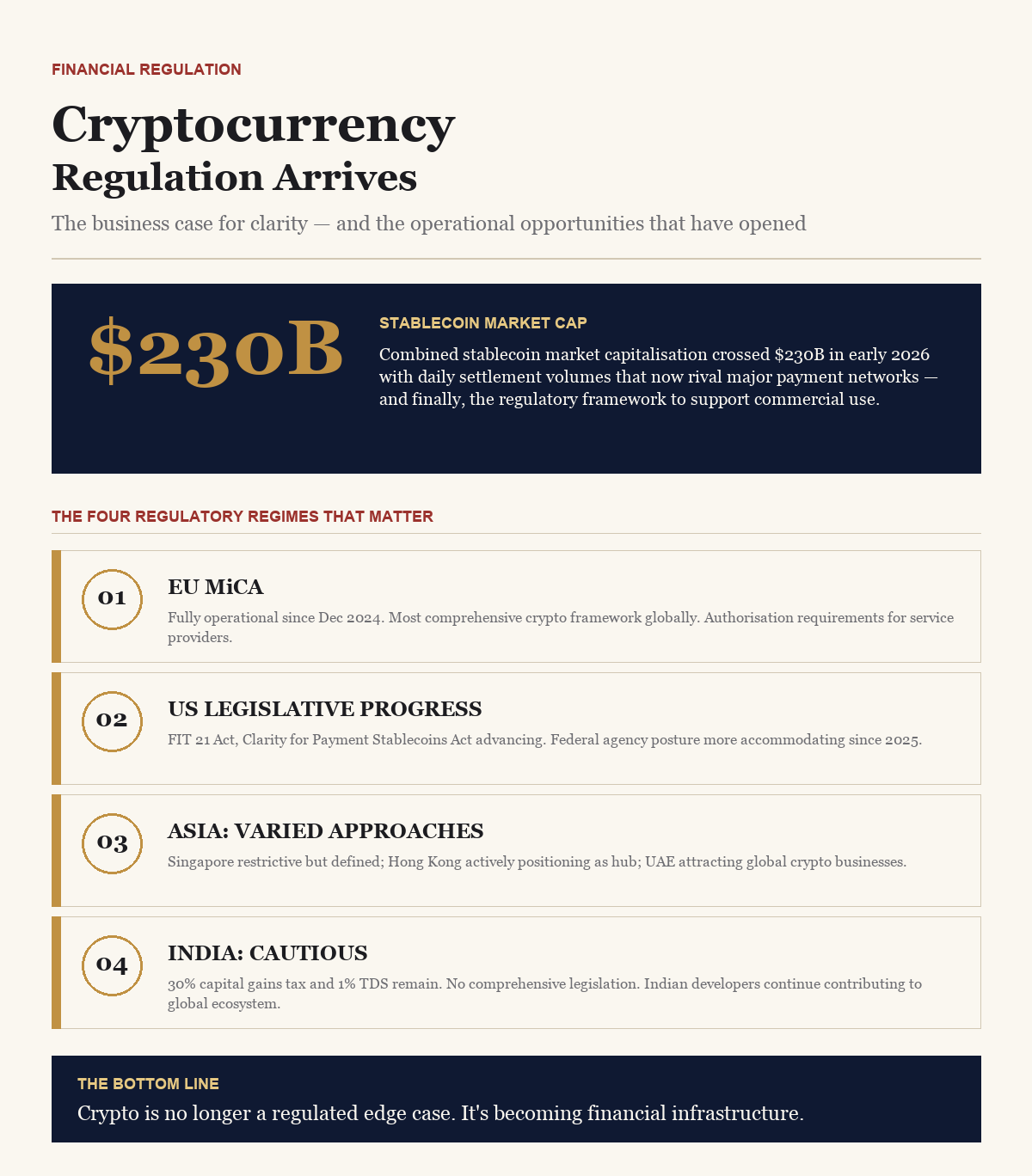
Cryptocurrency regulation has been characterised for years by ambiguity, enforcement-by-litigation, and jurisdictional fragmentation that made commercial planning difficult. That environment is changing. The EU’s Markets in Crypto-Assets regulation, fully operational from late 2024, provides the most comprehensive framework in any major economy. The US has moved haltingly but materially toward legislative clarity, with multiple bills advancing through Congress and clearer guidance emerging from federal agencies. Asian jurisdictions, Singapore, Hong Kong, Japan, the UAE, have established varied frameworks that range from restrictive to actively encouraging. For businesses that previously avoided cryptocurrency engagement primarily because of regulatory uncertainty, the operational basis for considered participation has materially improved.
The clarity has not eliminated complexity. Crypto regulation now resembles other sophisticated financial regulation in its detail, with different rules applying to different categories of asset (stablecoins versus utility tokens versus securities), different types of activity (exchange operation versus custodial services versus issuance), and different participant categories (retail investors versus qualified institutions versus regulated financial entities). The operational requirements for compliant crypto activity are substantial, but they are now defined, which allows businesses to make informed decisions about whether and how to engage.
The EU MiCA Framework
The Markets in Crypto-Assets regulation, which became fully effective across EU member states in December 2024, represents the most ambitious attempt globally to bring cryptocurrency into a comprehensive regulatory framework. MiCA covers issuance and trading of crypto-assets, the provision of crypto-asset services, and consumer protection requirements that apply across crypto activity. The regulation distinguishes between asset-referenced tokens (ARTs), electronic money tokens (EMTs), and other crypto-assets, with different requirements for each category.
For stablecoins, which fall into the asset-referenced and electronic money token categories, MiCA imposes substantial reserve, governance, and operational requirements. Issuers must maintain reserves at 1:1 ratio with the issued tokens, hold reserves in segregated accounts with credit institutions, and comply with specific governance and risk management requirements. Foreign-issued stablecoins must comply with these requirements to be marketed or used within the EU, which has effectively required global stablecoin issuers to restructure their operations or limit EU activity.
Crypto-asset service providers, exchanges, custodians, advisory firms, must obtain authorisation from EU regulators and comply with operational requirements covering capital, governance, conflict of interest management, market abuse prevention, and consumer protection. The authorisation process is similar in rigour to that for traditional financial services, and the operational burden of MiCA compliance has caused some smaller crypto businesses to exit the EU market while consolidating activity among larger, better-resourced operators.
The United States: Toward Legislative Clarity
US cryptocurrency regulation has been substantially more fragmented than the EU’s, with multiple federal agencies, the SEC, CFTC, FinCEN, OCC, claiming jurisdiction over different aspects of crypto activity, and significant disagreement among them about the proper regulatory treatment of various crypto categories. The result has been enforcement actions, court cases, and policy uncertainty that has made commercial crypto activity in the United States more complicated than in jurisdictions with clearer frameworks.
Legislative efforts have advanced significantly. The FIT 21 (Financial Innovation and Technology for the 21st Century) Act passed the House of Representatives in 2024 and provides a framework for distinguishing between crypto-assets that are securities (regulated by the SEC) and those that are commodities (regulated by the CFTC). The Clarity for Payment Stablecoins Act, advancing through Congress in 2025, provides a federal framework for stablecoin issuance and reserves. These pieces of legislation, when enacted, would provide the legal clarity that the industry has sought for years.
Federal agency posture has also shifted. The Trump administration’s policy direction on cryptocurrency, articulated through executive orders and agency leadership appointments, has been notably more accommodating than the previous administration’s. The SEC has dismissed or settled several major enforcement cases against crypto businesses, the formation of a crypto-focused task force has provided regulatory engagement that the industry previously lacked, and bank regulatory agencies have eased restrictions on bank participation in crypto activities. These changes have improved the operational environment for compliant US crypto businesses substantially.
The Stablecoin Question
Stablecoins, crypto-assets pegged to fiat currencies, primarily the US dollar, have become the most commercially significant category of cryptocurrency for non-trading use cases. The market capitalisation of major stablecoins exceeded $230 billion in early 2026, with Tether and USDC accounting for the majority of activity. Daily settlement volumes through stablecoins have reached levels comparable to major payment networks, with significant use in cross-border payments, decentralised finance applications, and as a substitute for dollar access in markets where US dollar banking is restricted.
The regulatory treatment of stablecoins has become a central focus of crypto regulation precisely because their commercial use is substantial and their potential impact on monetary stability is real. Both MiCA in the EU and the proposed US framework treat stablecoins as a special category requiring rigorous reserve, governance, and operational requirements. The convergence between major jurisdictions on stablecoin regulation provides commercial stability for major stablecoin issuers but also creates compliance burdens that may consolidate the stablecoin market further around a small number of well-resourced operators.
For businesses considering stablecoin use in operations, for treasury management, cross-border payments, or other commercial applications, the practical considerations now extend beyond technical implementation to include the regulatory status of the specific stablecoin being used, the jurisdictions through which it can flow, and the compliance obligations that apply to commercial use. These considerations make stablecoins more like traditional payment infrastructure than novel technology, which is a meaningful step in the maturation of the category (see our analysis in AI Regulation Around the World).
Asian Regulatory Approaches
Asian jurisdictions have taken varied approaches to crypto regulation that reflect different policy priorities. Singapore has established a comprehensive framework through the Monetary Authority of Singapore’s Payment Services Act and additional guidance, with licensing requirements for crypto businesses that are stringent but defined. Singapore’s framework has supported the development of significant crypto business activity while maintaining consumer protection standards, positioning the country as a regional hub for compliant crypto businesses (see our analysis in Bitcoin ETFs).
Hong Kong has pursued a deliberate strategy of becoming an internationally competitive crypto hub, with regulatory developments designed to attract crypto businesses to Hong Kong as an alternative to less accommodating jurisdictions. Spot Bitcoin and Ethereum ETFs received Hong Kong approval in 2024, and the licensing framework for virtual asset service providers has been operational for several years. The strategic objective is clearly to position Hong Kong as a critical node in the global crypto financial system (see our analysis in RWA Tokenisation).
Japan has the longest-established crypto regulatory framework among major economies, with licensing requirements for exchanges that predate similar requirements in most other markets. Japanese regulation is comprehensive and relatively restrictive, which has produced a smaller and more conservative crypto industry than in other major economies, but one with strong consumer protection and operational standards (see our analysis in Building Generational Wealth).
The UAE, particularly Dubai’s Virtual Asset Regulatory Authority and Abu Dhabi Global Market, has established frameworks designed to attract crypto businesses with clear rules and competitive operational environments. The UAE has become an important location for crypto businesses serving the Middle East and South Asian markets, with substantial operational activity now based in Dubai.
India’s Crypto Position
India’s cryptocurrency regulation has been characterised by ambivalence, between treating cryptocurrency as a financial innovation to be regulated and as a speculative activity to be discouraged. The 30 per cent capital gains tax on crypto transactions and the 1 per cent TDS on crypto transactions implemented in 2022 have remained in place, providing a tax framework that effectively discourages high-volume trading while permitting the activity. India has not enacted comprehensive cryptocurrency legislation, but has indicated through international forums and policy statements that an eventual framework will reflect concerns about consumer protection, financial stability, and capital flows.
The position of Indian businesses in the global crypto market is constrained by the regulatory environment but not absent. Indian crypto exchanges, CoinDCX, CoinSwitch, WazirX, continue to operate, though with smaller scale than their pre-tax-imposition peaks. Indian developers and engineers have built substantial reputations in international crypto and blockchain ecosystems. The mismatch between India’s strong technical talent in crypto-related technologies and its restrictive policy environment is one of the more interesting features of the country’s relationship with the sector.
What the Clearer Regulatory Environment Enables
The improvement in regulatory clarity over the past 18 months has enabled several categories of commercial crypto activity that were previously difficult or impractical. Corporate treasury holdings of cryptocurrency, primarily Bitcoin, have expanded materially as accounting standards have clarified and as the regulatory environment has stabilised. MicroStrategy’s continued accumulation has been the most visible example, but a growing number of public and private companies have established crypto treasury allocations of meaningful size.
Stablecoin-based payment infrastructure has expanded into commercial applications. Cross-border payments using stablecoins have become operationally viable for businesses that previously relied on traditional correspondent banking. Some payroll providers offer stablecoin payment options for international contractors. B2B payment networks built on stablecoin infrastructure have launched in multiple geographies. These applications are not yet at the scale of traditional payment infrastructure but are growing rapidly.
Institutional-grade crypto custody and asset management services have matured substantially. Major traditional financial institutions, BlackRock, Fidelity, JPMorgan, Goldman Sachs, Standard Chartered, now offer crypto-related products and services that meet institutional operational and compliance standards. The institutional infrastructure that previously was a barrier to substantial institutional engagement with crypto has been built out, and the next phase of institutional adoption depends primarily on investment thesis and risk appetite rather than operational capability.
Strategic Considerations for Businesses
For business leaders considering crypto engagement, the regulatory environment now supports informed decision-making in ways that were not previously available. The starting question should be specific: what specific commercial use case is being considered, in what specific jurisdictions, with what specific counterparties? The answer to these questions determines which regulatory frameworks apply and what compliance obligations are involved.
Three use cases warrant specific consideration for many businesses. Stablecoin-based cross-border payments may produce meaningful cost and operational improvements for businesses with significant international payment volume. Crypto treasury allocations may serve specific risk management or diversification objectives in business that have already established crypto operational competence. Integration with customer-facing applications, accepting crypto payments, providing crypto-related services to customers, may serve specific market opportunities depending on customer base and competitive position.
The era of crypto as a regulated edge case is ending. The frameworks now operating in major economies are sufficient to support serious commercial engagement, and the businesses that engage with deliberate strategy will be better positioned than those that either chase enthusiasm or avoid the category entirely. The clarity that has emerged is the operational foundation for considered participation, and considered participation is now both possible and increasingly necessary.
