



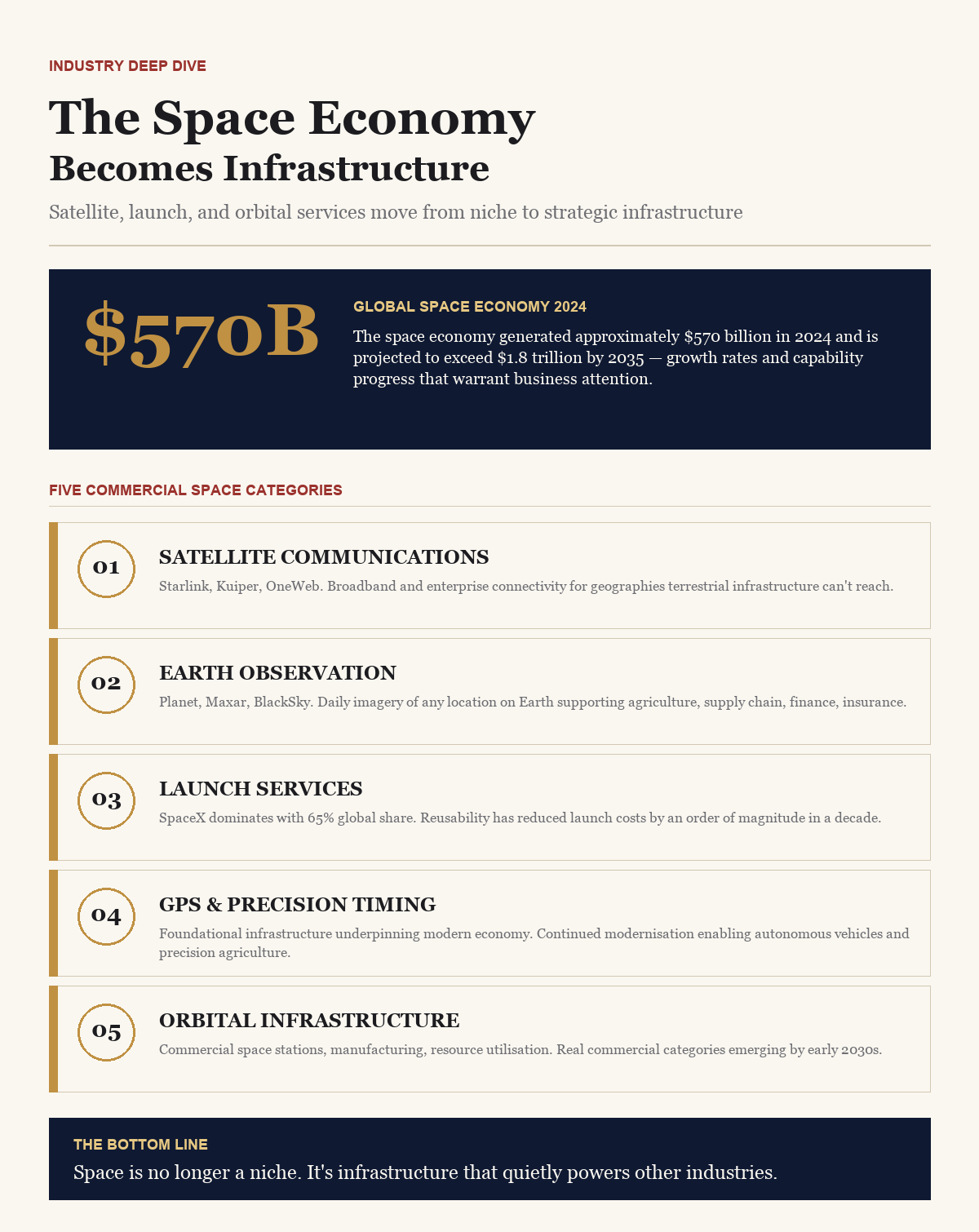
In late 2024, SpaceX completed its 100th orbital launch of the year, a milestone that no organisation, government or private, had previously achieved. The company’s Starlink constellation passed 7,000 active satellites and 5 million customers across more than 100 countries. Amazon’s Project Kuiper began operational deployment, joining Starlink as a commercial low-earth-orbit broadband provider. Rocket Lab achieved its 60th successful launch. China’s commercial space companies executed dozens of launches. The space economy in 2024 generated approximately $570 billion in global revenue, with annual growth above 8 per cent for five consecutive years. By any reasonable measure, space has become a serious commercial business rather than a niche category of government activity.
The transformation has implications that extend well beyond the aerospace sector. Space-based services, connectivity, observation, navigation, communications, are now integrated into operational infrastructure across industries from agriculture to logistics to financial services. The capital investment flowing into space is producing capabilities that are reshaping the economics of multiple ground-based industries. And the strategic competition for space access and capability is becoming a defining feature of great power relationships, with consequences for any business operating internationally.
The Launch Revolution Has Already Happened
The most consequential change in the space economy over the past decade has been the collapse in launch costs. The Space Shuttle, which retired in 2011, cost approximately $54,500 per kilogram to deliver payload to low earth orbit in inflation-adjusted terms. SpaceX’s Falcon 9, the workhorse of commercial launch, delivers payload to LEO at approximately $2,700 per kilogram. The Falcon Heavy, used for larger payloads, is somewhat lower per kilogram. Starship, when it reaches operational capability at projected cadences, is expected to reduce launch costs by another order of magnitude, potentially to several hundred dollars per kilogram.
These cost reductions have changed what is economically possible in space. Satellite constellations with thousands of satellites, economically inconceivable at Space Shuttle launch costs, have become commercial reality. Earth observation, communications, and navigation capabilities that were the exclusive domain of governments are now available as commercial services. The capability gap between space-based and ground-based infrastructure has narrowed substantially in categories where the unique characteristics of space, global coverage, no ground infrastructure required, line-of-sight to large geographic areas, provide advantage.
The launch market itself remains concentrated. SpaceX accounted for approximately 65 per cent of global commercial launches by mass to orbit in 2024, an extraordinary dominance for a single company in any infrastructure category. Chinese state and commercial launch providers held approximately 20 per cent. The remaining launch market is divided among Rocket Lab, ULA, Arianespace, and an emerging set of smaller commercial providers. The economics of launch favour scale and reusability, which advantages established providers, but multiple credible smaller competitors are reaching operational status with cost structures that should provide meaningful competitive pressure.
Satellite Services: The Commercial Application Layer
Satellite-based services are where the space economy intersects most directly with commercial activity in other industries. Satellite communications, dominated by Starlink and increasingly by Project Kuiper and OneWeb, provides broadband access in geographies where terrestrial infrastructure is uneconomic or impractical. The application set extends beyond consumer broadband to enterprise connectivity for shipping, aviation, energy infrastructure, and remote operations.
Earth observation has become a sophisticated commercial market with applications across agriculture, environmental monitoring, supply chain analytics, and financial services. Companies like Planet Labs, Maxar, BlackSky, and Capella Space provide imagery and analytics services that ground-based operations cannot match. The temporal resolution, how frequently a location can be imaged, has improved dramatically as constellations have grown. Daily imaging of any point on earth is now commercially available; revisits multiple times per day are achievable for high-priority targets.
Position, navigation, and timing services through GPS and similar systems are foundational infrastructure for the modern economy. The economic value of GPS to the US economy alone has been estimated at hundreds of billions of dollars annually, and the global value is multiples larger. The continued evolution of these systems, including more accurate positioning through services like Starlink-based positioning and GPS III modernisation, supports applications from autonomous vehicles to precision agriculture to financial transaction timing.
The Industries Being Reshaped by Space-Based Services
Agriculture is one of the most concrete examples of how space-based services are changing operational economics. Precision agriculture uses satellite imagery, GPS-guided equipment, and weather data to optimise input application, monitor crop health, and forecast yields. The economic returns on precision agriculture investments are substantial in large-scale operations, and the capability gap between farmers using advanced satellite-enabled techniques and those using conventional methods has widened materially.
Logistics and shipping have integrated satellite-based services across their operations. Tracking of containers, vehicles, and shipments via satellite-enabled IoT devices provides visibility that was impossible a decade ago. Weather routing for maritime shipping, which uses satellite-derived ocean and atmospheric data to optimise vessel paths, generates fuel savings and schedule reliability improvements that are now built into vessel operations rather than treated as optional optimisation.
Energy infrastructure operators use satellite imagery for monitoring pipelines, transmission lines, and remote facilities at scales that ground-based inspection cannot match. The same imagery supports environmental compliance reporting and ESG verification. The combination of routine monitoring with anomaly detection algorithms allows operators to identify issues, leaks, vegetation encroachment, unauthorised activity, much faster than previously possible (see our analysis in The $1.3T Chip Economy).
Financial services have integrated satellite-derived data in several specific applications. Hedge funds use satellite imagery of parking lots, shipping ports, and industrial facilities to forecast economic and corporate performance. Commodity traders use crop monitoring to forecast harvests. Insurance companies use satellite-based hazard assessment for underwriting and claims processing in agricultural insurance, property catastrophe insurance, and marine insurance (see our analysis in Edge Computing and IoT).
Orbital Infrastructure: The Next Frontier
The most ambitious developments in the space economy involve infrastructure in orbit beyond traditional satellite constellations. Space stations operated by commercial entities, Axiom Space, Vast Space, Blue Origin’s Orbital Reef, and others, are under active development to replace the International Space Station as it approaches retirement around 2030. The commercial space station market is projected to support research, manufacturing, tourism, and government uses, with revenue scales that justify the substantial capital investments being deployed (see our analysis in Food & Agriculture Tech).
Space-based manufacturing is an early-stage but real commercial category. Microgravity manufacturing of specific products, including certain pharmaceuticals, fibre optic cables, and semiconductor materials, produces results that cannot be achieved in earth-based facilities. The economics are challenging given current launch and infrastructure costs, but the pipeline of products in development and the progress in lowering supporting infrastructure costs suggest that commercial space manufacturing will be a meaningful category by the early 2030s.
Asteroid mining and lunar resource utilisation remain longer-term prospects but have moved from purely speculative ventures to seriously funded development programmes. Multiple companies are working on technologies for water extraction from the moon and from near-earth asteroids, with applications including in-space propellant production that could substantially reduce the cost of operations beyond low earth orbit. The timeline for commercial activity in these categories extends into the 2030s, but the engineering progress has been substantial.
The Strategic and Geopolitical Dimension
Space has become a focus of strategic competition between major powers in ways that have direct implications for commercial space activity. The United States, China, Russia, and increasingly other countries have developed counter-space capabilities, including anti-satellite weapons and electronic warfare systems, that could be used to threaten commercial as well as government satellites. The strategic posture of major commercial satellite operators must increasingly consider these risks alongside traditional commercial considerations.
Export controls on space technology have intensified significantly. The US International Traffic in Arms Regulations, which controls export of defence-related items including many space technologies, has been actively enforced and expanded. Similar regimes in the EU, UK, and other major economies have created compliance complexity for international space business activity. Companies operating in the global space economy must navigate these regimes with the same rigour applied to other heavily regulated industries.
India’s Space Economy
India’s space programme has demonstrated capability that increasingly translates into commercial activity. ISRO‘s Chandrayaan-3 lunar landing in 2023 and successful low-cost mission profile demonstrated technical capability at price points that few other space programmes can match. The Indian Space Policy 2023 opened the sector to private participation, and a growing ecosystem of Indian space startups, Skyroot Aerospace, Agnikul Cosmos, Pixxel, Bellatrix Aerospace, and others, has emerged with substantial venture capital backing.
The Indian space economy is positioned at an interesting intersection of capability and cost advantage. Indian launch services, satellite manufacturing, and space-based applications can serve global markets at price points that are competitive with international providers. The development of this commercial space sector is a deliberate national priority, supported by government policy and private capital, and it represents one of the more promising new categories in India’s economic development trajectory.
Strategic Implications for Business Leaders
For business leaders, the space economy creates strategic considerations that extend beyond the aerospace sector. The continued decline in space-based service costs is making capabilities accessible that previously required substantial dedicated investment, and businesses that integrate these capabilities into their operations gain capability and cost advantages over competitors that do not. The investment patterns flowing into space infrastructure are creating capabilities that will be widely available within five to seven years, and competitive positioning that anticipates this availability will be advantageous.
For investors, the space economy presents both significant opportunity and complex risk assessment requirements. The category includes well-established profitable businesses, infrastructure investments with utility-like characteristics, deep technology development with substantial capital requirements, and early-stage venture opportunities. Each category requires different evaluation frameworks, different capital structures, and different operational expertise. The undifferentiated ‘space investment’ is rarely the right framing; specific category and business-model selection drives outcomes.
The space economy is no longer a niche to be observed. It is becoming infrastructure that supports activities across the broader economy, with growth rates and capability progress that warrant strategic attention from any business operating at meaningful scale. The companies and economies that engage with it deliberately will be advantaged in the next phase of economic development.
