



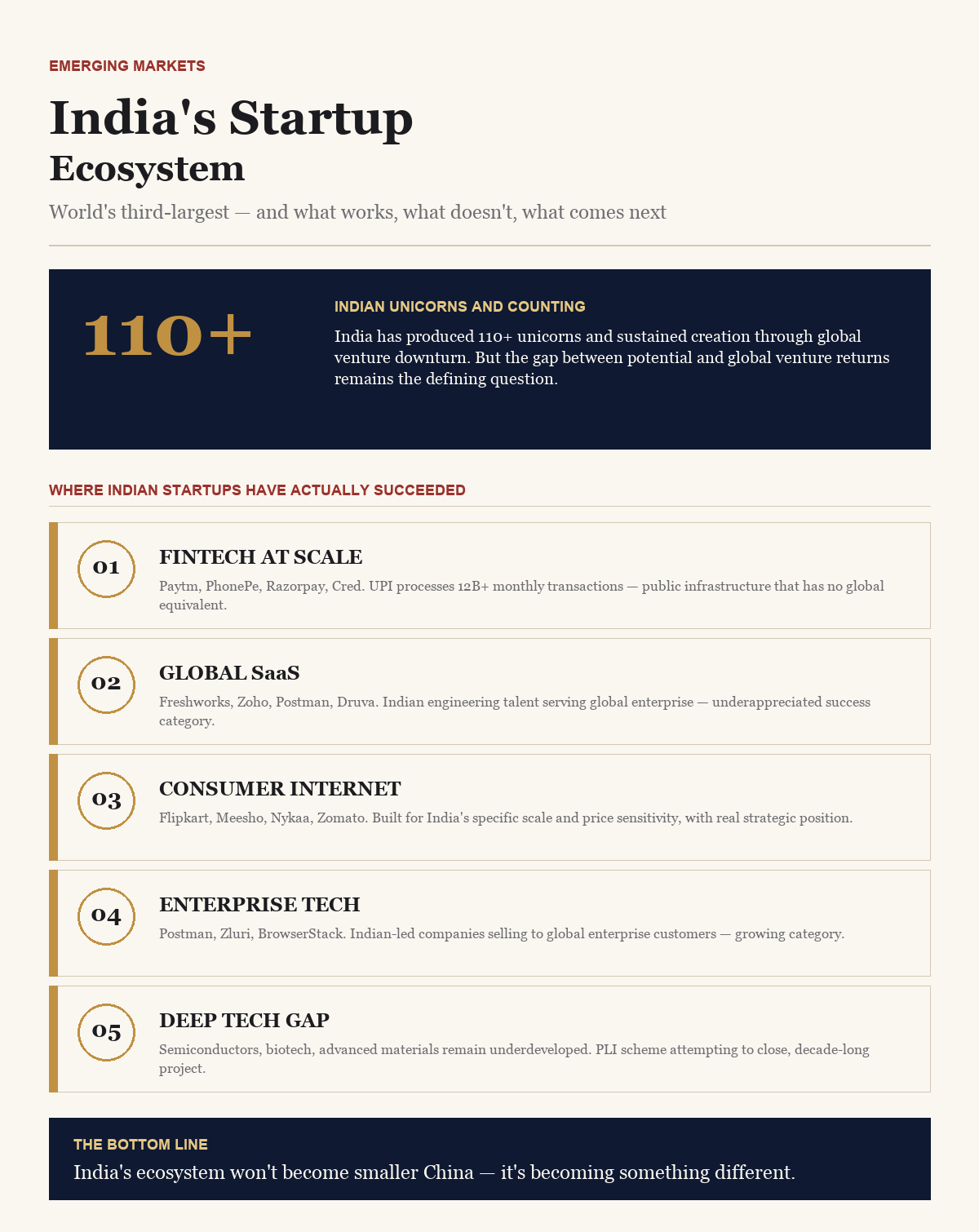
The transformation of India’s startup ecosystem over the past decade is one of the most consequential business stories of the 2010s and 2020s. From a small ecosystem dominated by IT services and outsourcing in the mid-2000s, India has built the world’s third-largest startup ecosystem by number of companies, behind only the United States and China. The country has produced more than 110 unicorns, private companies valued at over $1 billion, with sustained creation rates that have weathered the global venture downturn better than many competing markets. The Indian government’s Startup India initiative, launched in 2016, has produced regulatory simplifications, tax benefits, and signalling effects that have supported entrepreneurial activity.
And yet the ecosystem’s potential remains substantially unrealised by certain measures. India represents approximately 18 per cent of global GDP at purchasing power parity but attracts roughly 4 per cent of global venture capital. The exits that have emerged from the Indian startup ecosystem, while substantial in number, have produced cumulative returns to investors that lag those produced by US and Chinese ecosystems of comparable maturity. The next decade will determine whether India closes that gap and becomes a genuine global powerhouse for venture-funded innovation, or whether the gap proves structurally persistent.
What Has Actually Worked
Several categories of Indian startup have produced real, sustained business success that compares favourably with international benchmarks. Fintech has been the standout. Companies including Paytm, PhonePe, Razorpay, Pine Labs, and Cred have built payment, lending, and financial services businesses that serve hundreds of millions of customers. The Unified Payments Interface, a public infrastructure that processes more than 12 billion transactions monthly as of early 2026, has created a fintech operating environment that has no equivalent in any other major economy and has supported the development of fintech innovation that Western markets are now studying for inspiration.
Consumer internet and e-commerce have produced sustained successes despite well-documented challenges. Flipkart, Meesho, Nykaa, Zomato, and PolicyBazaar have built businesses that serve India’s enormous and rapidly growing online consumer base. The companies have generally not yet replicated the financial profile of comparable Western e-commerce successes, unit economics have been more challenging given India’s price-sensitive consumer base, but the strategic position they have built provides foundations for the next phase of monetisation and operational improvement.
Software-as-a-service businesses serving global customers from India have been an underappreciated success category. Companies including Freshworks, Zoho, Postman, Druva, and a substantial group of vertical SaaS businesses have built revenue at scale serving global enterprise customers, primarily in North America and Europe. The success of these businesses reflects India’s strength in software engineering talent, the lower cost base of building software in India versus the United States, and the demonstrated ability of Indian-led SaaS businesses to compete effectively in international markets.
Where the Ecosystem Has Struggled
Several categories of Indian startup have struggled more than peers in international markets, and understanding these struggles is important for forming realistic expectations about the ecosystem’s overall trajectory. Deep technology, semiconductors, biotechnology, advanced materials, frontier AI, has been a chronic gap in Indian startup activity. The reasons are structural: deep technology requires sustained capital deployment over long time horizons, access to specialised equipment and infrastructure, and integration with research institutions that have historically been weaker in India than in leading deep tech ecosystems. Government investment through the Semiconductor Mission and similar initiatives is attempting to address some of these gaps, but the timeline for results is measured in decades rather than years.
Direct-to-consumer brands have been a more recent challenge. The 2020-2022 period saw substantial investment in Indian D2C brands across categories, beauty, food, apparel, home goods, supported by digital marketing and direct distribution through e-commerce platforms. The subsequent performance has been mixed: a small number of brands have built genuine businesses, but many have failed to achieve scale, retain customers, or build margin structures that justify their capital deployment. The pattern reflects challenges that D2C brands face globally, exacerbated by India-specific issues including the cost of customer acquisition through digital channels and the difficulty of building loyalty in highly price-sensitive consumer segments.
The exit environment for Indian startups has been a persistent friction. The Indian IPO market has matured significantly, providing a credible exit option for businesses that have reached the scale and profitability thresholds that public markets demand. But the exit valuations and post-IPO performance have varied widely, and the secondary market for private Indian startups remains less liquid than US equivalents. Strategic M&A from Indian corporates has been less active than from Western corporates of comparable scale, reflecting different M&A cultures and ownership structures.
The Government’s Increasingly Active Role
The Indian government has become substantially more active in shaping the startup ecosystem over the past five years, with mixed implications. The IndiaAI Mission, the Semiconductor Mission, the Production Linked Incentive schemes, and various sector-specific industrial policy initiatives have committed substantial public funding to areas of strategic importance. These initiatives have catalysed activity in semiconductors, AI infrastructure, electronics manufacturing, and clean energy that would not have occurred otherwise (see our analysis in Why Startups Fail at Scaling).
Regulatory developments have been more contested. The government’s approach to social media, content moderation, data localisation, and digital business regulation has produced compliance complexity that affects startup operations. The 2024 advisory on generative AI deployment, while subsequently modified, signalled that Indian regulation may be more interventionist than founders had expected. The Digital Personal Data Protection Act and various sector-specific regulations create compliance obligations that startups must navigate alongside their business development priorities (see our analysis in The $300B VC Quarter).
Tax and incorporation policies have generally been supportive of startup activity, with the angel tax (a previously contentious issue) addressed in the 2024 budget. The Startup India initiative provides tax exemptions, fast-track patent processing, and self-certification for compliance with labour and environmental laws for eligible startups. These benefits are meaningful for early-stage businesses, though their impact diminishes as companies mature beyond startup status (see our analysis in India’s Manufacturing Moment).
The Talent Story
India’s talent base is the foundation of its startup ecosystem and the most durable source of competitive advantage. The country produces approximately 1.5 million engineering graduates annually, the largest engineering talent pool in the world. The quality distribution is highly uneven, but the top tier of Indian engineering talent, graduates from IITs, NITs, and leading private universities, compares favourably with global benchmarks. The depth of available engineering talent at moderate cost is a structural advantage that supports startup formation, particularly in software-intensive businesses (see our analysis in Seed Stage Is Broken).
The leadership talent picture is more mixed. Indian founders have demonstrated the ability to build large businesses, but the depth of experienced senior management, particularly in functions like product management, sales operations, and growth marketing, remains thinner than in mature ecosystems. The Indian diaspora in the United States has contributed substantially to filling this gap, both through return migration and through ongoing engagement with Indian startups as investors and advisors. The dynamic between India-based and US-based Indian leadership talent has become one of the distinctive features of the Indian startup ecosystem.
The China Comparison That Matters
Comparisons between Indian and Chinese startup ecosystems are inevitable but should be made carefully. China’s startup ecosystem benefited from a combination of factors that India has not replicated and will not: substantial state direction and capital deployment, deliberate exclusion of leading Western technology companies from the Chinese market for a critical period, and integrated capital markets that supported domestic exits. These factors produced a generation of Chinese technology companies that achieved enormous scale within a single very large domestic market.
India’s path is genuinely different and is producing different outcomes. India’s market remains open to global competition in most categories, which means Indian startups must compete with the best global products in their domestic market. India’s exit environment is less concentrated in domestic capital markets than China’s. The cultural and political relationship between Indian business and the Indian state is different from the Chinese version, with implications for which sectors receive support and how that support is delivered.
The implication is that India’s startup ecosystem will not become a smaller version of China’s; it is becoming something genuinely distinct. The strengths in software services, fintech infrastructure, consumer applications, and international SaaS reflect this distinctive character. The constraints in deep technology, hardware, and concentrated domestic market scale also reflect this character. Understanding India’s ecosystem on its own terms, rather than as a comparison with China or the United States, is essential for accurate assessment.
What Comes Next
The next phase of India’s startup ecosystem development will be defined by several specific developments. The continued maturation of the public market exit channel will determine whether Indian startups can produce the scale of exits that justify continued venture investment. Early indications from companies including Zomato, Nykaa, and PolicyBazaar suggest that the public market path can produce strong outcomes when companies reach appropriate scale and profitability before listing.
The development of deep technology capability, semiconductors, biotechnology, advanced materials, frontier AI, will determine whether India can participate in the categories that are likely to produce the most consequential business outcomes of the coming decade. Government investment is substantial but the timeline for results is long; the private capital that complements government investment is still developing the operational capability to deploy in deep technology effectively.
The integration of Indian startups with global markets will continue to be a defining feature of the ecosystem. Indian SaaS businesses serving global customers, Indian-led companies headquartered internationally, and Indian capital deployment into international markets are all dimensions of this integration that have grown substantially and are likely to continue growing. The Indian startup ecosystem, in its mature form, is unlikely to be a purely domestic phenomenon, it will be a globally integrated ecosystem with deep Indian roots.
The question of whether India becomes a ‘global powerhouse’ in startups depends partly on how that phrase is defined. India is already a globally important startup ecosystem by the measures of company creation, talent contribution, and capital deployment. The remaining questions concern the financial returns the ecosystem produces, the breadth of categories in which it competes at frontier levels, and the depth of impact its companies have on global markets. The evidence of the past five years suggests that the ecosystem is moving in the right direction on all three dimensions, though the pace of progress will continue to be debated.
