



The private equity industry has changed substantially over the past five years, and the change is most visible at the middle of the market. Mega-deal activity, the headline-generating $20 billion-plus leveraged buyouts that defined PE’s image during the easy-money years, has declined sharply as financing costs have risen and as some of the largest funds have struggled to deploy capital efficiently at scale. The middle market, by contrast, has seen consistent and growing activity, accounting for the majority of PE transaction volume by deal count.
The shift reflects several dynamics that have made mid-market businesses particularly attractive to PE buyers. Mid-market companies often have meaningful operational improvement opportunities that PE firms can capture through professional management, technology investment, and disciplined capital allocation. They typically transact at multiples of earnings that are lower than mega-cap acquisitions, providing a margin of safety in a higher-rate environment. And they are abundant: tens of thousands of US-based businesses fall in the mid-market range, with hundreds of thousands more in major international markets, providing deep deal flow for funds that have built mid-market deployment capability.
Why PE Is Increasingly Focused Here
The economic case for PE mid-market investment has strengthened over the past five years. Mid-market companies frequently sell at EBITDA multiples in the 7 to 10x range, compared to mega-cap acquisitions that often required 12 to 15x multiples at the 2021 peak. The lower entry multiple provides more cushion against operational mistakes and more upside potential from execution. Mid-market businesses also typically have less institutional management in place, meaning PE firms can drive operational improvement through professionalising functions that have been underdeveloped, finance, HR, technology, sales operations, procurement.
Sector specialisation has become a key competitive differentiator among mid-market PE firms. Firms that have built deep operating expertise in specific verticals, industrial services, healthcare services, software, specialty distribution, can identify, value, and improve businesses in those sectors more effectively than generalists. Vista Equity Partners‘ focus on enterprise software, Genstar Capital’s healthcare services franchise, and Audax Group’s middle-market specialist focus exemplify the trend toward sector-specialised mid-market PE.
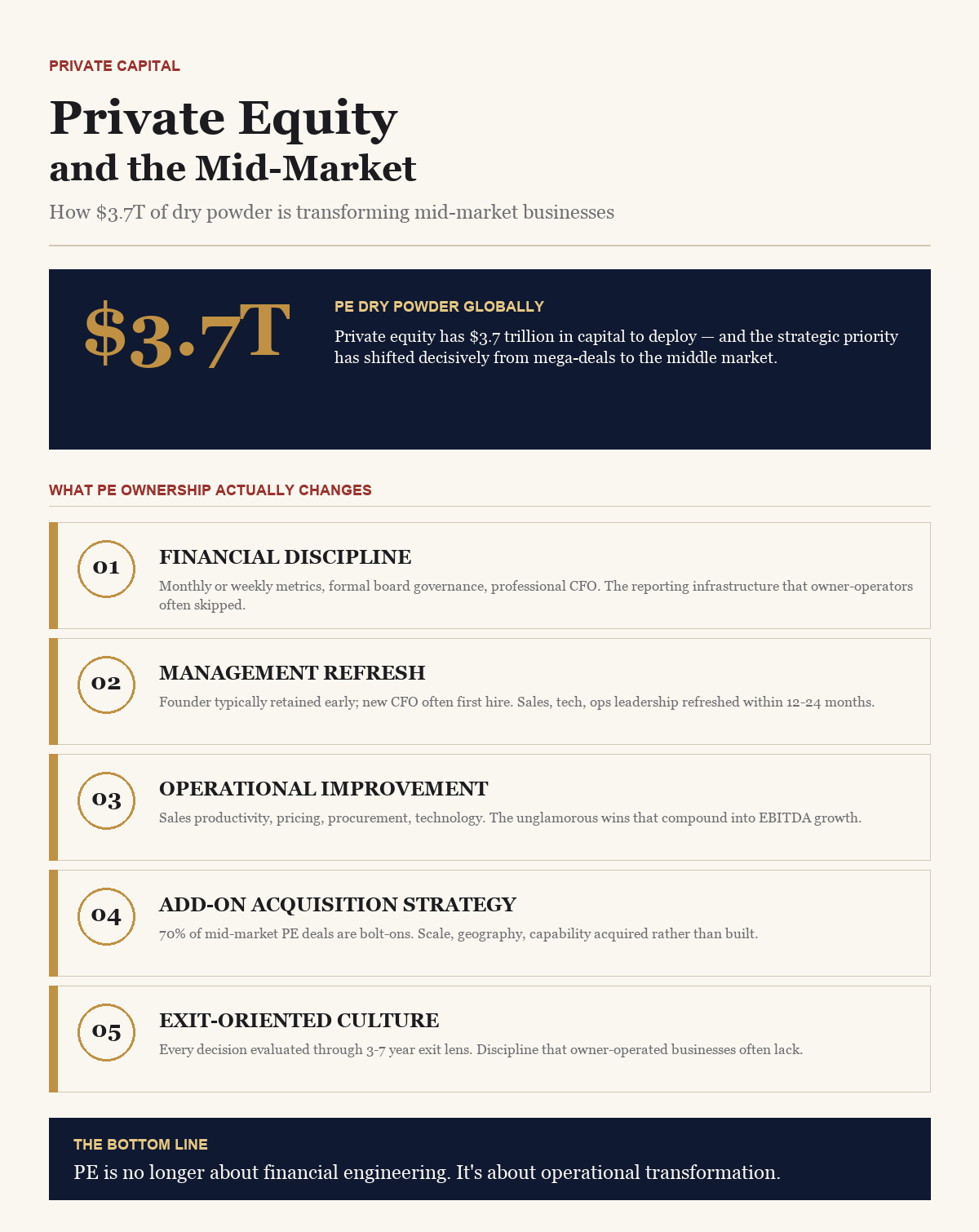
Add-on acquisition strategies, buying a platform company and then making multiple follow-on acquisitions to build scale, have become standard in mid-market PE. The strategy works particularly well in fragmented industries where consolidation can produce operational and financial advantages: managed services, healthcare practices, specialty insurance brokers, industrial distributors. Approximately 70 per cent of mid-market PE transactions in 2025 were add-on acquisitions to existing platform companies, compared to roughly 50 per cent a decade ago.
What Actually Changes When PE Takes Ownership
The transformation that follows PE acquisition is often more comprehensive than founders anticipate. The initial period, typically the first 100 days, involves intensive operational assessment and the establishment of new management infrastructure. Financial reporting systems are typically upgraded to provide monthly or weekly metrics that owner-operators may not have routinely produced. Board governance is formalised with regular meetings, performance reviews, and accountability structures. Strategic planning processes are introduced or strengthened.
Management changes are common, though not universal. PE firms typically retain the operating leadership of acquired businesses through the early period, particularly if the founder and key managers have demonstrated strong operational capability. But changes accumulate: a new chief financial officer is often the first significant management addition, bringing finance discipline that the founder may not have prioritised. Sales leadership, technology leadership, and operations leadership are often refreshed or supplemented in the first 12 to 24 months of ownership.
The capital deployment patterns that follow PE acquisition reflect the underlying value-creation thesis. Operational improvement initiatives, sales productivity, pricing optimisation, procurement, technology systems, typically receive priority investment in the early period. Acquisitions to expand scale, geographic reach, or service offerings typically follow as the platform stabilises and the operational improvements take effect. Capital return to ownership, through dividend recapitalisations or partial exits, typically occurs later in the holding period as the value-creation thesis matures.
The Founder Perspective: What to Negotiate
For founders and owners considering PE transactions, the deal structure matters enormously and often determines the practical experience of the post-transaction period more than the headline valuation. Several specific dimensions warrant explicit attention during negotiation. Rollover equity, the portion of sale proceeds that the seller invests back into the buying entity, is a standard feature of PE transactions and has significant economic implications. Aggressive rollover at the time of sale creates upside participation but also concentration risk in a leveraged business (see our analysis in Venture Capital in 2026).
Employment and management terms for the post-transaction period require careful negotiation. The PE buyer’s expectations about role, authority, and tenure should be discussed explicitly, not left to the implicit assumptions of either party. Exit covenants and non-compete provisions can have long-term implications for the founder’s subsequent career options. The cultural fit between the founder and the PE firm, communication style, decision-making approach, operational philosophy, often determines whether the post-transaction period is productive or fraught (see our analysis in The IPO Window Reopens).
Earnout structures, where part of the purchase price is contingent on future performance, are common in PE transactions but vary widely in their design. Earnouts tied to clearly measurable metrics that are within the seller’s control to influence post-closing are reasonable. Earnouts tied to subjective measures, to metrics influenced by buyer decisions post-closing, or to performance over very long periods are typically problematic. Founders should resist deal structures in which earnouts represent a substantial fraction of total consideration unless the metrics are clean and the achievement is reasonably certain (see our analysis in The $300B VC Quarter).
The Exit Calculus
PE firms typically hold portfolio companies for three to seven years before exiting, though the average holding period has lengthened modestly in the current environment. The exit options have evolved with the broader M&A and IPO markets. Strategic sales to industry acquirers remain the most common exit, accounting for approximately 60 per cent of PE exits in 2025. IPOs, which had been a more important exit channel during the 2020-2021 cycle, have returned more selectively as the IPO market has reopened. Secondary sales to other PE firms, one PE firm selling to another, have become an increasingly important exit channel, accounting for a growing share of large mid-market exits (see our analysis in Business Turnarounds).
The pricing dynamics of PE exits reflect the multiple expansion or compression that has occurred during the holding period. Mid-market PE exits in 2025 have transacted at multiples that are modestly above the entry multiples paid at acquisition, with operational improvement providing additional value through EBITDA growth. The combination of multiple expansion (modest) and EBITDA expansion (more substantial) drives the equity returns that PE firms deliver to their limited partners.
The Indian Mid-Market PE Story
Indian mid-market private equity has grown substantially over the past five years, supported by domestic capital pools and increasing involvement from international PE firms. The Indian mid-market presents different characteristics than US or European mid-markets: businesses are often family-owned with complex inter-generational dynamics, operational sophistication varies more widely, and the legal and tax considerations of PE transactions differ materially from Western markets.
Indian family businesses considering PE transactions face specific complexities that founders in Western markets typically do not. Inter-generational ownership dynamics, the integration of the business with extended family wealth and operations, and the tax implications of various transaction structures all require careful management. The successful Indian mid-market PE transactions of recent years have generally involved buyers with strong India presence and family business sensitivity, rather than purely financial buyers applying Western templates.
The Indian mid-market PE opportunity is genuine and growing, but the execution requires capability that not all international funds have developed. Several international PE firms have built dedicated India teams and have been increasingly active in mid-market transactions. Indian-based PE firms, Multiples, ChrysCapital, ICICI Venture, KKR India, combine local market knowledge with operational capability and have established strong franchises in the mid-market.
What This Means for Mid-Market Owners
For owners of mid-market businesses considering exit options or capital raising, several principles emerge from the current PE environment. Strategic optionality is more valuable than transaction maximisation. Building a business that is attractive to multiple types of buyers, strategic acquirers, PE firms with different strategies, public market investors if scale and growth support it, produces better outcomes than optimising for a single exit path. The optionality typically requires investment in financial reporting, management depth, and operational documentation that may seem unnecessary while the business is owner-operated.
Pre-transaction preparation makes a substantial difference in transaction outcomes. Businesses that approach PE transactions with clean financial records, identified growth investments, professional advisors, and clear strategic narrative typically command better valuations and better deal terms than businesses that approach transactions reactively. The 12 to 24 months before a transaction is the period when this preparation should occur.
The PE relationship is a partnership, even when the PE firm has majority ownership. The owners and executives who succeed in PE-backed businesses are typically those who engage actively with the PE firm’s expertise and resources, while maintaining the operational judgement and customer relationships that made the business successful in the first place. The owners who struggle are typically those who view PE ownership as either a passive financial relationship or as a constraint on their entrepreneurial flexibility. Neither view captures the reality of what makes PE-mid-market partnerships work.
