



On the morning of 2 April 2026, the United States Trade Representative published a Federal Register notice that most business leaders did not read until their lawyers called them. Titled ‘Determination of Action in Section 301 Investigation: Unfair Trade Practices of Trading Partners’, the notice announced tariff measures against 16 countries, ranging from 10% on imports from the European Union and United Kingdom to 46% on Vietnamese goods, 49% on Cambodian products, and 34% on Chinese imports stacked on top of existing measures that had already pushed effective tariff rates on some Chinese categories above 100%. The financial press called it ‘Liberation Day’. Trade lawyers called it something less celebratory.
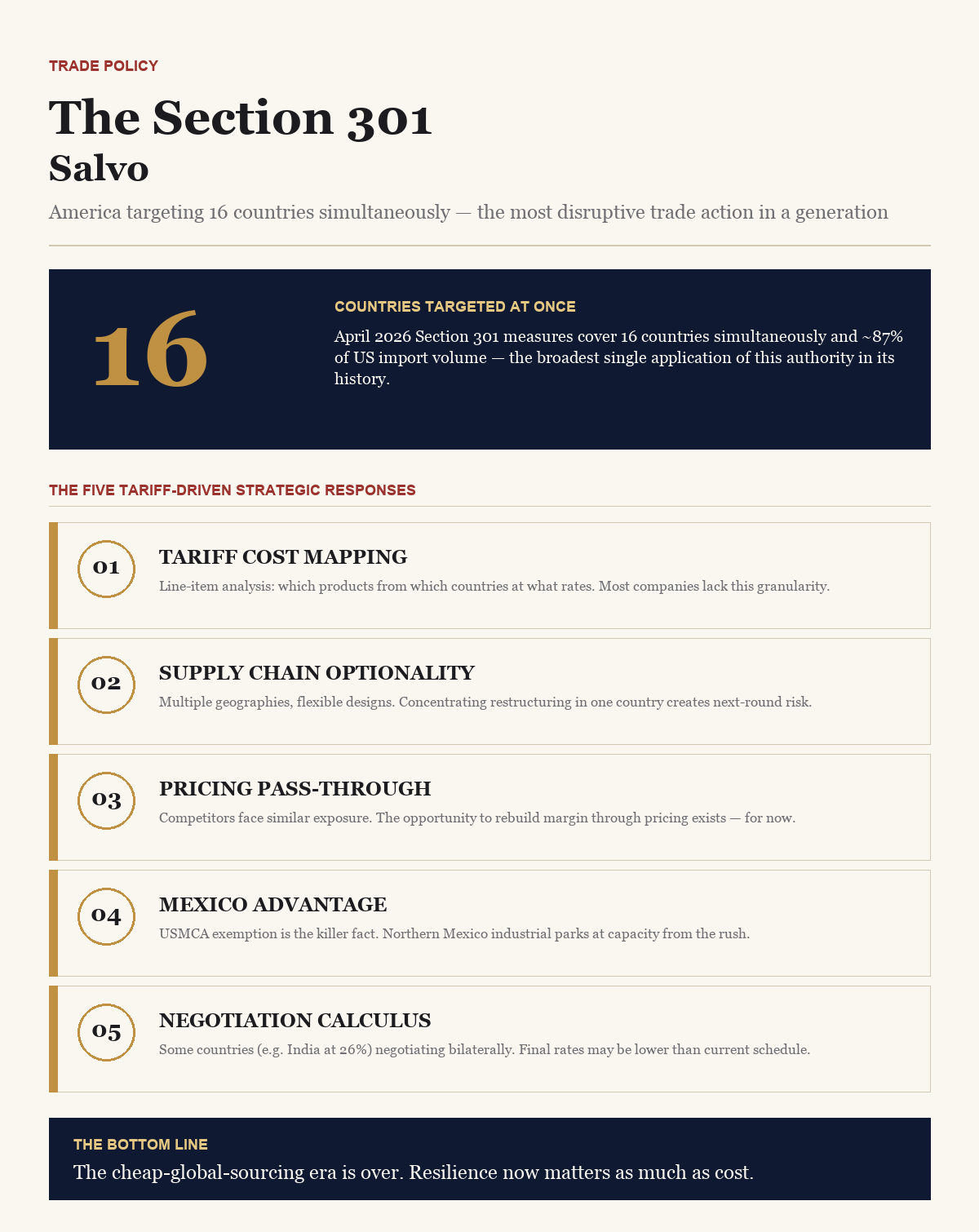
Section 301 of the Trade Act of 1974 grants the US President broad authority to impose tariffs and other trade measures against countries whose practices are deemed ‘unreasonable or discriminatory and burden or restrict US commerce’. It was used sparingly for decades, most famously in the first Trump administration’s China measures beginning in 2018. What distinguishes the April 2026 action is its scope: 16 simultaneous targets, covering approximately 87% of US import volume, deployed without the country-by-country investigation process that Section 301 technically requires. The legal challenges have already begun; the business disruption began immediately.
What Section 301 Actually Does, and Why This Time Is Different
Section 301 tariffs are paid by the US importer at the border, not by the exporting country. This is the first and most important correction to the political narrative surrounding the measures. A 34% tariff on goods from China means a US company importing $100 million of Chinese products pays $34 million to the US Treasury. The exporting Chinese manufacturer faces pressure on order volumes and pricing, but the immediate cash impact falls on the American importer, who must then decide how much of that cost to absorb and how much to pass to customers.
The 2018-2019 experience with China-specific Section 301 measures provided a preview of these dynamics. Research by economists at the Federal Reserve, Columbia University, and the National Bureau of Economic Research consistently found that US importers bore the majority of the tariff cost rather than exporting manufacturers, and that US consumer prices rose across affected categories. Those findings informed Fed Chair Powell’s characterisation of tariffs as ‘inflationary’ in his March 2026 testimony, a characterisation that contributed to the political pressure on his tenure.
What makes the April 2026 measures different from 2018 is the simultaneity and breadth. In 2018, businesses could and did redirect supply chains: Chinese production moved to Vietnam, Cambodia, Thailand, and Malaysia to avoid tariffs. That option largely disappears when Vietnam faces 46%, Cambodia 49%, Thailand 36%, and Malaysia 24%. The escape valve has been closed. Companies that spent 2019 to 2024 investing in ‘China Plus One‘ supply chain strategies, relocating production to Southeast Asia specifically to avoid US-China trade friction, now find those investments facing comparable tariff exposure.
Country-by-Country: The Business Implications
The tariff schedule contains significant variation that creates both risks and opportunities depending on supply chain geography. Mexico, operating under the USMCA free trade agreement, is exempt from the April 2026 measures on qualifying goods, a carve-out that has made Mexican manufacturing the most immediately attractive alternative for companies seeking to reduce tariff exposure. The northern Mexican states of Nuevo León, Coahuila, and Sonora are experiencing an investment surge that local officials are struggling to process: factory announcements, infrastructure commitments, and labour market tightening are all running ahead of available capacity.
India received a 26% tariff rate, lower than most Southeast Asian competitors but higher than Mexico and existing US free trade agreement partners. The Indian government’s response was to open immediate negotiations toward a bilateral trade agreement, with early concessions offered on agricultural goods and medical devices that are politically sensitive in Washington. The outcome of those negotiations will materially affect India’s competitive position in sectors including pharmaceuticals, textiles, and engineering goods where it competes directly with higher-tariffed Southeast Asian producers.
The European Union, at 20%, and the United Kingdom, at 10%, face measures that are disruptive but not existential for most categories. European luxury goods, automobiles, and industrial equipment face meaningful price increases in the US market, but the tariff levels are not so high as to trigger immediate supply chain restructuring. The EU has prepared retaliatory measures targeting American agricultural products, aircraft, and consumer goods, though it has paused implementation pending negotiation, a pattern that reflects both the strategic importance of the transatlantic relationship and the EU’s awareness that a full trade war with the United States would damage European growth more than American.
Supply Chain Restructuring: The Real Cost
For multinational manufacturers, the response to broad-based tariffs is not a spreadsheet exercise, it is a multi-year capital reallocation programme with significant uncertainty about the policy environment that will exist when the investments come online. Building a new factory in Mexico, India, or Eastern Europe takes two to four years from decision to production. Tariff policy can change in an election cycle. The companies that moved production to Vietnam after 2018 made rational decisions based on the information available; those decisions now look less rational given the April 2026 measures.
The consulting firm Kearney estimates that supply chain restructuring in response to the April 2026 measures will represent $1.2 trillion in capital deployment over five years globally, factory construction, logistics infrastructure, workforce training, and technology transfer. That figure dwarfs any previous episode of trade-policy-driven supply chain adjustment. It also creates significant winners: engineering and construction firms, industrial real estate developers, logistics providers, and the communities in tariff-advantaged geographies that will host new manufacturing capacity (see our analysis in Doing Business in the Age of Sanctions).
For Indian businesses, the implications cut in both directions. Indian manufacturers in sectors facing 26% tariffs to the US market must recalibrate their pricing and volume assumptions. But Indian companies positioned as suppliers to the global supply chains being restructured, steel, chemicals, textiles, electronics components, face a genuine demand uplift as manufacturers seek alternatives to Chinese and Southeast Asian sources (see our analysis in Supply Chain Sovereignty).
The Legal and Institutional Challenge
The April 2026 Section 301 measures face serious legal challenges on multiple fronts. The World Trade Organization‘s dispute settlement mechanism, weakened by the United States’ long-running refusal to appoint judges to the appellate body, cannot provide timely relief, but formal disputes have been filed by the EU, Japan, South Korea, and India that will create ongoing legal uncertainty about the durability of the measures. Domestically, several trade associations have filed suits in the US Court of International Trade arguing that the simultaneous multi-country investigation violated the procedural requirements of Section 301 (see our analysis in India’s Manufacturing Moment).
Courts have historically been reluctant to second-guess executive branch trade actions, and the Supreme Court’s 2024 Loper Bright decision limiting judicial deference to agency interpretations cuts in both directions. The legal risk is real but unlikely to result in rapid reversal. Businesses planning supply chain investments should model scenarios in which tariff levels are reduced through negotiation rather than legal challenge, the pattern established in 2018 to 2020, when multiple country-specific exclusion processes provided partial relief without fully unwinding the measures.
Strategic Responses for Business Leaders
The tariff environment created by the April 2026 measures is not going to resolve quickly, regardless of negotiation outcomes. The baseline assumption for supply chain planning should be that some version of elevated US tariffs will persist through at least 2028 and potentially beyond, regardless of which party controls the White House. That assumption should drive three categories of strategic response.
First, tariff cost mapping. Every business that sources products or components affected by the new measures needs a precise, line-item analysis of tariff exposure: which products, from which countries, at what tariff rates, and what the pass-through economics look like to customers and competitors. Many companies lack this analysis at the granularity required to make good decisions. The first priority is knowing the number.
Second, supply chain optionality. The lesson of 2018 to 2026 is that concentrating supply chain restructuring in a single alternative geography creates re-exposure to the next round of trade policy. Businesses investing in supply chain resilience should be building genuine optionality, multiple geographies, flexible production designs, and supplier relationships in tariff-advantaged locations, rather than making a single large bet on the next low-cost country.
Third, pricing strategy. In a world where competitors face similar tariff exposure, the ability to pass through cost increases is greater than in normal competitive conditions. Companies with strong brand positioning and customer relationships have an opportunity to rebuild margin through pricing adjustments that the tariff environment makes easier to justify. Those conversations with customers should be happening now, before competitors establish the new pricing norms.
The Longer View
Section 301’s historical purpose was to address specific, identifiable unfair trade practices, currency manipulation, intellectual property theft, state subsidies to specific industries. The April 2026 measures applied it to virtually every major US trading partner simultaneously, on the basis of bilateral trade deficit arithmetic rather than identified unfair practices. That represents a fundamental shift in the philosophy underlying US trade policy, from a rules-based system with negotiated exceptions to a results-based system where trade balances are the metric of fairness.
Whether that shift proves durable or is partially reversed through negotiation and legal challenge, it has already altered the calculus of every multinational company with US market exposure. The era of assuming relatively stable, rules-based international trade is over for the foreseeable future. Building corporate strategy that is resilient to continued trade policy volatility, rather than optimised for a specific tariff regime that may change, is the defining supply chain and finance challenge of this decade.
