



The startup failure conversation tends to focus on the early stages: failed product launches, founders who could not find product-market fit, businesses that ran out of money before they could prove they had built something customers wanted. Those failures are common, but they are not actually the majority of startup failures. The larger and more underappreciated category of failure occurs after the initial product proves itself, when companies that have achieved genuine product-market fit attempt to scale and fail in ways that consume far more capital, take longer to manifest, and cause more economic damage than early-stage failures. CB Insights data on failed startup post-mortems consistently shows that scaling failures account for a larger share of capital destroyed than early-stage failures, even though they receive less attention in startup discourse.
Understanding why this happens, and how the best operators avoid it, is essential for founders who have proven they can build products customers want but who now face the very different challenge of building a business those customers can sustain. The transition is genuinely difficult, and the difficulty is structural rather than incidental.
The Premature Scaling Problem
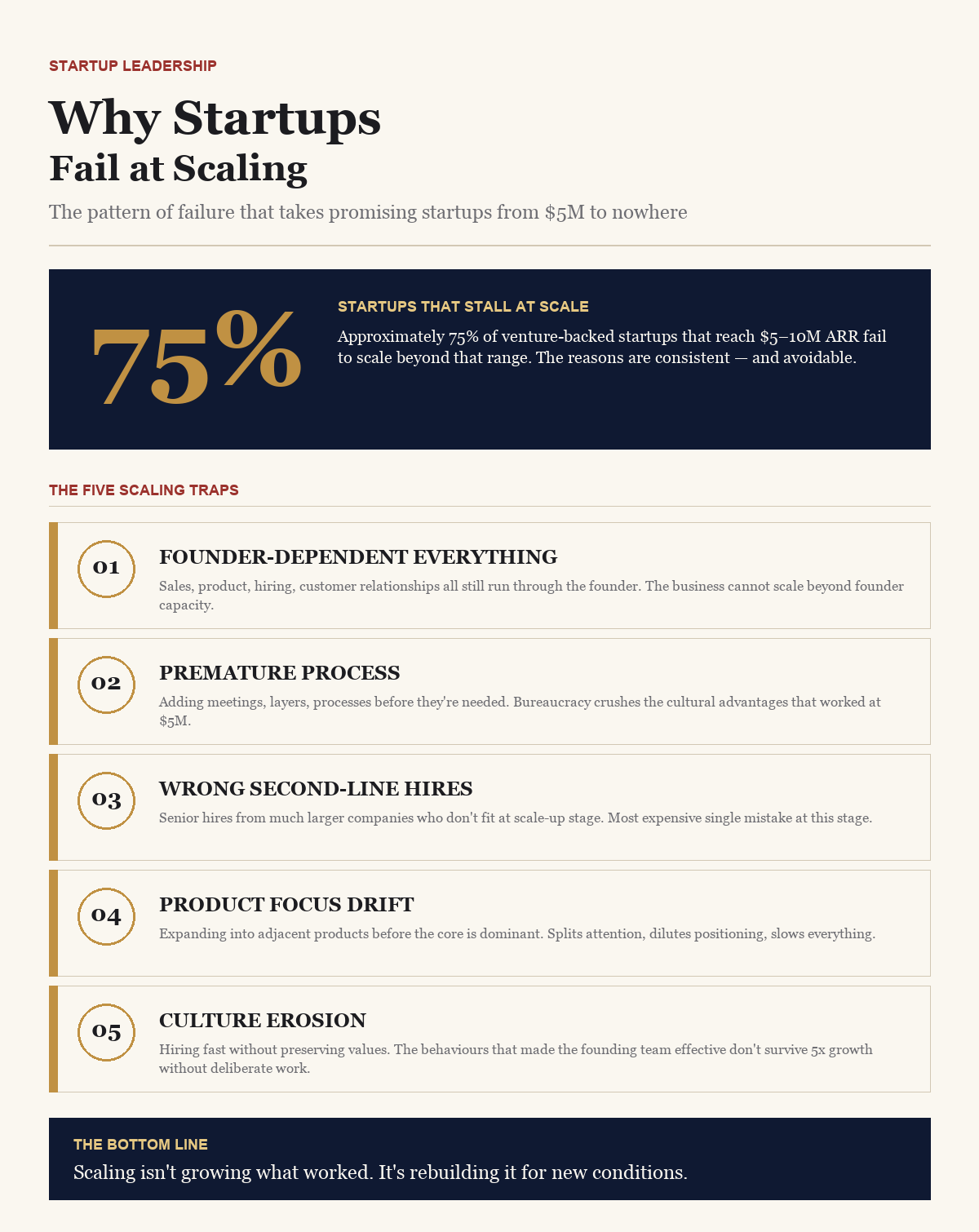
Premature scaling, investing in growth before the business has validated that it can support that growth profitably, is the single most common failure mode in venture-backed scaling. The pattern is consistent: a startup achieves promising early traction with a small customer base, raises a Series A or Series B based on that traction, and then deploys the capital aggressively into sales, marketing, and operational expansion based on the assumption that scaling the inputs will produce proportional scaling of the outputs.
The problem is that early traction often comes from customer segments, use cases, or geographies that are not representative of the broader market. Customer acquisition that worked at 10 customers does not necessarily work at 1,000 customers. Channel partnerships that produced strong results in pilot deployments do not necessarily produce results at scale. Pricing that customers accepted in early-stage deals may face resistance from later-stage customers who have more options. The scaling assumption, that early unit economics will hold as the customer base expands, frequently proves wrong, and the capital deployed against the wrong assumption produces growth that does not justify the investment.
The remedy is not to avoid scaling, but to scale only what has been validated. Each element of the growth motion, customer acquisition channels, sales process, customer onboarding, customer success, product capability, should be validated at a scale appropriate to test the assumption before being scaled further. Startups that scale incrementally, with explicit validation at each step, typically produce more durable growth than startups that scale aggressively based on extrapolation from early-stage data.
The Hiring Without Infrastructure Failure
Aggressive hiring without commensurate investment in management infrastructure is the second consistent scaling failure. The pattern is familiar: a startup grows from 20 to 100 employees in 12 months, then from 100 to 300 employees in another year, while maintaining essentially the same management structure that worked when the company had 20 employees. The result is predictable, execution quality degrades, decision-making slows, employee engagement declines, and the organisation’s productive output grows much more slowly than its headcount and cost base.
The infrastructure required to support a growing organisation includes management capacity, communication systems, decision-making processes, performance management, onboarding programmes, and cultural integration mechanisms. Each of these requires deliberate investment that is often deferred because the demands of growth feel more urgent than the demands of organisational infrastructure. The deferral typically produces visible problems six to twelve months later, when the organisation has scaled past its capacity to function effectively and recovery requires either retrenchment or substantial additional investment in the deferred infrastructure.
The most successful scaling companies typically invest in management infrastructure before the strain becomes visible, accepting some near-term cost in exchange for sustained operational quality through subsequent growth. Identifying and developing managerial talent internally, recruiting experienced managers for key positions before the strain becomes acute, and building systematic onboarding and performance management processes are the unglamorous work that distinguishes companies that scale well from companies that scale poorly.
Geographic and Product Over-Expansion
Expansion beyond the proven market, into new geographies, new customer segments, or new product lines, before fully exploiting the original market is a third common scaling failure. The expansion is often motivated by investor pressure to demonstrate growth across multiple vectors, by competitive pressure to claim adjacent markets before competitors do, or by founder ambition to build a multi-product or multi-geography business. The motivations are sometimes legitimate, but the execution requires resources and capability that early-scale companies typically do not yet possess (see our analysis in Bootstrapping vs Fundraising).
Geographic expansion is particularly dangerous because each new geography requires substantial localised investment in sales infrastructure, marketing localisation, regulatory compliance, language support, and operational adaptation. The economic case for entering a new geography is often presented as ‘we will replicate what works in our home market with modest adaptation’, but the actual experience is that adaptation requirements are substantial and the replication is partial. Companies that enter multiple geographies simultaneously typically end up with diluted investment in each, producing weak market positions across multiple geographies rather than strong positions in any (see our analysis in Contrarian Founder Playbook).
The discipline that successful scaling companies typically apply is sequential expansion: prove the model fully in one market before extending to a second, prove it in the second before extending to a third. The discipline costs growth in the short term, fewer markets entered, fewer products launched, but produces stronger market positions and more efficient capital deployment over time. The companies that have built durable global businesses, including the ones whose international success is most cited, typically followed sequential rather than simultaneous expansion strategies (see our analysis in The Solopreneur Economy).
Capital Strategy Errors
Capital strategy errors during scaling are a fourth category of failure that contributes substantially to startup mortality. The errors take several forms. Raising too much capital at too high a valuation creates dilution pressure on future rounds and locks in growth expectations that the business may not be able to meet. Raising too little capital leaves the business vulnerable to operational missteps that should be survivable. Choosing investors who are not aligned with the business model, growth-stage investors expecting hypergrowth in a business that should be optimising for profitability, or value-oriented investors expecting financial discipline in a business that requires continued investment, produces governance dynamics that damage operational execution.
Term sheet errors compound through subsequent rounds. Liquidation preferences that seemed acceptable in good times become significant constraints when valuations decline. Anti-dilution provisions that protect early investors at the expense of founders and employees create alignment problems when subsequent rounds price below earlier rounds. Pay-to-play provisions that require investor participation in subsequent rounds become important in difficult fundraising environments. The structural terms of each round have implications that extend well beyond the immediate transaction, and managing those implications requires understanding that many first-time founders do not naturally possess.
The Founder Transition Challenge
A fifth category of scaling failure relates to the founder’s own transition. The skills required to start a company, vision, customer obsession, willingness to do whatever is needed across functions, comfort with ambiguity, are not the same skills required to lead a 500-person company. Most founders are reluctant to acknowledge this transition or to adapt their leadership approach to the changing requirements of the business. The reluctance is understandable: the entrepreneurial energy that founders bring is genuinely valuable, and the suggestion that they should change is often received as criticism of what made them successful in the first place.
The transition that successful scaling founders typically undergo is from doing the work directly to enabling others to do the work effectively. The shift involves investment in hiring senior executives who can lead functions at scale, building processes and systems that institutionalise what was previously dependent on the founder’s personal involvement, and developing the discipline to focus on the small number of decisions that genuinely require founder attention rather than trying to maintain involvement in everything. The founders who execute this transition successfully build companies that continue to scale; the founders who do not typically reach a ceiling on the size and quality of organisation they can lead.
The Indian Context
Indian startups face several specific scaling challenges that compound the general patterns. The Indian market is genuinely difficult to scale within for many business models. Customer acquisition costs in digital channels are high relative to the average revenue per user in many consumer categories. Geographic and linguistic fragmentation across India creates operational complexity that comparable size markets in other countries do not. The Indian regulatory environment introduces compliance requirements that small companies can manage but that become more substantial as companies scale and become more visible to regulators.
The transition from Indian market dominance to international expansion has been particularly difficult for many Indian startups. The capabilities required to compete in international markets, particularly the ability to sell to international enterprise customers, build international brand recognition, and manage operations across multiple geographies, are different from the capabilities that produced Indian market success. The Indian startup ecosystem has produced a small number of companies that have made this transition successfully, but the majority of Indian startups that have attempted international scaling have struggled.
What Successful Scaling Actually Looks Like
The companies that have scaled successfully tend to share several characteristics that are observable in retrospect, though not always recognisable in advance. Operational discipline that is unfashionable in the broader startup discourse. Deliberate sequencing of investments rather than parallel pursuit of multiple growth vectors. Senior management talent that complements rather than mirrors the founders’ capabilities. Capital efficiency that maintains operational flexibility through different market conditions. Clear customer focus that resists the temptation to chase adjacent opportunities prematurely.
These attributes are not exciting, and they are not the elements of the startup narrative that produce media attention or investor interest. But they are the elements that produce companies that survive the scaling transition and become durable businesses. The startups that have built generational businesses, those that have lasted decades and produced sustained value for customers, employees, and investors, have generally exhibited these characteristics. The startups that have not exhibited them have generally not become durable businesses, regardless of how promising their initial products or early traction appeared.
Avoiding the scaling traps does not guarantee success. Markets shift, competitors emerge, technology changes in ways that can undermine even well-executed businesses. But navigating the scaling transition successfully is the foundation on which durable startup success is built, and it is the stage at which most ventures fail. Understanding the patterns and managing against them is one of the most important and most underdiscussed elements of building a business that lasts.
