


In 2015, a first-time founder with a working prototype and early user traction could raise a $1-2 million seed round at a $5-8 million pre-money valuation from a combination of angel investors and small seed funds. The process was time-consuming and required persistence, but it was broadly accessible to anyone with a credible product and a coherent pitch. In 2026, the median seed round for a venture-backed startup in the United States has risen to $4.5 million at a $20 million valuation, and that figure understates the bifurcation, because the median is dragged upward by AI-adjacent companies raising $8-15 million at $50 million valuations in rounds that close in days based on founder pedigree rather than product traction.
For founders with Stanford or MIT degrees, prior experience at Google or Stripe, or a network that includes prominent investors and serial entrepreneurs, the seed market is competitive and well-resourced. For everyone else, the first-generation university graduate from a non-target city, the immigrant founder without a US network, the domain expert from a non-technology industry building a vertical software solution, the path to seed capital has become structurally more difficult even as the total capital deployed at the seed stage has grown. This is not a minor access problem at the margins; it is a systematic failure of the venture capital industry to allocate capital based on opportunity rather than network proximity.
How Seed Stage Economics Changed
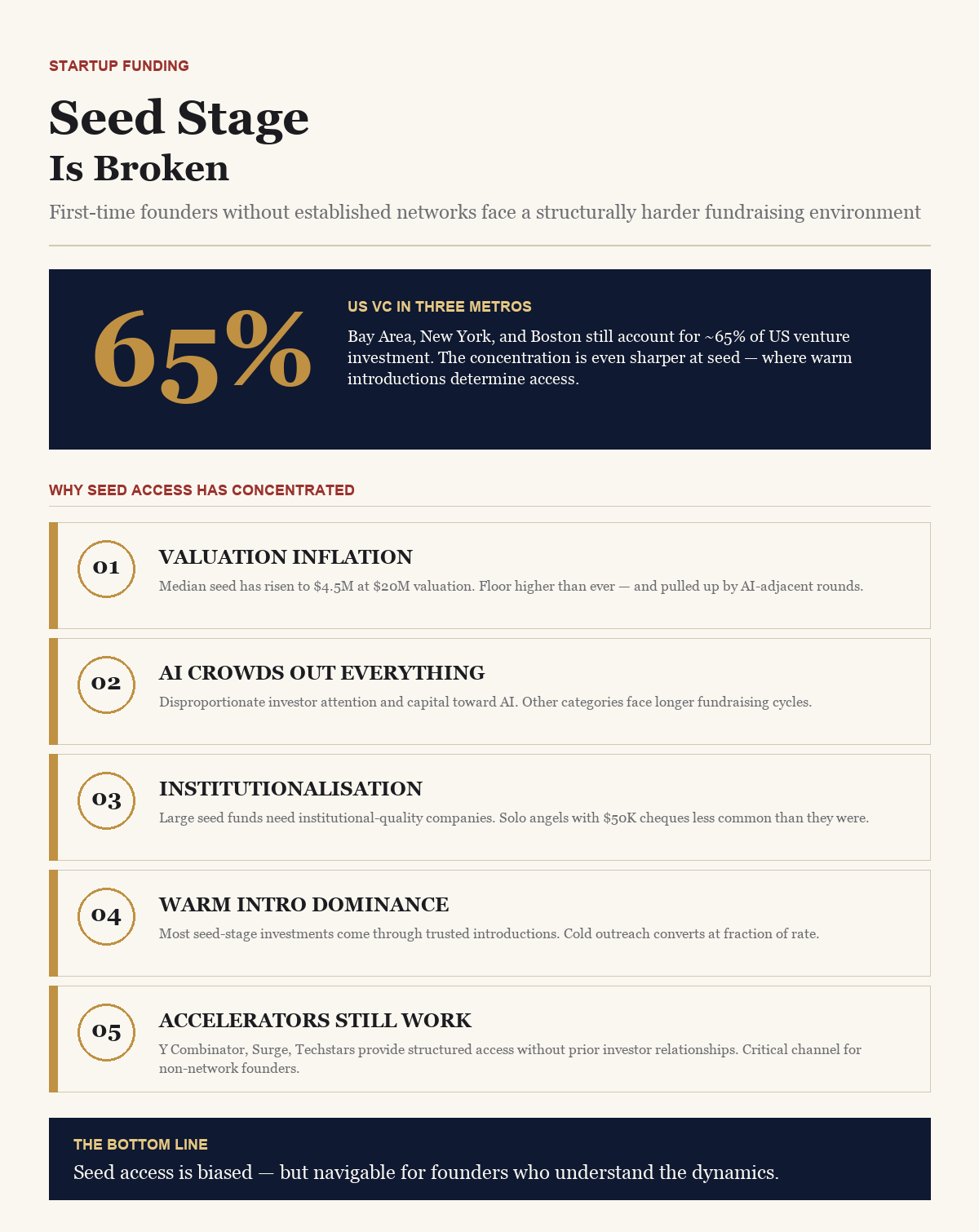
The shift in seed stage economics has several causes that are reinforcing rather than independent. The first is valuation inflation carried over from the 2021 cycle. Pre-money valuations at the seed stage reached extraordinary levels during 2020 and 2021, $20 million, $30 million, even $50 million for companies with minimal revenue, and while those peaks have moderated, the floor has risen. What was once the domain of $5 million pre-money valuations is now rarely achievable for companies with genuine traction in AI-adjacent categories.
The second cause is the concentration of seed-stage attention on AI. A disproportionate share of seed-stage investor attention and capital is flowing toward AI applications, AI infrastructure tooling, and AI-enabled services. Founders building in other sectors, consumer health, B2B logistics, climate technology, financial inclusion, report longer fundraising cycles and more investor skepticism than peers building AI-native companies with comparable traction. The AI theme commands a valuation premium that creates a two-tier seed market within the same dollar denomination of round.
The third cause is the institutionalisation of seed stage investing itself. The rise of large seed funds, $200-500 million vehicles deploying at the seed stage, has changed the dynamics of seed rounds. Institutional seed funds have portfolio management requirements, board seat expectations, and return benchmarks that push them toward fewer, larger bets on companies with clear institutional-quality characteristics: technical founders from top universities, large addressable markets, and evidence of prior venture backing or accelerator participation. The solo angel writing $50,000 cheques into rough-edged early-stage companies is still present but represents a shrinking fraction of available seed capital.
The Geography Problem
Venture capital remains one of the most geographically concentrated industries in the world. Despite a decade of predictions that remote work and digital communication would democratise venture geography, the 2025 data from PitchBook shows that San Francisco Bay Area, New York, and Boston still account for approximately 65% of all US venture investment by value. The concentration is even more pronounced at the earliest stages, where investor relationships and in-person trust-building matter most and where the warm introduction network is most determinative of access.
For a founder in Hyderabad, Lagos, Warsaw, or even Chicago, the structural disadvantage is not merely distance, it is the absence of the social infrastructure through which early-stage venture investment actually flows. Most seed-stage investments are made through warm introductions from trusted sources: a portfolio founder, a co-investor, a university network connection. Cold outreach to venture funds, while occasionally successful, converts at rates that are a fraction of warm introductions. A founder without access to warm introduction networks faces a fundamentally different fundraising experience than one embedded in them.
India’s startup ecosystem illustrates both the progress and the persistent gap. Bengaluru, Hyderabad, and Mumbai have developed genuine venture ecosystems with domestic seed funds, angel networks, and accelerator programmes. The top tier of Indian startups, those with strong founder credentials, international market ambitions, and early revenue, can access international venture capital on competitive terms. But for the broader mass of Indian seed-stage founders, the seed capital available domestically is smaller in volume and more conservative in risk appetite than US counterparts, and access to US capital requires network connections that most founders outside the IIT/IIM elite do not have (see our analysis in The $300B VC Quarter).
What Is Still Working
Despite the structural challenges, some channels for first-time founders without established networks remain genuinely functional. Accelerator programmes, Y Combinator pre-eminently, but also Techstars, South Asia-focused programmes including Surge (Sequoia India) and CRED Garage, and sector-specific accelerators, provide structured access to seed capital that does not require prior investor relationships. Y Combinator in particular has maintained a commitment to backing first-time founders from non-traditional backgrounds and geographies; its acceptance decisions are based on founder quality and idea merit, and its post-batch funding environment is the most reliable conversion mechanism from accelerator acceptance to seed capital anywhere in the world (see our analysis in The Solopreneur Economy).
Revenue-based financing and alternative capital providers have expanded the options available to founders who want to build on their own terms without the valuation and control implications of traditional venture. Clearco, Capchase, and a growing number of regional alternatives provide growth capital to businesses with demonstrable revenue without requiring equity dilution or investor board seats. For businesses with a clear revenue model and capital needs that are primarily for growth rather than R&D, revenue-based financing may be a better structural fit than equity venture capital.
Bootstrapping to meaningful revenue before seeking institutional capital has re-emerged as a legitimate strategy, not a consolation prize, but a genuine competitive advantage in the current environment. A founder who reaches $1-2 million in annual recurring revenue before approaching venture investors has demonstrated product-market fit, retained control of the equity table, and can negotiate from a position of strength rather than dependence. The capital efficiency discipline that bootstrapping enforces often produces better outcomes than premature scale funded by early venture capital.
The Systemic Cost of a Broken Seed Stage
The inaccessibility of seed capital for founders outside established networks is not merely an equity or fairness problem, it is an economic inefficiency that reduces the total value creation from the startup ecosystem. The assumption underlying venture capital’s social legitimacy is that capital flows to the best opportunities regardless of who presents them. When capital flows preferentially to the most well-connected presenters of opportunities, the industry captures a smaller fraction of the available opportunity set.
The empirical evidence supports this concern. Research by Stanford economist Ilya Strebulaev found that the most successful venture-backed companies of the past two decades disproportionately came from backgrounds and geographies that were underrepresented in venture portfolios at the time of their founding. The missed investments, the founders who did not get meetings, the pitches that were passed on because the introduction was not warm enough, represent value that the venture industry failed to capture.
The Path Forward for Founders
For first-time founders navigating the current seed environment, the practical guidance is to be strategic about sequencing. Build to revenue before seeking institutional capital wherever the business model allows. Use accelerator programmes as a network entry point if the fit is right. Seek out investors, domestic angel networks, diaspora investor communities, sector-specific funds, who have specific domain expertise and deal flow advantages in your geography or vertical, rather than approaching generalist funds who have no particular reason to prioritise your application.
Build the network proactively and specifically. Investor relationships that enable warm introductions are built through founder communities, shared investor events, and genuine engagement with investors’ published thinking, not through mass outreach campaigns. The founders who successfully raise seed capital from a standing start typically do so by identifying two or three specific investors whose thesis matches their company closely, building a genuine relationship over three to six months, and converting that relationship into a lead investment that enables the rest of the round.
The seed stage is not irreparably broken, it is structurally biased in ways that can be navigated by founders who understand the dynamics. The founders who navigate it most successfully are those who work with the incentive structure of the investor community rather than against it, while maintaining the discipline to build real value that makes investor interest a question of when rather than whether.
