


In the spring of 2026, Taiwan Semiconductor Manufacturing Company reported quarterly revenue of $25.8 billion, a record, driven by insatiable demand for the advanced chips that power artificial intelligence infrastructure. TSMC‘s 3-nanometre and 2-nanometre processes, available nowhere else on earth at commercial scale, are the substrate on which the AI economy is being built. Nvidia‘s H100 and H200 GPUs. Apple’s A-series and M-series chips. Qualcomm’s Snapdragon processors. AMD’s EPYC server chips. Every one of these products, and hundreds more that run the global digital economy, is manufactured in Taiwan.
The concentration of advanced semiconductor manufacturing in a single island nation that faces a specific, documented military threat from its neighbour is not a risk that business analysts invented. It is a risk that TSMC’s own leadership, the US Department of Defense, the European Commission, and the governments of Japan, South Korea, and Australia have all characterised as a systemic vulnerability requiring urgent diversification. Understanding that vulnerability, its dimensions, its timeline, and its implications for businesses that may not think of themselves as semiconductor companies, is now a basic requirement of strategic planning.
The Concentration That Creates the Risk
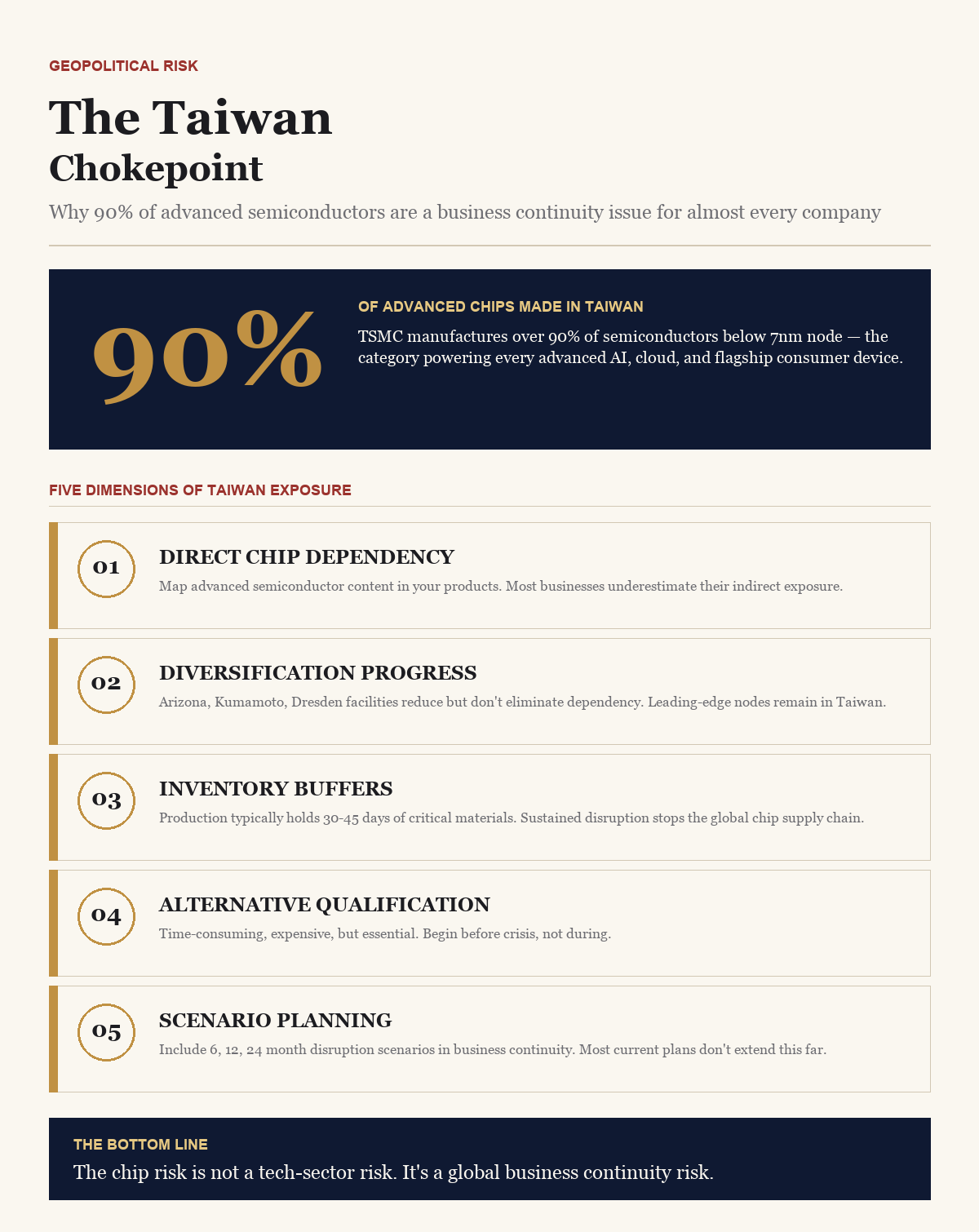
TSMC manufactures approximately 54% of all semiconductors globally by revenue and over 90% of the chips below 7 nanometres in node size, the category that includes every chip powering advanced AI, cloud computing, and flagship consumer electronics. The next most advanced foundry is Samsung in South Korea, which manufactures at comparable nodes but at roughly one-third of TSMC’s capacity and with a lower yield rate on the most advanced processes. Intel is rebuilding its foundry capability in the United States and Europe but will not reach competitive volumes at leading-edge nodes before 2027 at the earliest.
The geographic concentration goes beyond TSMC. Taiwan’s broader semiconductor ecosystem, including Mediatek for chip design, ASE Group for advanced packaging, and hundreds of specialised component and materials suppliers, represents decades of accumulated expertise and infrastructure that cannot be replicated quickly. The Hsinchu Science Park, where many of these companies operate, is the most valuable three square kilometres of industrial land on earth by any reasonable measure of economic output. A disruption to that ecosystem, whether through military conflict, natural disaster, or sustained blockade, would not merely inconvenience technology supply chains. It would halt them.
What a Taiwan Contingency Actually Looks Like
Scenario planning for Taiwan contingencies exists across a spectrum from most likely to most severe. At the less severe end, periodic Chinese military exercises, which have become more frequent and more provocative since 2022, including missile launches over Taiwan and repeated incursions into Taiwan’s Air Defence Identification Zone, create periods of elevated tension that affect shipping insurance premiums, freight rates, and investor risk pricing without directly disrupting production.
A naval blockade, China’s declared intention, according to multiple military planning documents, would be economically catastrophic without involving direct combat. Taiwan’s semiconductor fabrication facilities require continuous delivery of ultra-pure chemicals, gases, and materials that are consumed in the manufacturing process. A blockade that prevented those supply deliveries would halt fab operations within weeks. TSMC facilities hold approximately 30-45 days of critical materials inventory under normal operating conditions. A blockade that persisted beyond that window would stop production of every advanced chip currently in the pipeline.
Military conflict involving damage to fabrication facilities represents the tail risk that no scenario plan can adequately address. Semiconductor fabrication equipment, the extreme ultraviolet lithography machines manufactured exclusively by ASML in the Netherlands, the deposition and etching systems manufactured by Applied Materials and Lam Research in the United States, takes two to three years to manufacture and install. A fabrication facility that sustains significant damage cannot be rebuilt in months. The global economy’s dependence on Taiwan’s fabrication capacity means that severe physical disruption would produce a technology supply shock without historical precedent in the modern era.
Diversification: What Is Actually Being Built
The semiconductor industry and the governments that depend on it have been investing in diversification since 2022, when the passage of the US CHIPS and Science Act committed $52 billion to domestic semiconductor manufacturing. TSMC has responded to government pressure and customer demand by building fabrication facilities outside Taiwan for the first time in its history: a $65 billion investment programme in Arizona, a facility in Japan (Kumamoto), and a facility in Germany (Dresden) in partnership with partners including Sony, Bosch, and Infineon.
These investments are real and significant. TSMC’s Arizona facility is producing chips at the 4-nanometre node, advanced by most standards, though not at the 2-nanometre leading edge that remains exclusively in Taiwan. The Japanese facility is producing mature-node chips critical for automotive and industrial applications. The German facility is focused on automotive semiconductors. Samsung is building advanced foundry capacity in Taylor, Texas. Intel’s Ohio and European investments, supported by the EU Chips Act’s €43 billion in funding commitments, are expanding the geographic distribution of semiconductor manufacturing.
The honest assessment of this diversification programme is that it reduces but does not eliminate Taiwan dependency. The Arizona facility, when fully operational, will produce chips that were manufactured exclusively in Taiwan two years ago, progress, but not a replacement for TSMC’s Taiwan capacity. The leading-edge nodes, the 2-nanometre and sub-2-nanometre processes that will power next-generation AI and computing, will remain concentrated in Taiwan for at least the next five years under any realistic scenario. The diversification being built today addresses yesterday’s concentration, while tomorrow’s concentration continues to develop (see our analysis in The Section 301 Salvo).
Implications for Non-Technology Businesses
The most important insight about Taiwan semiconductor risk for business leaders outside the technology sector is that it is not a technology sector problem. Modern manufacturing depends on semiconductors at every level of the value chain. Automotive companies, whose vehicles now contain $600-$800 of semiconductor content per unit on average, up from $150 in 2000, experienced this directly during the 2021-2022 chip shortage, when the loss of a few hundred million dollars of semiconductor supply idled factories producing tens of billions of dollars of finished vehicles (see our analysis in Supply Chain Sovereignty).
Medical device manufacturers, industrial automation companies, energy infrastructure operators, agricultural equipment producers, and consumer goods companies all have semiconductor dependencies that a Taiwan disruption would expose. The 2021-2022 shortage was a demand shock, COVID-driven demand spikes in electronics competing with automotive for limited fab capacity. A Taiwan geopolitical disruption would be a supply shock of far greater magnitude and duration.
The practical implication is that Taiwan risk assessment should be part of every company’s supply chain risk framework, not just technology companies’. The questions to ask: which components in our products contain advanced semiconductors manufactured in Taiwan? What is the inventory buffer we hold for those components? Are there alternative suppliers, and what qualification timelines do they require? What would a six-month, twelve-month, or twenty-four-month disruption to Taiwan semiconductor supply do to our production capacity?
What India’s Role Could Be
India has announced ambitious plans to develop domestic semiconductor manufacturing capability, supported by a $10 billion production-linked incentive scheme. The first concrete realisation of that ambition is the Tata Electronics semiconductor assembly and test facility in Dholera, Gujarat, which broke ground in 2024 and is expected to begin production in 2026. Separately, Micron Technology, the US memory chip manufacturer, is building an assembly and test facility in Sanand, Gujarat, with Indian government support.
These are meaningful first steps but they should be understood accurately: assembly, testing, and packaging of semiconductors, rather than front-end fabrication. The distinction matters because the geopolitical risk in Taiwan is concentrated in the fabrication step, the actual manufacture of the chip from silicon wafers using lithography and chemical deposition processes. Assembly and testing, while valuable, do not address the fabrication bottleneck. India does not currently have a front-end semiconductor fabrication facility, and building one requires not just capital but an ecosystem of materials suppliers, equipment specialists, and process engineers that takes many years to develop.
India’s semiconductor ambition is real and worth pursuing, but its contribution to resolving the Taiwan concentration risk is a decade away at the earliest, and only if the investment programme is sustained and expanded beyond its current scope.
Managing Exposure Now
For business leaders, the Taiwan Strait risk requires neither panic nor paralysis, it requires explicit, scenario-based risk management that is currently absent from most corporate planning processes. Three practical priorities stand out. First, map Taiwan-sourced semiconductor content in your supply chain with the same rigour applied to any other single-supplier dependency. Second, build relationships with semiconductor distributors and alternative suppliers before a shortage creates competition for limited inventory. Third, include a Taiwan disruption scenario in your business continuity planning, with specific triggers and responses defined in advance rather than improvised under pressure.
The Taiwan Strait is 180 kilometres wide, and what happens there affects virtually every business in the world that depends on electronics, automation, or digital infrastructure. That category, in 2026, includes almost every business of scale. The question is not whether this risk matters, it does, but whether it is being managed as explicitly as the business exposure warrants.
