



The narrative around environmental, social, and governance investing has been turbulent. After years of ascendancy in which ESG-themed funds attracted record inflows, the past three years have seen political backlash, regulatory rollback in some jurisdictions, and a wave of journalism questioning whether ESG claims were ever substantiated by performance. The retreat has been most visible in the United States, where ESG fund flows turned negative in 2024 and 2025, and where state legislatures in Texas, Florida, and other states have actively penalised asset managers that integrate climate considerations into investment decisions.
And yet, looking past the political noise to the underlying business and financial data, something more interesting is happening. Companies that have integrated genuine sustainability into their operating models are, on average, outperforming their less sustainable peers across a range of measures that matter to investors. The premium is not in the marketing claims. It is in the operational reality of businesses that have built sustainability into how they procure, produce, finance, and serve customers. The companies that benefit are not necessarily the ones with the loudest ESG narratives; they are the ones that have done the harder work of operational transformation.
What the Performance Data Actually Shows
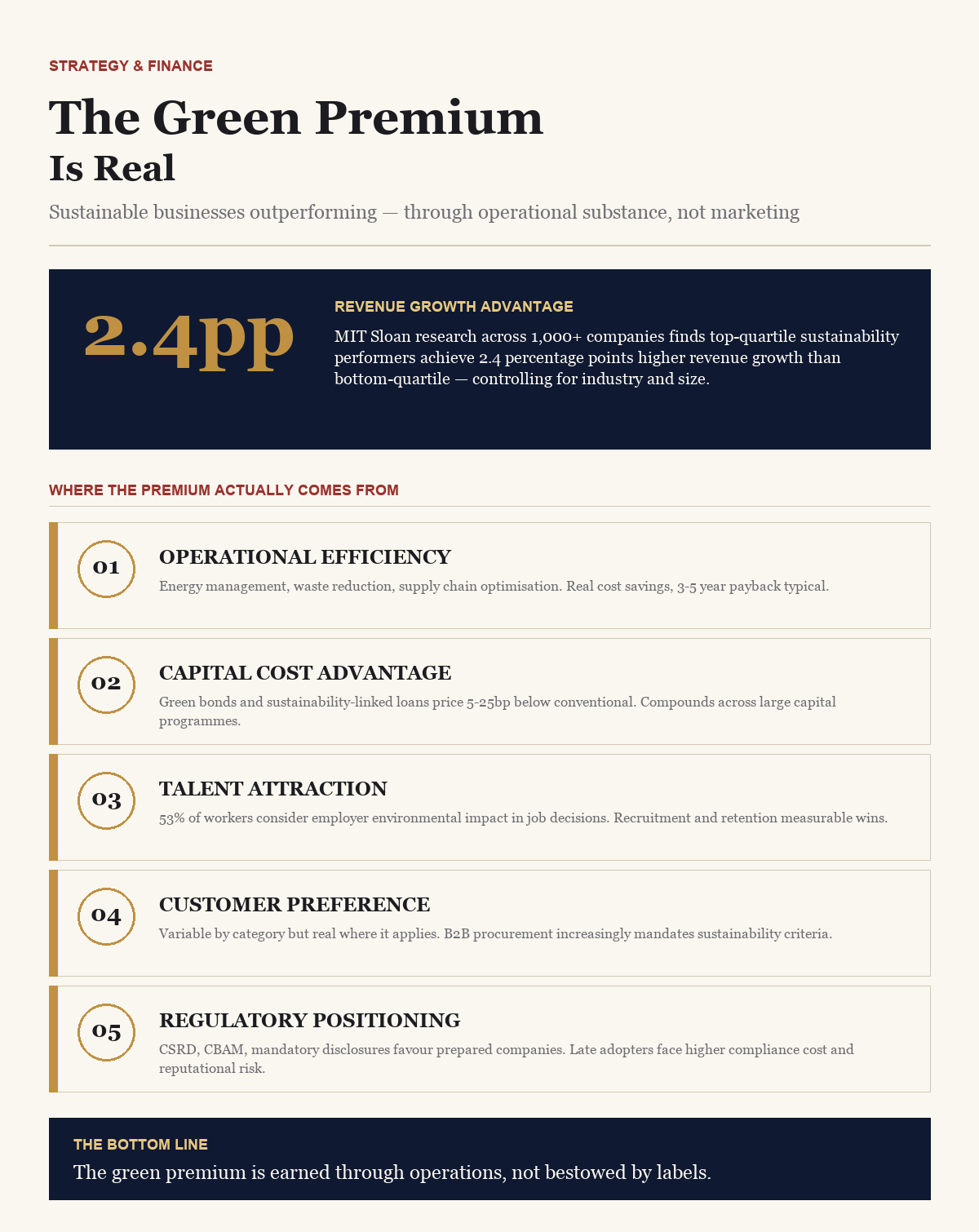
Disentangling the green premium from broader market dynamics requires careful analysis, but the consistent findings across multiple academic studies and proprietary research efforts paint a coherent picture. Research from the MIT Sloan Centre for Sustainable Business, analysing more than 1,000 large public companies from 2018 to 2025, found that companies in the top quartile of sustainability performance generated revenue growth approximately 2.4 percentage points higher than companies in the bottom quartile, after controlling for industry and size.
Margin performance shows a similar pattern. Companies with mature sustainability programmes report lower energy costs, reduced waste, and more efficient supply chains, operational improvements that translate into measurable margin expansion. McKinsey‘s 2025 sustainability report estimated that companies that systematically pursued operational sustainability initiatives captured cost reductions averaging 12 to 18 per cent in addressable categories, with payback periods of 3 to 5 years for most investments.
Capital cost advantages may be the most consequential dimension of the green premium for many businesses. Green bonds and sustainability-linked loans typically price 5 to 25 basis points below comparable conventional financing, depending on the issuer and the specific structure. For investment-grade corporates issuing in the green bond market, the cumulative savings on cost of capital can run into hundreds of millions of dollars over the life of large infrastructure investments.
Where the Premium Actually Comes From
The mechanisms producing the green premium are concrete and operationally identifiable, not abstract or ideological. Energy efficiency is the most consistent source of measurable value. Companies that have invested systematically in energy management, better building envelopes, more efficient industrial processes, on-site renewable generation, smarter facility operations, have reduced their energy costs significantly even as utility prices have risen. In energy-intensive industries such as chemicals, steel, and cement, the cost differential between best-in-class and average performers is now significant enough to affect competitive position.
Talent attraction is a less visible but increasingly important source of advantage. Surveys of professionals in their 20s and 30s consistently find that environmental and social considerations factor materially into job choice decisions for a substantial fraction of the talent pool. Companies with credible sustainability commitments are attracting better candidates, retaining them longer, and reducing recruitment costs in tight labour markets. Pwc‘s 2025 Global Workforce Hopes and Fears Survey found that 53 per cent of workers consider an employer’s environmental impact in their employment decisions.
Customer preference effects are more variable across categories but real where they apply. B2C categories with engaged consumers, consumer goods, automotive, fashion, hospitality, show measurable willingness to pay for sustainability attributes, though the size of the premium varies by category and the credibility of the claims. In B2B categories, the dynamic is shifting from consumer preference to procurement requirement: large enterprise customers increasingly include sustainability criteria in their supplier selection processes, making sustainability a market access requirement rather than a marketing advantage (see our analysis in Food & Agriculture Tech).
The Categories Where the Premium Is Largest
The green premium is not uniformly distributed. Some sectors and categories show much larger differentiation than others, and understanding where the premium concentrates is important for strategic decisions. Renewable energy and clean technology businesses naturally show the largest premiums, but the underlying dynamics extend well beyond pure-play green sectors. Real estate is one of the clearest cases, energy-efficient and green-certified buildings command rent premiums of 5 to 15 per cent across major markets, with sale price premiums that are typically larger still. The structural reason is straightforward: green buildings have lower operating costs and increasingly favourable financing terms, making them more valuable to both operators and owners (see our analysis in Greenwashing Crackdowns).
Consumer goods companies that have built genuine sustainability into their operations report material premium pricing power. Patagonia, the apparel brand, has built a business model around environmental commitment that justifies pricing significantly above mainstream competitors. Beyond Meat and Impossible Foods have, despite recent challenges, demonstrated that plant-based alternatives can capture premium positions in markets that conventional food companies thought were settled. The lesson is not that sustainability automatically supports premium pricing, many sustainability-positioned products have failed commercially, but that genuinely differentiated sustainability claims, anchored in operational reality and aligned with customer preferences, can support pricing power that pure cost reduction cannot (see our analysis in ESG Investing).
Industrial companies serving large enterprise customers face the most consistent procurement-driven premium. Companies that supply automotive manufacturers, electronics OEMs, or large consumer brands must increasingly meet sustainability requirements as a condition of supplier qualification. The shift from voluntary to mandatory sustainability reporting in the EU and UK, with similar requirements emerging in other jurisdictions, has accelerated this trend by giving customers measurable metrics they can apply to supplier selection.
Where the Premium Disappears
It is equally important to understand where the green premium does not exist or has reversed. Companies that have invested in sustainability initiatives that lack operational integration have generally not seen returns commensurate with their spending. The pattern is most visible in companies that have built large sustainability and communications functions while leaving core operational decisions largely unchanged, what critics call greenwashing, and what often produces real expenditure without corresponding business returns.
Hydrogen-focused energy companies, certain electric vehicle startups, and ESG-themed financial products with high management fees but limited differentiation have all underperformed the underlying market in recent years. The signal is that the green premium is earned, not bestowed by association. Investors and customers increasingly distinguish between substantive sustainability and superficial sustainability, and the financial returns reward the former.
Regulatory Tailwinds That Persist
Even as US political opposition to ESG has intensified, the regulatory infrastructure supporting sustainability disclosure and performance continues to expand globally. The EU’s Corporate Sustainability Reporting Directive, fully effective from 2025, requires detailed sustainability reporting from approximately 50,000 companies, including large non-EU companies with significant European operations. The UK’s similar Sustainability Disclosure Standards, India’s Business Responsibility and Sustainability Reporting framework, and Japan’s mandatory climate-related disclosures have created a global regulatory architecture that makes sustainability performance increasingly transparent and comparable.
Carbon pricing is expanding, even where it remains politically contested. The EU’s Carbon Border Adjustment Mechanism, fully effective in 2026, applies effective carbon costs to imports of cement, iron and steel, aluminium, fertilisers, electricity, and hydrogen, creating a real cost advantage for low-emission producers exporting to EU markets. China’s national emissions trading scheme covers approximately 40 per cent of national emissions and is gradually expanding to additional sectors. The cumulative effect is that the cost of carbon-intensive production is rising in markets that collectively represent the majority of global trade.
Building Operational Sustainability That Creates Value
For executives seeking to capture the green premium for their own businesses, the practical priorities are clear. The starting point is energy and resource efficiency in core operations, these initiatives typically deliver measurable financial returns alongside emissions reductions and are the foundation on which more ambitious sustainability strategies are built. Supply chain transparency and lower-emission alternatives in priority categories deliver both cost benefits and risk reduction. Product design that incorporates sustainability principles, recyclability, lower material intensity, longer lifespans, can be a meaningful source of differentiation in categories where customers are receptive.
The risk discipline matters as much as the opportunity capture. Climate risk assessment, physical and transition risk modelling, and integration of these risks into financial planning are now expected of large companies and are migrating to the mid-market. Companies that ignore physical climate risks to facilities and supply chains, or transition risks to high-carbon products and markets, face capital cost penalties and strategic vulnerabilities that the market increasingly prices.
The green premium is real, measurable, and earned through operational substance rather than communications strategy. The companies capturing it are building sustainable businesses because sustainability is producing competitive advantage, not because of regulatory mandate, investor pressure, or ideological commitment. That is the most durable foundation on which the next decade of business value creation will be built.
