



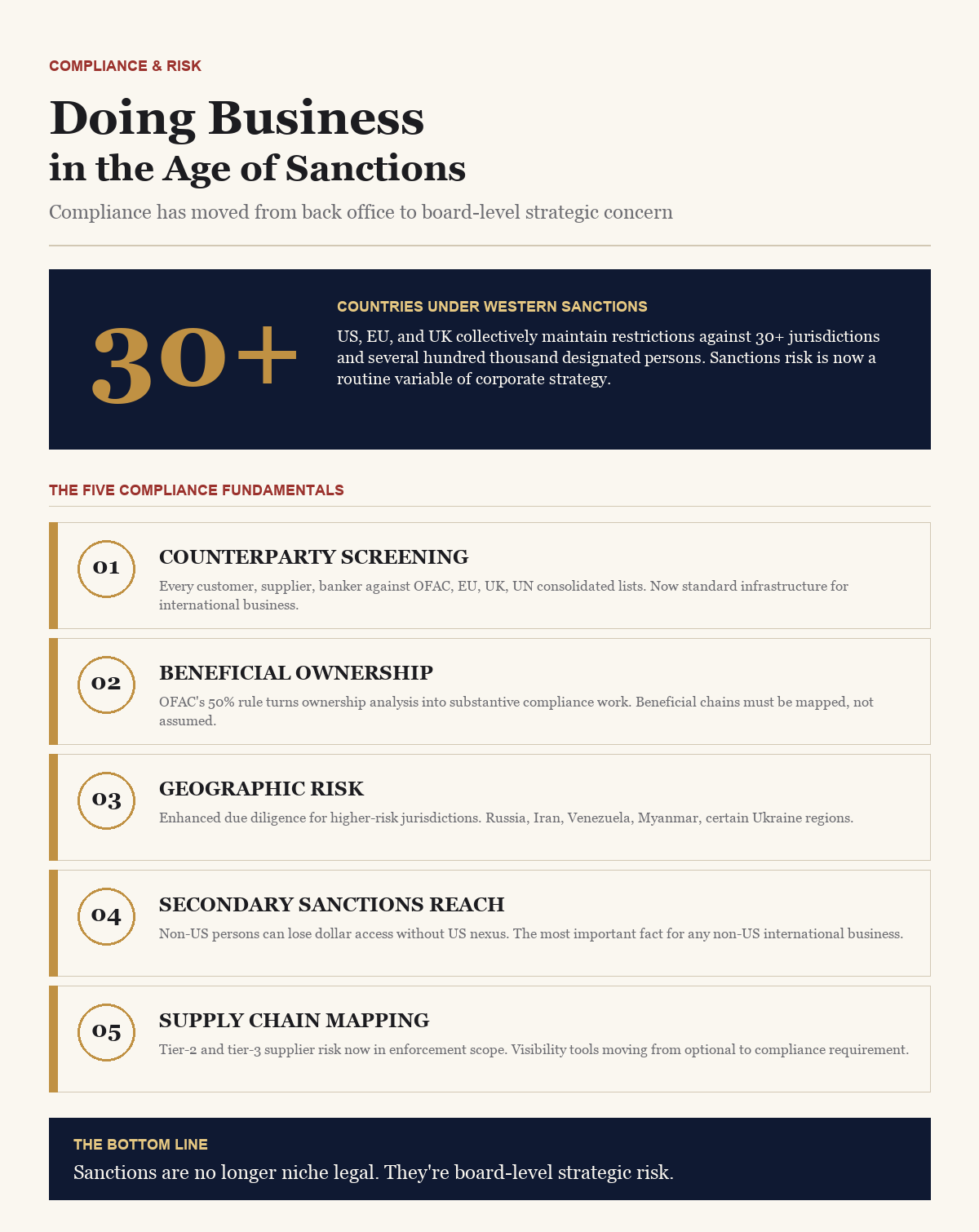
There was a time, not very long ago, when sanctions compliance was the kind of issue that a multinational’s general counsel managed quietly in the background. A handful of countries, Iran, North Korea, Cuba, were on the restricted list, the rules were stable, and most businesses outside the energy and defence sectors could conduct their affairs without giving sanctions much thought. That world has ended. In 2026, the major sanctioning powers, the United States Office of Foreign Assets Control, the European Union, the United Kingdom’s Office of Financial Sanctions Implementation, collectively maintain restrictions against more than 30 jurisdictions and several hundred thousand designated persons and entities. The volume and complexity of these regimes have made sanctions risk a routine part of corporate strategy rather than an edge case.
The shift has been driven by geopolitics, not regulatory ambition. Russia’s invasion of Ukraine produced the most extensive sanctions package ever assembled against a major economy. Sanctions on Iran have tightened repeatedly as nuclear negotiations have stalled. Secondary sanctions targeting Chinese financial institutions for facilitating sanctioned trade have placed previously routine transactions under scrutiny. The result, for any business with international operations or aspirations, is a compliance environment that demands explicit management attention rather than passive monitoring.
The Scope of the Modern Sanctions Landscape
Sanctions today operate across multiple overlapping dimensions. Comprehensive sanctions prohibit virtually all dealings with a country, these apply to North Korea, Iran in significant ways, Syria, and parts of Russia following 2022. Targeted sanctions restrict dealings with specific individuals, entities, and sectors, these apply much more broadly, including against Chinese technology companies, Russian energy firms, and Venezuelan officials. Sectoral sanctions limit specific activities such as financing or technology transfer to designated entities, without imposing a full prohibition.
Secondary sanctions extend the reach of US restrictions to non-US persons and entities. A European bank financing a sanctioned Iranian oil shipment, or an Indian technology company supplying restricted goods to a designated Russian defence firm, can be cut off from the US financial system without ever having a US office or US persons involved in the transaction. The extraterritorial reach of US sanctions is the single most important fact for any non-US business to understand: the absence of a US nexus is not a defence against US enforcement.
Building a Sanctions Compliance Programme That Actually Works
Effective sanctions compliance starts with knowing your counterparties, every customer, every supplier, every banking partner, every shipping route. Screening systems that check these counterparties against the consolidated lists maintained by OFAC, the EU, the UK, and the United Nations are now standard infrastructure for international businesses. The real differentiation lies in the rigour with which screening hits are investigated and resolved, and in the depth of due diligence applied to higher-risk relationships.
Beneficial ownership analysis is where most compliance programmes fall short. A counterparty that appears unrestricted on its face may be owned or controlled by sanctioned persons through a chain of holding companies that requires effort to unravel. OFAC’s 50 percent rule, which treats any entity owned 50 percent or more by sanctioned persons as itself sanctioned, turns ownership analysis from a paperwork exercise into a substantive compliance requirement. Sophisticated compliance teams use specialised data services to map beneficial ownership chains, but the technology is only as good as the analysts who interpret the output.
Geographic risk assessment overlays counterparty screening with country-level analysis. Operations or supply chain involvement in higher-risk jurisdictions, the Russian Federation, Belarus, Iran, Venezuela, Myanmar, certain regions of Ukraine, require enhanced due diligence procedures that are typically more rigorous than what is applied to routine commercial transactions. The cost of this enhanced diligence is real, and businesses operating internationally must build it into their pricing and operating models.
Industry-Specific Sanctions Pressures
Different sectors face different sanctions risk profiles, and the compliance approach should reflect those differences. Financial services firms bear the highest compliance burden, in part because they sit at the centre of the international payment system and in part because regulators view banks as the first line of sanctions enforcement. Banking compliance programmes typically deploy substantial dedicated resources to sanctions screening, transaction monitoring, and beneficial ownership analysis, often costing $50-100 million annually for a large international institution.
Technology and telecommunications companies face specific risks around export controls and dual-use items. Advanced semiconductors, encryption technologies, and certain software products require export licences in most major jurisdictions, and the licensing regimes have tightened significantly since 2022. The US Bureau of Industry and Security’s expanded controls on advanced computing technology have effectively prohibited the export of leading-edge AI chips to China, creating both compliance complexity and strategic uncertainty for technology firms with significant Chinese revenue (see our analysis in Supply Chain Sovereignty).
Energy companies operate at the intersection of geopolitics and sanctions in ways that few other sectors do. Oil sanctions on Russia, Iran, and Venezuela have created a parallel grey market in oil trading that mainstream international oil companies cannot touch without facing severe penalties. The price cap mechanism applied to Russian oil since 2022 has added a unique compliance dimension that requires verification of price levels through the maritime supply chain (see our analysis in The Section 301 Salvo).
The Specific Challenges for Indian Businesses
Indian businesses face a particular set of sanctions challenges that arise from India’s foreign policy independence and from its commercial relationships with countries that are extensively sanctioned by Western governments. India’s continued purchase of Russian oil, its trade relationships with Iran in non-sanctioned categories, and its energy and defence relationships with countries on Western sanctions lists create persistent compliance pressure for Indian companies with international operations (see our analysis in China+1 Supply Chain).
The Indian government has navigated this terrain by maintaining trade and diplomatic relationships that the West regards as suboptimal but tolerable, while encouraging Indian companies to manage their own sanctions risk in their international dealings. This produces a two-track environment in which government-to-government engagement can continue with sanctioned countries while individual Indian companies bear primary responsibility for ensuring their commercial relationships do not trigger Western enforcement actions.
For Indian companies seeking to expand internationally, particularly into US and European markets, the practical implication is that sanctions compliance must be embedded in international business strategy from the outset. Acquisitions of foreign companies, partnerships with Western firms, listings on Western stock exchanges, and access to dollar financing all require demonstrable sanctions compliance frameworks that meet international standards.
Sanctions and Supply Chain Strategy
Sanctions risk now shapes supply chain decisions in ways that pure cost optimisation never required. The relocation of production from Russia and Belarus following 2022 sanctions was the most visible example, but similar dynamics apply across multiple geographies. Chinese suppliers in the technology sector face increasing exposure to US technology controls; Iranian and Venezuelan inputs in chemicals and energy require careful tracking; suppliers in countries that maintain commercial relationships with sanctioned regimes may themselves face designation risk.
The supply chain mapping required for effective sanctions compliance goes beyond what most procurement organisations have historically performed. Tier-1 supplier screening is now routine, but tier-2 and tier-3 supplier risk, the suppliers of your suppliers, has become a focus for enforcement authorities and a real source of compliance vulnerability. Investing in supply chain visibility tools that can trace components and materials through multiple tiers is increasingly a compliance requirement, not just an operational improvement.
Building Resilience Into Geopolitical Risk Management
Sanctions are one component of a broader geopolitical risk environment that includes export controls, anti-corruption regimes, anti-money laundering requirements, and broader trade restrictions. The companies that manage these risks most effectively treat them as a single integrated category rather than as separate compliance silos. Geopolitical risk committees at the board level, scenario planning that includes sanctions evolution, and clear escalation procedures when compliance issues emerge, these are now the markers of sophisticated international business operation.
The practical question for any business with international operations is whether the compliance investment is commensurate with the actual risk exposure. Under-investment exposes the business to enforcement actions that can range from fines into the billions to forced divestiture of business lines. Over-investment ties up resources that could be deployed against revenue-generating activities. Calibrating that balance requires explicit risk assessment that should be revisited at least annually, given how rapidly the sanctions landscape evolves.
The era of treating sanctions as a niche legal issue is over. For any business of meaningful international scale, sanctions compliance has joined data protection, anti-bribery, and competition law as a board-level governance topic. Companies that build that capability deliberately, through investment in systems, expertise, and operational integration, are better positioned to navigate the geopolitical disruption that is now a permanent feature of international commerce.
