



For most of the past several decades, Africa has been characterised in international business discourse primarily as a frontier market, a category of investment destinations characterised by potential exceeding current reality, structural challenges that defer the realisation of that potential, and consequently a tendency to be addressed by international businesses through limited and tactical engagement rather than serious strategic positioning. That characterisation no longer fits the continent’s actual trajectory. Africa’s economic, demographic, and technological development has accelerated meaningfully in recent years, and the business opportunity is both larger and more concrete than the frontier market framing has suggested.
The continent’s 1.4 billion people represent the second-largest population grouping after India. The economic activity of major African economies, Nigeria, Egypt, South Africa, Kenya, Ethiopia, Morocco, Ghana, collectively exceeds $2.5 trillion in GDP. The growth rates across major African economies have averaged 4 to 6 per cent annually over the past decade, exceeding global averages and producing the kind of expansion that creates new customer bases, new market opportunities, and new competitive dynamics. The combination of growing population, expanding middle class, and accelerating technology adoption is producing market conditions that are increasingly difficult for global businesses to ignore.
The Demographic Reality
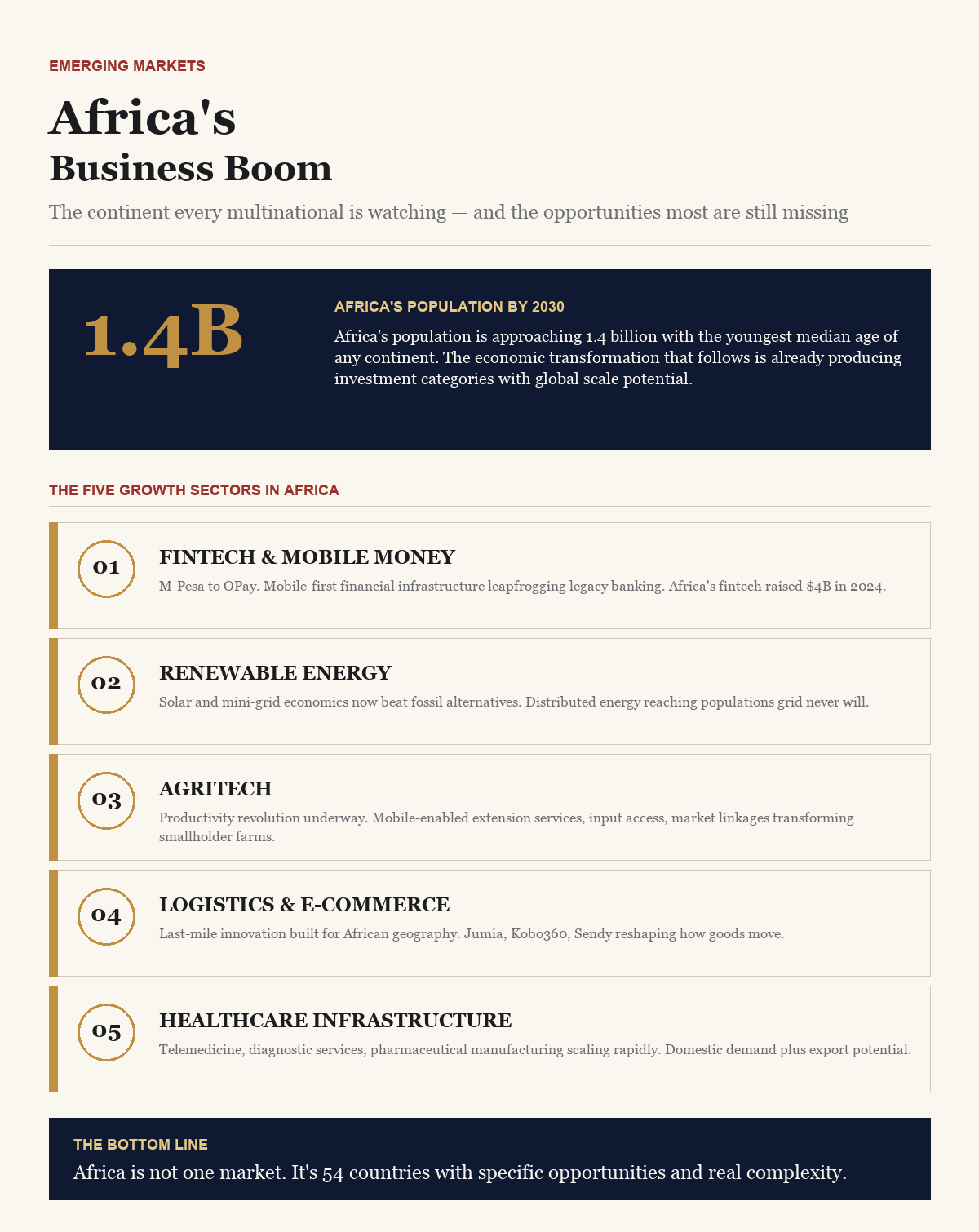
The demographic trajectory of Africa is the most important single factor shaping its business future. The continent’s population is projected to grow from approximately 1.4 billion in 2026 to approximately 2.5 billion by 2050, with most of this growth concentrated in working-age populations. Africa will have more people under the age of 25 than any other region of the world for the foreseeable future. The economic implications are substantial: a growing labour force, expanding consumer base, and the demographic conditions that have historically supported sustained economic development.
The demographic dividend is conditional on educational and infrastructure development that translates population growth into productive economic activity. The track record across African countries varies substantially. Kenya, Rwanda, Ghana, and Morocco have produced infrastructure and educational outcomes that support productive employment of growing populations. Other countries have struggled to keep pace with population growth, producing the underemployment and migration pressures that have characterised parts of the continent’s recent history. The variability across the continent means that ‘Africa’ as a single business market is rarely the right framing; specific country selection and market entry strategies matter substantially.
Urbanisation is accelerating across the continent. Africa’s urban population is expected to grow from approximately 600 million currently to over 1.5 billion by 2050, with major cities including Lagos, Cairo, Johannesburg, Nairobi, and Casablanca developing into metropolitan areas with consumer bases that justify significant commercial investment. The urbanisation trend has substantial implications for retail, consumer goods, real estate, infrastructure, and the broader set of industries that scale with urban population growth.
The Technology Leapfrog
Africa’s technology adoption has produced some of the most consequential financial and digital innovation of the past two decades. M-Pesa, the mobile money platform launched by Safaricom in Kenya in 2007, demonstrated that mobile money could provide financial services to populations that traditional banking had not effectively served. The platform’s success in Kenya, with active user populations representing the majority of the Kenyan adult population at peak, has been replicated across multiple African markets, with mobile money penetration in some countries exceeding traditional banking penetration by substantial margins.
The mobile money infrastructure has supported development of broader fintech ecosystems across African markets. Companies including Flutterwave, Chipper Cash, Paystack (acquired by Stripe), Branch, and Cellulant have built financial services businesses that serve consumers and small businesses across multiple African countries. The investment flowing into African fintech has been substantial, peaking in 2022 before moderating but remaining at meaningful levels through subsequent years. The technology and business model innovation emerging from African fintech is now being studied for application in other emerging markets and increasingly in developed markets.
E-commerce development across the continent has been more variable than fintech. Jumia, the most prominent pan-African e-commerce company, has experienced operational challenges that reflect the genuine difficulty of building consumer e-commerce at scale across diverse African markets. Logistics infrastructure, payment infrastructure (now substantially improved through fintech development), and customer acquisition cost economics have all created friction. But several country-specific e-commerce successes, Jumia and Konga in Nigeria, Takealot in South Africa, Souq.com in Egypt before its acquisition by Amazon, have established meaningful e-commerce activity in the largest African markets.
Sectoral Opportunities Across the Continent
The economic sectors that are most attractive for international investment vary substantially across African countries, reflecting different resource endowments, infrastructure development, and policy environments. Natural resources continue to be a significant component of several African economies, oil and gas in Nigeria, Angola, Algeria, and others; minerals in the Democratic Republic of Congo, South Africa, and across the continent; agricultural products across multiple economies. The resource sectors have provided the export earnings that have supported broader economic development, though they have also created exposure to commodity price volatility.
Consumer goods and services represent a growing opportunity as middle-class populations expand. African consumer markets are projected to exceed $2.5 trillion in spending by 2030, with concentrated growth in food and beverages, household goods, telecommunications, and personal care categories. International consumer goods companies including Unilever, Procter & Gamble, Nestle, and Coca-Cola have substantial African operations that have been growing consistently. African consumer brands including Dangote (cement and consumer goods), MTN (telecommunications), Shoprite (retail), and increasingly fintech-related consumer brands have built significant businesses serving these growing markets.
Healthcare presents both substantial opportunity and significant operational complexity. African healthcare spending is projected to grow rapidly as economies develop, but the existing infrastructure varies widely across markets and the policy environments differ substantially. Pharmaceutical companies, medical device manufacturers, and healthcare services providers face complex market entry decisions that depend heavily on specific country selection. The presence of major Western pharmaceutical companies has grown over recent years, but penetration of advanced healthcare technologies remains modest by global standards (see our analysis in Middle East Economic Diversification).
Renewable energy is a particularly attractive opportunity given Africa’s solar resource availability and the need for electricity infrastructure expansion across the continent. The combination of declining renewable energy costs and the gap between current electricity availability and population needs has supported substantial investment in solar projects, off-grid electrification, and increasingly utility-scale renewable energy development. African renewable energy development is becoming a significant component of the global energy transition and a substantial commercial opportunity (see our analysis in India’s Manufacturing Moment).
The Geopolitical Competition for African Markets
Geopolitical competition for influence and commercial position in Africa has intensified substantially. China’s engagement with African economies, supported by Belt and Road Initiative investments and substantial trade flows, has been the most prominent factor. Chinese investment in African infrastructure, roads, ports, railways, electricity generation, has been substantial and visible across the continent. Chinese companies have built significant commercial positions across multiple African sectors, often with state support and patient capital deployment that Western competitors have not matched (see our analysis in $5 Trillion Logistics Industry).
Western powers have responded with various engagement strategies. The US Africa Strategy, the EU’s Global Gateway Initiative, and the G7 Partnership for Global Infrastructure and Investment all represent attempts to provide alternatives to Chinese engagement. The actual scale of Western commitment has often fallen short of announcements, but the strategic recognition that Africa matters in geopolitical and commercial terms has been more consistent across recent administrations than in earlier periods.
India’s engagement with Africa has historical depth, through migration, trade, and political relationships, and has been growing in recent years. Indian companies have built significant African operations across sectors including pharmaceuticals, automotive components, telecommunications equipment, and information technology services. The Indian diaspora in eastern and southern Africa has historically played important commercial roles, and direct Indian government engagement has expanded through development assistance, training programmes, and diplomatic initiatives.
The Specific Markets That Matter Most
For international businesses considering African market engagement, the country selection question is more important than the general question of whether to engage with Africa. The largest African economies, Nigeria, Egypt, South Africa, provide market scale that justifies focused commercial investment. The high-growth and reform-positive economies, Kenya, Rwanda, Ghana, Ethiopia, Morocco, Cote d’Ivoire, provide opportunities for engagement that may compound rapidly over the next decade. The resource-rich economies, Angola, DRC, Zambia, Algeria, provide opportunities tied to specific resource sectors.
Each market has specific operational considerations that affect business strategy. Regulatory environments vary substantially. Currency controls and macroeconomic stability differ across markets. Talent availability and labour costs vary widely. Infrastructure quality affects supply chain economics in significant ways. The companies that have built successful African businesses have generally done so through deep engagement with specific markets rather than through pan-African strategies that have averaged across these differences.
The Operating Environment
The operating environment for international business in Africa has improved in many respects over the past two decades, though challenges remain substantial in specific markets. Regulatory transparency has improved across major African economies, supported by various reform initiatives and increased emphasis on rule of law in commercial transactions. Anti-corruption efforts have produced uneven but real progress in several major markets. Macroeconomic management has generally been more stable in the major African economies, though specific currency crises and inflation episodes continue to affect particular markets.
The infrastructure environment for cross-border commerce has improved significantly through the African Continental Free Trade Area, which entered force in 2021. The treaty creates a framework for reducing trade barriers among African countries that has historically been a significant constraint on intra-African commerce. Implementation has been gradual, but the trajectory toward more integrated African markets is meaningful for businesses considering operations across multiple African countries.
What This Means for Business Leaders
For business leaders evaluating African opportunities, several principles emerge from the experience of companies that have built successful African businesses. Patient capital and long-term commitment are important. African markets often require substantial investment over multiple years before producing the kind of returns that international companies have come to expect from emerging market expansion. Companies that have approached African markets with short-term ROI expectations have generally been disappointed; companies that have committed to building positions over decade-long timeframes have generally produced better results.
Local capability and local partnership are typically more important in African markets than the general principles of international business expansion suggest. Understanding specific country regulatory environments, building relationships with local commercial and political networks, and developing local management capability all require sustained effort. International companies that have attempted to operate African markets from regional or global headquarters without strong local capability have generally produced worse results than companies that have built genuine local operating capability.
Africa’s business future will be substantial, both as a market for international companies and as a producer of business innovation that will influence global commerce. The companies that engage seriously now, with the patience and local capability that genuine African market development requires, will be positioned for participation in one of the most consequential economic developments of the coming decades. The window for early positioning will not remain open indefinitely; as African markets mature and competitive intensity increases, the advantages of early engagement will compress.
