



Content marketing has matured from a novel tactic into a routine line item in most B2B and consumer marketing budgets. Total global content marketing spending exceeded $400 billion in 2025, with the majority concentrated in B2B sectors where content is a primary mechanism for thought leadership, lead generation, and customer education. The growth in spending has not been matched by growth in measurable returns. Multiple industry studies, from the Content Marketing Institute, HubSpot, and various marketing research firms, consistently find that fewer than 30 per cent of marketers believe their content marketing programmes are producing strong measurable returns, and the figure has declined modestly over recent years rather than improving with greater spending.
The disconnect between investment and outcomes reflects structural changes in how content is created, distributed, and consumed. Generative AI tools have made it possible for any business to produce volumes of content that were previously impossible. Search algorithms have evolved to value different signals than they did several years ago. Audience behaviour has shifted toward different platforms and consumption patterns. The content marketing playbook that worked in 2018 or 2020 has been substantially eroded by these changes, and many programmes continue operating on assumptions that no longer reflect the current environment.
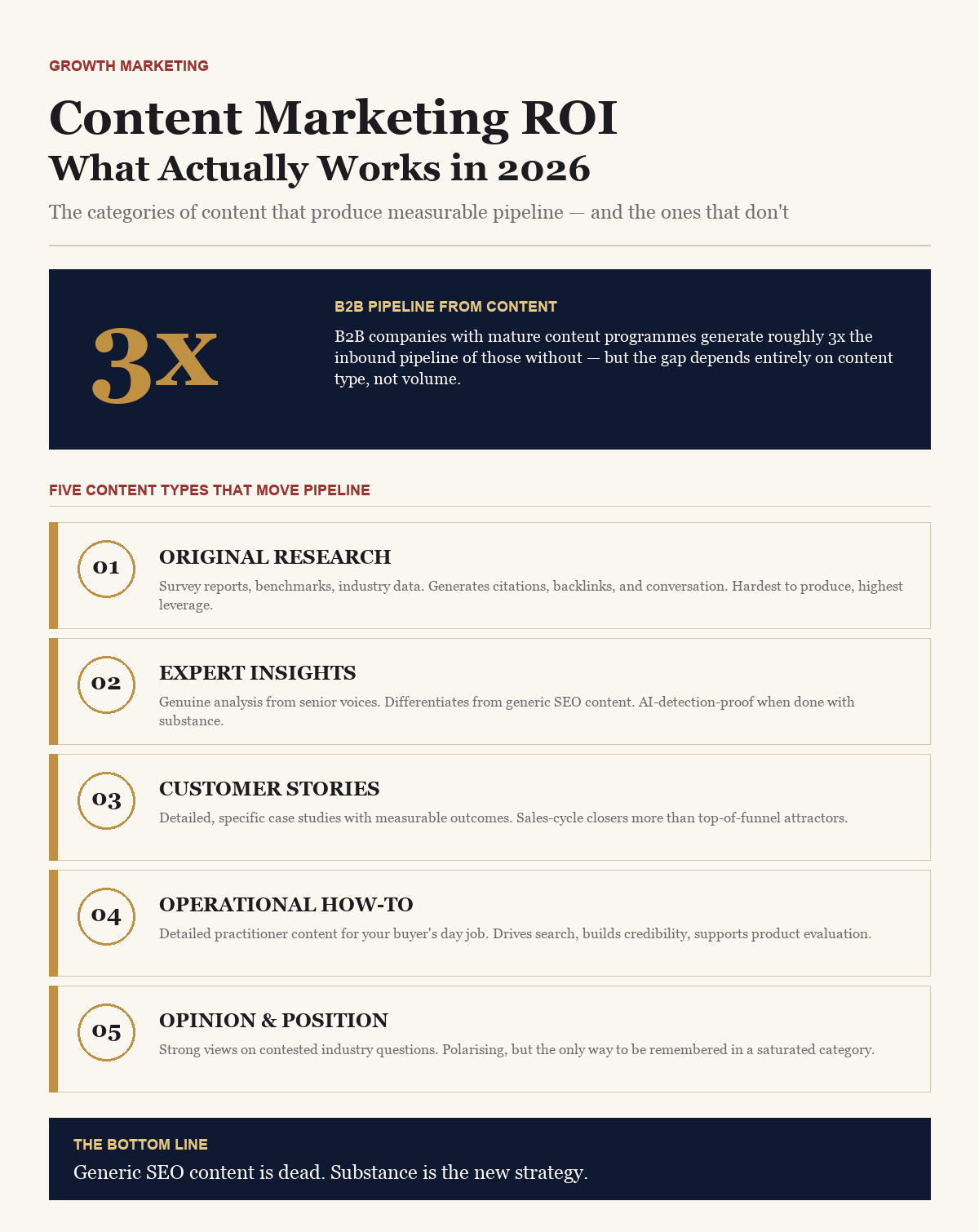
Why Generic Content Has Lost Its Effectiveness
The first and most consequential shift is that generic content, articles, blog posts, white papers, and other materials that could have been produced by any of dozens of similar companies, no longer produces the marketing returns it once did. The reasons are mechanical: search engines, social media algorithms, and audience attention all increasingly distinguish between content that provides genuine value and content that is essentially commoditised information processing. The era when ‘we should publish a blog post about industry trends’ was a viable content marketing strategy has ended.
The proliferation of AI-generated content has accelerated this shift. The capability to produce high-volume, surface-level content on virtually any topic has effectively eliminated the value of generic informational content as a marketing tool. Google’s quality guidelines have explicitly addressed AI-generated content, and the algorithm updates of the past two years have systematically demoted thin, generic content regardless of whether it was produced by humans or AI. The content that performs in search results in 2026 demonstrates expertise, experience, and authority that generic content cannot replicate.
Audience attention has shifted in parallel. Professional audiences have become more selective about what content they consume, both because they have less time and because the cost of consuming low-value content has increased as the volume of available content has grown. Content that does not offer specific, applicable insights, that reads as if it could have come from any source, increasingly does not get the attention required to produce marketing outcomes regardless of how it appears in search results or social feeds.
What Is Working: Expertise and Specificity
The content that is producing measurable marketing returns in 2026 is characterised by demonstrable expertise, specific applicability, and clear differentiation from what competitors and AI tools can produce. The pattern is consistent across B2B and consumer categories: content that provides specific, useful, expert insight on topics that the audience genuinely cares about produces engagement, lead generation, and customer outcomes; content that does not provide these characteristics does not.
Practitioner-authored content, material written by people with direct, demonstrated experience in the topic area rather than by marketing teams or contracted writers, has become substantially more valuable. The credibility signals that audiences and algorithms use to evaluate content quality increasingly require evidence of authentic expertise rather than just well-written prose. Subject matter experts who can write coherently about their domain are increasingly recognised as more valuable content creators than skilled writers without domain expertise.
Original research has emerged as a particularly high-return category of content marketing. Surveys, data analyses, benchmarking studies, and similar original research produce content that competitors cannot replicate quickly, that establishes the publishing company as an authoritative source in its category, and that supports both top-of-funnel awareness and bottom-of-funnel sales conversations. The investment required to produce credible original research is substantial, typically tens of thousands of dollars per major piece, but the marketing return per dollar of investment has generally been substantially better than similar investment in generic content production.
The Channel Mix Has Changed
How content is distributed has shifted at least as much as how content is produced. Search engine optimisation remains important but has changed substantively. The pure organic traffic strategy that worked through the 2010s, publish high volumes of content optimised for keywords, accumulate links, watch organic traffic grow, has been substantially undermined by algorithm changes, by AI-powered search experiences that synthesise answers rather than direct traffic to source content, and by zero-click search behaviour that increases for many query types. SEO continues to produce marketing value, but the strategies that produce that value in 2026 are different from those that worked five years ago.
LinkedIn has become an increasingly important channel for B2B content distribution, particularly for content that benefits from being associated with specific individuals rather than only with company brands. The platform’s algorithm rewards individual creator activity in ways that make LinkedIn presence by executives and subject matter experts more valuable than purely corporate posting. The companies that have built strong LinkedIn presence through individual employee participation typically produce content marketing outcomes substantially better than companies that rely primarily on corporate accounts (see our analysis in D2C Brands).
Email newsletters have experienced a substantial resurgence as audience consumption patterns have shifted. The combination of declining trust in social media algorithms, audience preference for content that arrives directly rather than through algorithmic curation, and the high engagement rates that well-executed newsletters can achieve has made email newsletters one of the most reliable content distribution channels. The newsletter platforms, particularly Substack, Beehiiv, and Ghost, have enabled both individual creators and companies to build direct audience relationships that platform algorithms cannot mediate (see our analysis in Data-Driven Decision Making).
Podcasts continue to be a strong B2B content channel for companies whose audience profiles support audio consumption. The economics of podcasting have been challenging for many publishers, but for specific B2B applications, particularly when used as a relationship-building mechanism with potential customers and partners, podcasting can produce marketing returns that other channels cannot match. The podcast as a guest of other relevant podcasts is often more valuable than building one’s own podcast, particularly for companies that do not have the audience scale to justify building their own programme.
The Role of AI in Content Production
Generative AI’s role in content marketing has been more complex than either the most enthusiastic or most pessimistic predictions suggested. AI tools have made certain kinds of content production substantially more efficient, first drafts, research summaries, formatting and editing tasks, language translation, and various supporting activities that would previously have required substantial human time. The companies that have integrated AI thoughtfully into their content production workflows have reduced their per-piece content costs while maintaining or improving quality.
At the same time, AI-generated content used as the primary content production approach, replacing rather than supporting human creators, has consistently produced disappointing marketing outcomes. The lack of distinctive perspective, the absence of authentic expertise, and the surface-level treatment of topics that AI-generated content typically produces all undermine the marketing value of the content. The companies that have attempted to scale content production primarily through AI generation have generally not produced the marketing returns they expected.
The most effective use of AI in content marketing combines AI capability with strong human direction and editorial oversight. AI assists with research, structure, and editing; human creators provide the perspective, expertise, and judgement that produces genuinely valuable content; the combination produces content at lower cost than purely human production while maintaining the qualities that produce marketing impact. This pattern requires content marketing organisations to invest in human expertise even as they leverage AI capabilities, which is the opposite of the cost reduction story that AI content production sometimes promises.
Measurement Challenges and Improvements
The measurement of content marketing ROI has been a persistent challenge that has actually become more complex in recent years. The attribution challenges, connecting specific content interactions to ultimate business outcomes, have intensified as audience journeys have become more complex and as third-party cookie deprecation has limited the data available for attribution analysis. The marketing analytics tools that improved through the 2010s have had to be substantially reconfigured for the privacy and attribution environment that has emerged.
Despite the measurement challenges, several measurement approaches have proven more reliable than the older ROI calculations that depended on tracking individual users across long journeys. Lift studies that compare engagement and conversion rates between content-exposed and content-unexposed populations provide cleaner attribution data than journey-based tracking. Sales team feedback on the content that customers reference during sales conversations provides qualitative signals about content marketing effectiveness that supplement quantitative measurement. Direct survey of customers about content consumption and decision-making provides input that purely behavioural data does not.
The Indian Content Marketing Context
Indian content marketing has matured significantly over recent years, with Indian companies producing content that competes effectively in international markets and Indian audiences becoming more sophisticated consumers of content. The Indian content marketing services industry, including both agencies and platform-specific specialists, has grown substantially, providing capability that did not previously exist domestically. Indian companies have used content marketing effectively in both domestic markets and in serving international customers.
The specific opportunity for Indian companies in international content marketing has expanded as global trends have favoured content with authentic expertise and specific perspective. Indian companies in software services, financial services, and various technology categories have produced content that has built brand presence in international markets, often at marketing costs that are substantially below what international competitors spend. The pattern is most visible in B2B technology categories where Indian companies have used content marketing to establish thought leadership in markets where they did not have established sales presence.
Building Content Marketing That Produces Returns
For business leaders evaluating their content marketing investment, several principles emerge from the experience of the past several years. Investment should concentrate on a smaller number of higher-quality pieces rather than spreading across high volumes of generic content. Subject matter experts should be more directly involved in content creation, either as writers themselves or as the substantive direction behind content that is produced with editorial support. Distribution should be diversified across multiple channels rather than depending primarily on organic search or social media algorithms. Measurement should focus on indicators that genuinely reflect business outcomes rather than vanity metrics that are easy to track but loosely connected to results.
Content marketing remains a valuable investment for businesses with appropriate audience profiles and competitive positioning. The companies that have continued to produce strong returns from content marketing have generally been those that have adapted to the structural changes that have emerged rather than continuing to execute the playbook from earlier years. The companies that have not adapted, that continue to produce high volumes of generic content optimised for outdated search algorithms, are increasingly seeing their content marketing investments produce diminishing or negative returns. The capability to distinguish between the strategies that are working in the current environment and those that have been overtaken by structural change is now central to successful content marketing.
