


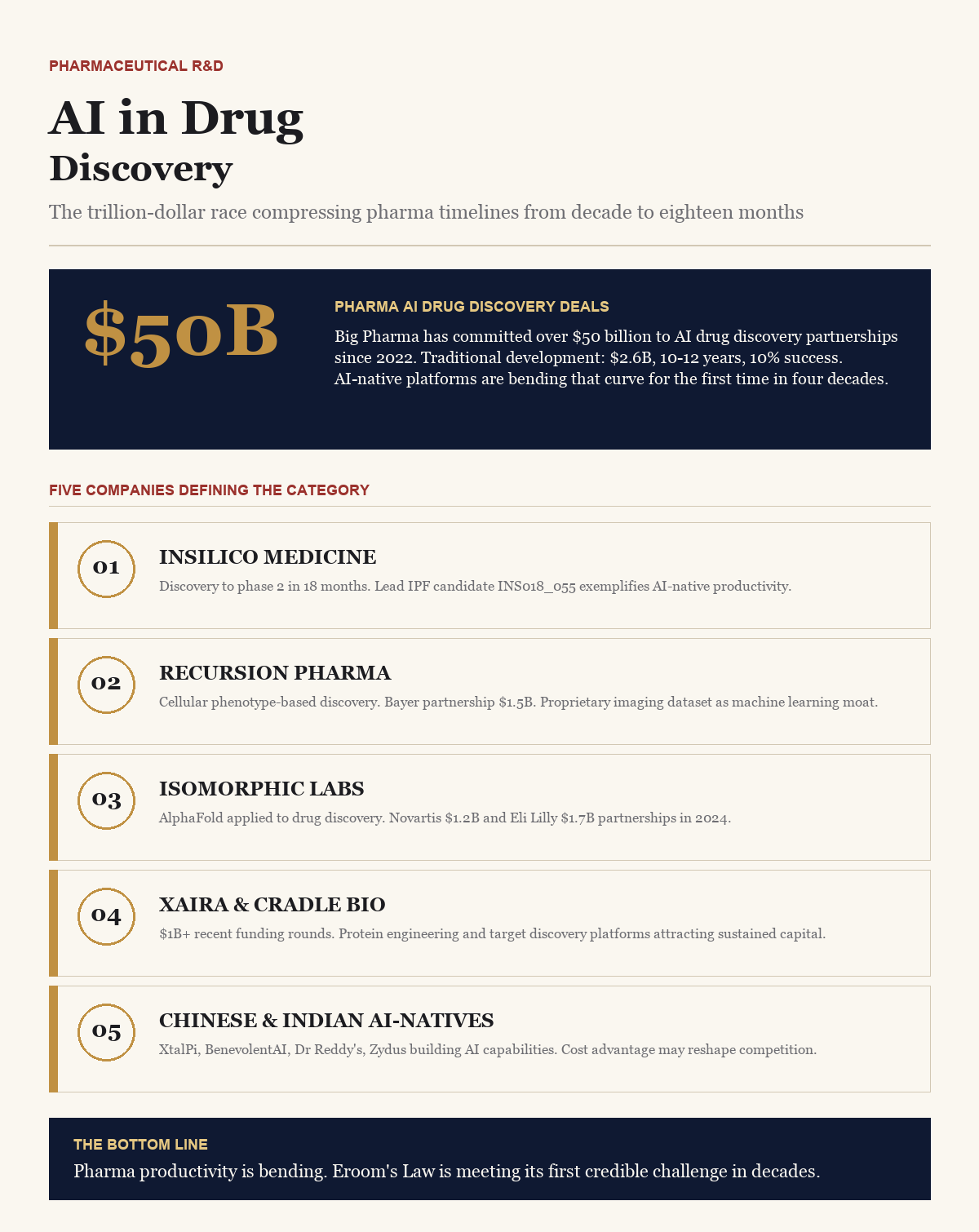
The pharmaceutical industry has spent decades operating with a well-documented productivity problem. The cost of developing a new drug has approximately doubled every nine years for the past four decades, a phenomenon known as Eroom’s Law, the deliberate inverse of the semiconductor industry’s Moore’s Law. By 2022, the average fully-loaded cost of bringing a new drug from initial research through FDA approval had reached approximately $2.6 billion, with development timelines averaging 10 to 12 years and success rates from candidate molecule to approved drug hovering around 10%. The economics of pharmaceutical innovation had reached a point where only the largest companies could sustain full-pipeline investment, and even they faced serious questions about whether the productivity trajectory could continue.
Artificial intelligence, and specifically the deep learning and generative AI techniques that have advanced dramatically since 2020, has emerged as the most credible potential disruption to this productivity curve. Multiple technical developments have converged simultaneously: AlphaFold’s protein structure prediction breakthrough, generative models capable of designing novel molecular structures, machine learning approaches to predicting drug-target binding, and AI-enabled analysis of the vast biological datasets that pharmaceutical research now generates. The result is that drug discovery workflows that traditionally consumed years of laboratory time are increasingly being compressed into computational processes measured in weeks or months.
The Companies Redefining the Category
Several companies have emerged as reference points for what AI-native drug discovery looks like at scale. Insilico Medicine, headquartered between Hong Kong and Boston, has published multiple case studies documenting the discovery of novel drug candidates in periods measured in months rather than years. Its lead candidate INS018_055, an AI-designed treatment for idiopathic pulmonary fibrosis, moved from target identification through preclinical development in under 18 months and entered phase 2 clinical trials in 2024. The company’s platform combines generative chemistry, target discovery, and clinical trial design in ways that traditional pharmaceutical R&D organisations are still working to replicate.
Recursion Pharmaceuticals has built a different approach centred on high-throughput cellular imaging combined with machine learning analysis. The company operates one of the world’s largest datasets of cellular images captured under thousands of experimental conditions, using deep learning to identify drug candidates based on cellular phenotype changes rather than traditional target-based approaches. Recursion’s partnership with Bayer, worth $1.5 billion in upfront and milestone payments, exemplifies how major pharmaceutical companies are seeking access to AI-native discovery platforms rather than trying to build them from scratch.
Isomorphic Labs, spun out of Google DeepMind in 2021, brings the most direct application of the AlphaFold protein structure prediction technology to drug discovery. The company’s partnerships with Novartis (worth $1.2 billion in initial commitments) and Eli Lilly (worth $1.7 billion) demonstrate that even the largest pharmaceutical companies with substantial internal AI capabilities are willing to pay significant amounts to access specialised AI drug discovery platforms.
Other notable companies redefining the category include Xaira Therapeutics (a $1 billion Series A in 2024 backed by ARCH Venture Partners and Foresite Capital), Cradle Bio (protein design and engineering), and BenevolentAI (target discovery and drug candidate identification). The category has attracted investor capital at levels that exceed prior biotechnology investment cycles, with cumulative funding for AI-native drug discovery companies exceeding $25 billion since 2020.
Where AI Is Genuinely Compressing Timelines
The productivity gains from AI drug discovery are not uniform across the drug development process. The compression is most dramatic in the earlier stages: target identification, candidate molecule design, preclinical safety prediction, and initial in vitro testing. These stages historically consumed three to five years of a typical drug development timeline. AI-enabled workflows have compressed the fastest examples to under 12 months. The productivity implications for pharmaceutical R&D budgets are material: the same organisational resource can now advance more candidates in parallel, or advance the same candidates at lower cost.
Clinical development, the phase 1, 2, and 3 human trials that determine safety and efficacy, has been less transformed by AI to date. Clinical trials are constrained by biology, regulation, and the practical realities of recruiting and monitoring human subjects. AI has produced meaningful improvements in trial design, patient selection, and biomarker identification, but the fundamental timeline of clinical development has not compressed nearly as much as the discovery phase. This has produced a paradoxical situation: pharmaceutical pipelines contain more AI-discovered candidates than ever before, but the throughput to approved drugs has not increased proportionally because clinical trials remain the binding constraint.
Regulatory review has also seen meaningful AI application. The FDA’s Elsa program, launched in 2024, applies AI to accelerate initial reviews of new drug applications and to identify safety signals in adverse event databases. The European Medicines Agency has similar initiatives underway. These regulatory applications of AI could eventually compress approval timelines further, though the fundamental scientific evidence requirements for drug approval remain unchanged.
The Partnership vs Build Debate
Major pharmaceutical companies face a strategic decision that will shape their competitive positioning for the next decade: whether to build internal AI drug discovery capabilities, partner with AI-native companies, acquire capability through M&A, or pursue some combination. The observed strategies have varied significantly across the industry.
Pfizer, Merck, and Sanofi have pursued primarily partnership-based approaches, structuring long-term collaborations with multiple AI-native drug discovery companies while building internal capabilities more selectively. Novartis and Eli Lilly have combined substantial internal investment (each committing over $1 billion to internal AI drug discovery capabilities) with large partnerships to access specialised external platforms. AstraZeneca has been particularly aggressive in acquisitions, purchasing multiple AI drug discovery capabilities through both outright acquisitions and equity investments.
The economics of the build-versus-partner decision are complex. AI drug discovery platforms require substantial ongoing investment in computational infrastructure, machine learning talent, and specialised biological data generation. Building comparable capabilities internally at Big Pharma organisations has proven possible but expensive. Partnerships allow access to specialised expertise but concentrate upside in the AI-native partner. The strategic path that emerges most often is a hybrid: internal capability for platform-critical applications combined with selected partnerships for specialised techniques or therapeutic areas.
The Data Advantage Question
A critical unresolved question in AI drug discovery is the durability of any competitive advantage based on proprietary data. Machine learning models are only as good as the data they are trained on, and the highest-quality biological data, particularly clinical outcomes data, chemistry and biology laboratory results, and structural biology datasets, is largely held by pharmaceutical companies with decades of research history. This creates a potential advantage for incumbents that own such data over newer AI-native competitors.
The counter-argument is that pharmaceutical data is often locked in incompatible systems, inconsistent formats, and organisational silos that prevent effective machine learning training. AI-native companies that build proprietary data generation platforms, like Recursion’s cellular imaging pipeline, may create data assets that are more machine-learning-ready than the accumulated data at incumbent companies. The empirical evidence to date suggests that the winners will be companies that combine both types of data effectively, either through partnerships or through consolidation.
Investment Landscape and Return Expectations
The AI drug discovery investment landscape has evolved through several phases since 2020. The initial 2020-2021 enthusiasm produced high valuations for early-stage AI biotech companies and multiple SPAC transactions that have subsequently underperformed. The 2022-2024 period saw more disciplined pricing but continued strong investment in companies with credible platforms and near-term drug candidates. The current phase, as of 2026, is characterised by concentration of capital in a smaller number of companies with demonstrated productivity metrics, actual advancement of drug candidates into clinical trials on compressed timelines.
Return expectations for investors have been recalibrated. The initial thesis was that AI drug discovery would produce multiple decabillion-dollar biotech companies within a decade. The current view is more nuanced: some AI-native companies will produce major successes and command premium valuations, but the returns will be concentrated in a small number of players with genuine platform advantages. Most participants in the category will produce returns comparable to traditional biotech investment, adjusted for the somewhat different risk profile.
The India and China Dimensions
Chinese and Indian participation in AI drug discovery is significant and growing. Chinese companies including Insilico Medicine (operationally distributed across Hong Kong, Boston, and mainland China), XtalPi, and Bota Bio have built substantial AI drug discovery capabilities that compete with Western equivalents. The Chinese pharmaceutical industry has been particularly aggressive in AI adoption, driven by both government support and the competitive pressure of shorter development timelines in generic and biosimilar categories.
Indian pharmaceutical companies including Dr. Reddy’s, Sun Pharma, and Zydus Lifesciences have made meaningful investments in AI-enabled drug discovery, though at scales smaller than their US and European counterparts. The Indian government’s biotechnology innovation programmes have identified AI drug discovery as a strategic priority, and several Indian AI-native biotech startups have emerged with credible platforms. The combination of India’s substantial pharmaceutical manufacturing base and growing AI capability could produce distinctive competitive advantages over the next decade, particularly in categories where cost-effective development matters.
What Executives Should Understand
For pharmaceutical executives, AI drug discovery has moved from an emerging technology worth monitoring to a competitive necessity requiring active strategic engagement. The organisations that are building genuine AI capabilities, whether internally, through partnerships, or through acquisition, are positioning for a decade of productivity advantage over those that are not.
For investors evaluating pharmaceutical and biotechnology opportunities, the AI dimension has become a material factor in valuation and strategic assessment. Companies with credible AI drug discovery capabilities warrant premium valuations relative to those without, and the differentiation between platforms is meaningful rather than superficial.
For healthcare executives, hospital systems, and payers, the implications extend beyond pharmaceutical R&D. AI drug discovery will produce a steady flow of new therapeutic options across many disease categories over the next decade, with potentially transformative impact in areas including rare diseases, oncology, and neurodegenerative disease. Preparing organisational capabilities to evaluate, adopt, and integrate these new therapeutic options is itself a strategic priority.
The trillion-dollar race is real, though the eventual winners are still being determined. What is certain is that pharmaceutical productivity is no longer following Eroom’s Law. For the first time in four decades, the cost curve of drug development is showing signs of bending. The companies that harness this productivity shift most effectively will define pharmaceutical leadership for the coming generation.
