

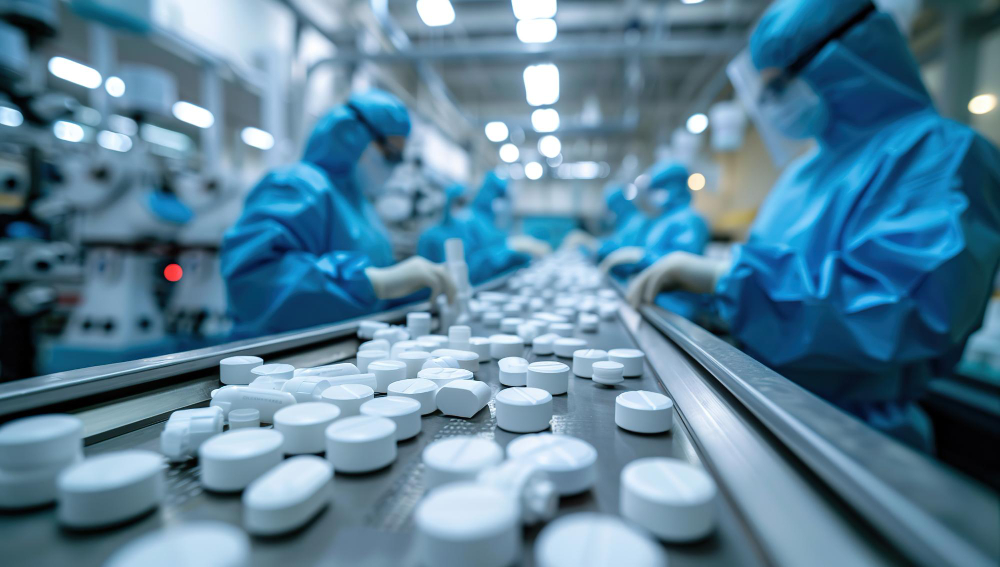

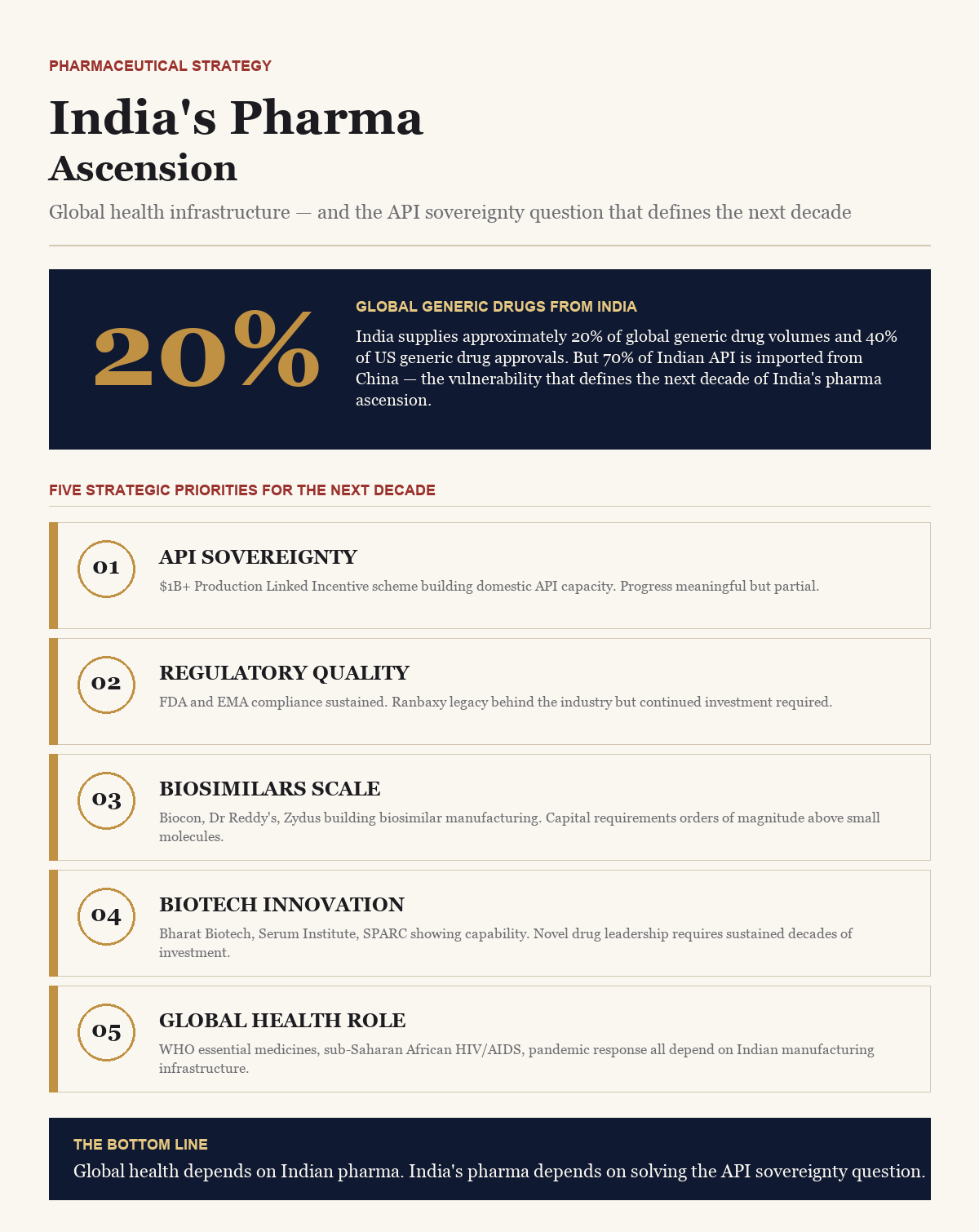
India’s role in global pharmaceutical supply has become one of the most consequential yet underappreciated features of contemporary global health infrastructure. The country supplies approximately 20% of global generic drug volumes by unit count, is the largest supplier to the World Health Organization’s essential medicines procurement programme, and manufactures the majority of low-cost antiretroviral drugs that have sustained the global response to HIV/AIDS. When Indian pharmaceutical manufacturing operates well, patients in dozens of countries have access to affordable medications. When it faces disruption, as it did during the early phases of COVID-19, the consequences ripple across the global health system.
The Indian pharmaceutical industry’s ascendance to this position was neither inevitable nor primarily the result of low-cost labour. It reflects decades of deliberate policy investment, entrepreneurial capability building, and regulatory sophistication that took Indian pharmaceutical companies from patent-copying commodity producers in the 1970s to sophisticated manufacturers meeting international regulatory standards by the 2010s. The current phase of India’s pharma ascension involves both consolidating this global leadership position and addressing the structural vulnerabilities that have become apparent through recent supply chain disruptions.
The Generic Drug Manufacturing Foundation
India’s pharmaceutical manufacturing capability was built primarily through the generic drug industry. The Indian Patents Act of 1970 excluded pharmaceutical products from patent protection while permitting patents on processes, which created a legal framework in which Indian companies could manufacture generic versions of patented drugs by developing alternative production processes. This policy environment, combined with substantial investment in chemistry education and process engineering capability, produced a generation of Indian pharmaceutical companies with genuine technical expertise in complex chemistry and process development.
Companies including Cipla, Sun Pharma, Dr. Reddy’s Laboratories, Lupin, and Ranbaxy (later acquired by Sun Pharma) built substantial businesses on generic drug manufacturing, initially serving the domestic Indian market and later expanding to international markets as India joined the World Trade Organization and adopted product patent protection in 2005. The transition to WTO compliance was widely predicted to devastate the Indian generic pharmaceutical industry. Instead, Indian companies pivoted to become sophisticated manufacturers of off-patent generic drugs for regulated markets in the United States, European Union, and other advanced economies.
The US market has been particularly important to Indian pharmaceutical companies. Indian manufacturers now hold approximately 40% of all US Food and Drug Administration approvals for generic drug applications and supply approximately one-third of generic prescription volumes in the American market. This has produced substantial commercial businesses for Indian companies while creating measurable healthcare cost benefits for American patients and payers. The Indian pharmaceutical industry has become critical infrastructure for the American healthcare system in ways that most Americans do not recognise.
The API Dependency Vulnerability
The structural vulnerability at the heart of India’s pharmaceutical position is the country’s dependence on Chinese active pharmaceutical ingredients, the chemical compounds that provide the therapeutic effect in finished medications. Approximately 70% of the API used in Indian pharmaceutical manufacturing is imported, with the majority coming from Chinese suppliers. This dependence developed over decades as Chinese chemical manufacturing achieved cost advantages that made domestic Indian API production commercially uncompetitive for many product categories.
The vulnerability became visible during COVID-19 when Chinese factory shutdowns and export restrictions temporarily disrupted API supply to Indian manufacturers. The Indian government’s export restrictions on certain medications during the peak of the pandemic reflected in part the reality that Indian production capacity depended on Chinese inputs that were suddenly uncertain. The strategic implications of this dependency have been recognised at senior policy levels: Indian pharmaceutical sovereignty requires domestic API production capability that current market economics do not support.
The Production Linked Incentive scheme for API manufacturing, launched in 2020 with an initial commitment of approximately $1 billion, was designed to address this vulnerability. The programme provides direct financial incentives for Indian companies to establish domestic manufacturing capacity for critical APIs, particularly those where Chinese supply concentration has been highest. Early results have been meaningful but partial: several Indian companies have established significant domestic API capacity, but the country’s overall dependence on Chinese APIs remains substantial.
The Regulatory Sophistication Challenge
Indian pharmaceutical companies have navigated increasingly complex international regulatory environments to build their current market positions. The FDA’s expectations for good manufacturing practice compliance, data integrity, and quality management have grown steadily more stringent over the past two decades. The European Medicines Agency, UK Medicines and Healthcare products Regulatory Agency, and Australian Therapeutic Goods Administration have similar sophisticated requirements. Meeting these standards requires manufacturing investment and organisational capability substantially beyond what basic generic drug production requires.
The regulatory environment has not been uniformly favourable to Indian manufacturers. Multiple Indian companies have faced FDA warning letters, import alerts, and manufacturing site restrictions over the past decade related to data integrity concerns, manufacturing quality issues, or other compliance findings. Ranbaxy Laboratories’ 2013 fraud settlement, at $500 million, the largest such penalty against a generic drug manufacturer at that time, was a defining moment that forced the entire Indian pharmaceutical industry to accelerate quality management improvements. Contemporary Indian pharmaceutical manufacturing generally meets international standards, but the operational capabilities required to sustain compliance are substantial and continuing.
The Biologics and Complex Products Transition
The pharmaceutical industry has been transitioning from small molecule drugs to biologics and other complex therapeutic modalities. This transition presents both challenge and opportunity for Indian pharmaceutical companies. Small molecule generic manufacturing, where Indian companies have built dominant market positions, will continue to produce revenue but at declining growth rates as more of the pharmaceutical value creation shifts to biologics, gene therapies, cell therapies, and other complex modalities.
Indian companies have responded to this transition with substantial investment in biosimilar manufacturing capability. Biocon, Dr. Reddy’s, Zydus Lifesciences, and Reliance Life Sciences have established meaningful biosimilar businesses, though the complexity of biologics manufacturing is substantially greater than small molecule generic manufacturing. The capital investment required for biologics manufacturing is orders of magnitude higher than for small molecules, and the specialised expertise required takes time to develop.
The Indian government has identified biotechnology as a strategic priority area and has committed significant funding to research infrastructure, manufacturing capability, and workforce development. The Department of Biotechnology’s biotech innovation programmes, the Council of Scientific and Industrial Research’s biologics initiatives, and various academic research partnerships have created a foundation for Indian biotechnology industry growth. Whether this foundation translates into competitive positions comparable to Indian generic drug leadership over the next decade remains to be seen.
The Innovation Ecosystem Development
Beyond generic and biosimilar manufacturing, Indian pharmaceutical companies have been building capability for novel drug development. Sun Pharma, Dr. Reddy’s, and Cipla have all invested in specialty and innovative therapeutic programmes, with mixed but genuine results. A generation of Indian biotech companies, Bharat Biotech, Serum Institute of India (both major COVID vaccine producers), Biocon, Sun Pharma Advanced Research Company, and others, has demonstrated capability in complex therapeutic development.
The Indian research ecosystem includes premier academic institutions like the Indian Institutes of Science, various IITs, and specialised biomedical research institutes that produce competent scientific workforce. Government initiatives including the Biotechnology Industry Research Assistance Council have supported research translation. The number of Indian scientists working in international pharmaceutical research has grown to substantial levels, and reverse migration to India by senior scientists is becoming more common.
The gap between Indian pharmaceutical research capability and the innovation leadership positions held by American, European, and increasingly Chinese pharmaceutical industries remains significant. Closing this gap would require sustained investment over multiple decades, and the returns on investment are uncertain given the technical and commercial risks involved in novel drug development. Whether India develops genuine pharmaceutical innovation leadership or remains primarily a manufacturing and generics power will be one of the defining questions of the sector’s next twenty years.
Global Health Implications
The state of India’s pharmaceutical industry has consequences for global health outcomes that extend far beyond commercial pharmaceutical markets. Sub-Saharan African healthcare systems, particularly those addressing HIV/AIDS, malaria, and tuberculosis, depend substantially on affordable Indian generic drugs. The COVAX vaccine distribution programme relied heavily on Indian manufacturing capacity, particularly through Serum Institute of India. Global responses to future pandemics and health emergencies will similarly depend on Indian pharmaceutical infrastructure being available and functional.
The tensions between commercial pharmaceutical patents and access to essential medicines in developing countries have played out significantly through Indian legal and regulatory frameworks. The Indian Supreme Court’s 2013 rejection of Novartis’s patent claim for the cancer drug Gleevec became a defining precedent in the global debate about how much patent protection is appropriate for pharmaceutical innovations. The Indian legal environment continues to balance commercial pharmaceutical company interests with public health imperatives in ways that other jurisdictions watch closely.
What the Next Decade Requires
For India’s pharmaceutical industry to sustain and extend its global position over the next decade, several strategic priorities require sustained attention. Domestic API manufacturing capability must be built systematically to reduce Chinese supply chain dependence. Regulatory quality management must continue to improve to sustain access to premium international markets. Biosimilar and biotechnology manufacturing capability must scale to participate in the shift toward complex therapeutic modalities. Innovation ecosystem development, while long-term in nature, requires ongoing investment to eventually produce Indian pharmaceutical companies with genuine novel drug development capability.
The Indian government’s policy commitment to these priorities appears sustained through the Production Linked Incentive schemes, biotechnology research programmes, and regulatory modernisation efforts. Private sector investment in the required capabilities has been substantial though variable in its focus and effectiveness. The next decade will determine whether the combination of government policy and private sector execution produces the industry position that Indian pharmaceutical stakeholders envision.
For business leaders in the pharmaceutical industry globally, understanding the Indian pharmaceutical sector’s trajectory matters strategically. Indian companies are established competitors in generic drugs and increasingly credible competitors in biosimilars, complex generics, and novel drug development. Indian manufacturing infrastructure is critical supply chain input for global pharmaceutical operations. The India dimension of pharmaceutical business strategy has become impossible to ignore, and the next decade will determine what shape it takes for the industry’s next generation.
