



The scientific study of ageing has spent decades sitting at the periphery of mainstream biomedical research. The prevailing view in most of the twentieth century was that ageing was an inevitable biological process that could be modestly modified through healthy behaviours but not fundamentally altered through therapeutic intervention. The pharmaceutical industry, structured around the identification of specific disease targets with clear regulatory approval pathways, had few natural incentives to invest in ageing itself as a therapeutic target. Research funding for basic ageing biology, while not negligible, was small compared with the funding directed at specific age-related diseases like cancer, cardiovascular disease, and neurodegenerative disorders.
The past five years have produced a significant shift in this landscape. Scientific advances in cellular reprogramming, senolytic compounds, epigenetic clocks, and multiple other domains have produced concrete evidence that ageing is more modifiable than the previous scientific consensus suggested. Simultaneously, commercial investment in longevity biotechnology has expanded to levels that no previous decade had approached. The result is that the longevity economy has emerged as a legitimate investable category, with credible scientific foundations, substantial capital commitment, and increasing pharmaceutical industry engagement.
The Companies Defining the Category
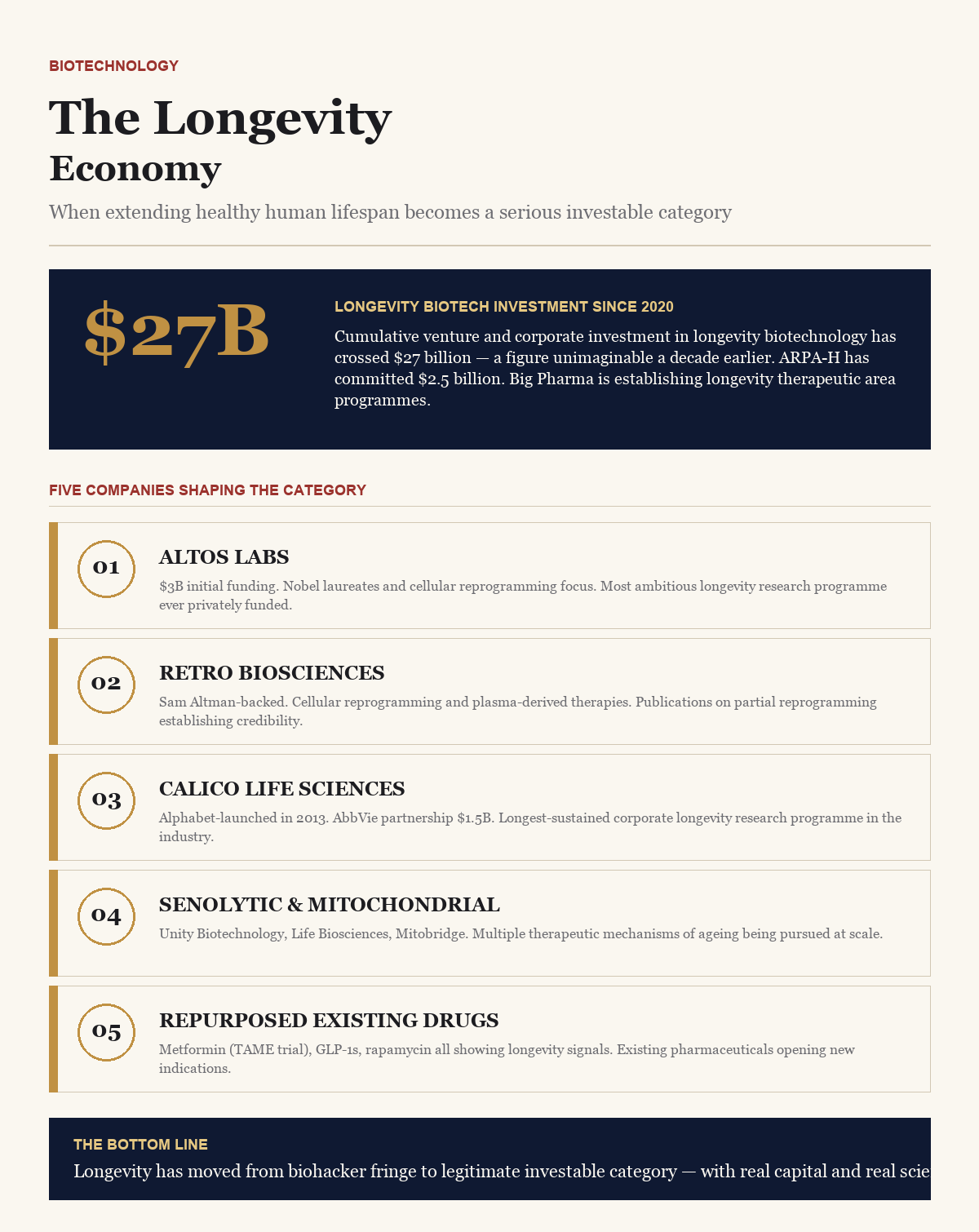
Altos Labs, launched in 2022 with $3 billion in initial funding from a consortium including Jeff Bezos, has established itself as the most prominent example of the longevity biotech category. The company’s focus on cellular rejuvenation, the reprogramming of cellular age markers through Yamanaka factor-inspired approaches, represents one of the most technically ambitious biological research programmes ever undertaken by a private company. Altos has assembled research teams that include several Nobel Prize winners and dozens of leading academic biologists, operating from research campuses in Cambridge (UK), the San Francisco Bay Area, and San Diego.
Retro Biosciences, funded initially with $180 million from Sam Altman and other investors, has taken a related but distinct approach centred on cellular reprogramming and plasma-derived therapies. The company’s early publications on partial cellular reprogramming and its clinical development pipeline have positioned it as a credible competitor in the same broad space Altos is pursuing.
Calico Life Sciences, launched by Google’s parent company Alphabet in 2013, represents the most sustained corporate longevity research programme. Its partnership with AbbVie, worth over $1.5 billion in initial commitments, produced multiple drug development programmes focused on age-related diseases. Calico’s approach has been more traditional in structure than Altos or Retro, focusing on specific therapeutic targets rather than fundamental cellular reprogramming, but its scientific output has been substantial.
Beyond these highest-profile companies, the longevity biotech ecosystem includes dozens of specialised firms working on senolytic compounds (Unity Biotechnology, Life Biosciences), stem cell approaches (SENS Research Foundation-affiliated companies), mitochondrial function (Mitobridge, acquired by Astellas), and various other mechanisms of ageing. The cumulative venture and corporate investment in the longevity category has exceeded $27 billion since 2020, a figure that would have been almost unimaginable a decade earlier.
The Scientific Progress That Matters
The scientific case for longevity intervention has strengthened materially over the past five years, though the timeline for clinical impact remains uncertain. Cellular reprogramming research has demonstrated that specific gene expression programmes can reverse markers of cellular ageing in laboratory settings and in some animal models. Senolytic compounds, drugs that selectively kill senescent cells that accumulate with age, have shown positive effects in animal models and are in clinical trials for specific age-related conditions. Epigenetic clocks, particularly the Horvath and GrimAge methodologies, have produced remarkably accurate measurements of biological age that appear to respond to interventions.
The most consequential recent finding may be the growing evidence that specific existing medications produce measurable longevity benefits in humans. Metformin, the widely-prescribed diabetes medication, has been the subject of the TAME trial (Targeting Aging with Metformin), which is testing whether the drug can delay the onset of multiple age-related conditions in older adults. The GLP-1 medications discussed extensively in the pharmaceutical industry have shown cardiovascular protection and other apparent longevity benefits in observational data. Rapamycin and rapalogs have shown lifespan-extending effects in multiple animal models and are being investigated for human application.
Perhaps most importantly, the scientific community has developed increasing consensus that ageing itself is a modifiable process rather than an immutable biological trajectory. This paradigm shift, while still contested at the edges, has created the intellectual foundation for treating ageing as a therapeutic target in ways that regulatory frameworks, medical education, and clinical practice can gradually incorporate.
The Investment Landscape
The investment landscape for longevity has evolved through several distinct phases. The initial 2020-2022 wave was characterised by high enthusiasm and substantial valuations for early-stage companies, often based on scientific narratives rather than clinical progress. The 2022-2023 biotech correction reset expectations across the sector, with valuations declining substantially for both public and private longevity companies. The current phase has been more discipline-focused, with capital concentrating in companies that combine strong scientific foundations with credible near-term clinical development plans.
Public market participation in the longevity category has been limited compared with the private investment activity. Unity Biotechnology, the earliest longevity-focused public company, has struggled with clinical trial disappointments. Other public companies with longevity-relevant pipelines have generally been valued based on their specific therapeutic programmes rather than a broader longevity thesis. This limited public market presence is likely to change as private longevity companies mature and consider IPO paths, potentially producing a more defined public market category over the next five years.
Family offices, private investment firms, and high-net-worth individuals have been particularly active investors in the longevity category. The personal interest that many wealthy investors have in longevity outcomes has produced patient capital willing to accept longer development timelines than traditional biotech investors typically tolerate. This capital source has been essential to funding the scientifically ambitious but commercially distant research programmes that Altos, Retro, and similar companies represent.
ARPA-H and the Government Dimension
The United States government has emerged as a substantial funder of longevity-relevant research through several programmes. The Advanced Research Projects Agency for Health (ARPA-H), established in 2022, has explicitly identified healthy longevity as a strategic priority and has committed approximately $2.5 billion to related research programmes. The National Institute on Aging within the National Institutes of Health continues to fund basic ageing research at levels that have grown substantially over the past decade.
The regulatory dimension of ageing research has begun to evolve as well. The FDA has traditionally required demonstration of efficacy in specific approved disease indications rather than general ‘ageing’ claims. Recent discussions between researchers and FDA staff about potential approaches to evaluating ageing-directed therapeutics have suggested increased regulatory openness to considering ageing biomarkers and multi-disease outcomes in ways that could enable different clinical development pathways. The regulatory evolution will be gradual but appears to be moving in directions that could support commercial longevity therapeutic development.
The Consumer Longevity Market
Alongside the clinical and biotechnology longevity economy, a substantial consumer market has emerged around longevity-focused products, services, and lifestyle interventions. Continuous glucose monitors like those from Levels and Nutrisense have positioned themselves as tools for metabolic optimisation. Biological age testing services from companies like TruDiagnostic, Elysium Health, and various academic-affiliated laboratories have created a consumer market for epigenetic clock measurements. Longevity-focused clinics and concierge medicine practices have proliferated in major American cities, offering personalised protocols combining testing, coaching, and interventions.
The consumer longevity market includes some products with genuine scientific foundations and some that reflect the enthusiasm-outrunning-evidence pattern common in emerging categories. Distinguishing between the two requires domain expertise that most consumers do not possess. The market’s rapid growth and unclear regulation have produced regulatory attention from the FTC and state attorneys general, with some enforcement actions against particularly aggressive claims. The category will likely mature through a combination of self-regulation, clinical evidence generation, and regulatory oversight over the coming years.
What Business Leaders Should Understand
For pharmaceutical industry executives, the longevity space represents both opportunity and disruption. Traditional pharmaceutical business models based on treating specific age-related diseases will remain the primary revenue driver for the foreseeable future, but longevity-directed therapeutics could eventually reshape the pharmaceutical landscape in ways comparable to the shift from acute disease treatment to chronic disease management that defined the past several decades. Pharmaceutical companies that build meaningful engagement with longevity biology now will be positioned to participate in that transition as it develops.
For investors, the longevity category presents genuine opportunity combined with substantial complexity. The scientific timelines involved are longer than most venture capital funds are structured to accommodate, and the commercial pathways are less clear than for traditional biotech therapeutic categories. Investors approaching the category need to be honest with themselves about time horizons, technical risk tolerance, and their ability to evaluate scientific fundamentals of complex biological research programmes.
For business leaders in industries adjacent to healthcare, insurance, employer benefits, consumer goods, longevity trends warrant strategic attention even without specific product exposure. Consumer preferences around health and longevity are shifting materially, employer competitive dynamics around benefits are evolving to reflect these preferences, and insurance product design is beginning to accommodate the possibility of substantially different age-adjusted mortality patterns than historical data would suggest.
The longevity economy will not deliver on the most ambitious predictions of its enthusiasts within the next five years. Fundamental biological research is inherently slower than commercial hype suggests. But the category has established itself as a substantive investable and strategic domain, with sufficient scientific progress, capital commitment, and industry engagement to warrant serious consideration by business leaders across multiple sectors. When extending healthy human lifespan becomes investable, it is worth understanding.
