



The direct-to-consumer brand movement has been one of the most consequential shifts in consumer goods retailing of the past decade. Starting with companies like Warby Parker, Casper, Dollar Shave Club, and Bonobos in the early to mid-2010s, the model demonstrated that consumer brands could be built directly through digital channels without the established retail distribution that previously seemed essential. The success of these early D2C brands attracted substantial venture capital, generated dozens of category-specific D2C entrants, and reshaped consumer expectations about what shopping should feel like across product categories from apparel and personal care to mattresses and pet food.
The picture in 2026 is more complicated than the early enthusiasm suggested. A small number of D2C brands have built durable consumer franchises that have proven their staying power. A larger number have either failed or have been acquired at valuations well below their peak. The customer acquisition economics that supported the early D2C wave have deteriorated substantially as digital advertising costs have risen and as the consumer attention market has become more crowded. The legacy retailers that the D2C movement was meant to disrupt have adapted in ways that have substantially reduced the structural advantages that early D2C brands enjoyed. Understanding what is actually working, and what has stopped working, is essential for anyone building, investing in, or competing with D2C brands.
The Original D2C Advantage
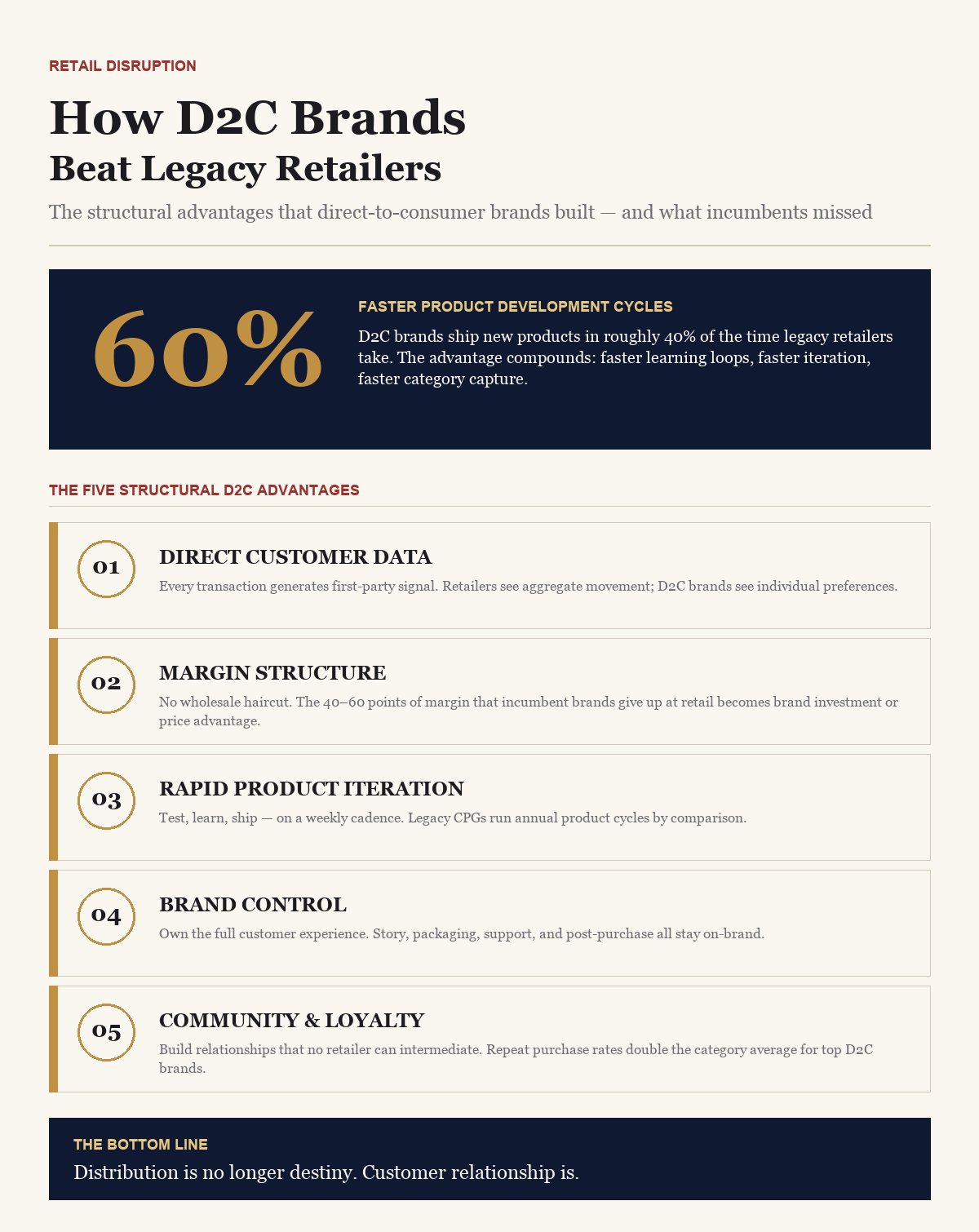
The early D2C brands captured several structural advantages over legacy consumer goods companies and retailers that operated through traditional distribution. The first was margin: by selling directly to consumers, D2C brands captured the wholesale-to-retail margin that traditional brands ceded to retailers. The second was customer relationship: D2C brands owned the customer relationship and data, supporting targeted marketing, product development informed by direct customer feedback, and customer retention strategies that traditional brands selling through retail channels could not match. The third was brand control: D2C brands controlled the customer experience from initial discovery through purchase and use, allowing them to build brand consistency that retail distribution often diluted.
These structural advantages were real and provided the foundation for the early D2C successes. Warby Parker’s eyewear, Casper’s mattresses, Dollar Shave Club’s razors, Glossier’s beauty products, and various other early entrants captured customer mindshare and market share that traditional brands and retailers had not anticipated. The brand stories, startup challengers using digital channels to provide better products at better prices than entrenched incumbents, resonated with consumers, particularly younger demographics, in ways that supported rapid customer acquisition.
The marketing channels that supported early D2C growth were also unusually advantageous. Facebook and Instagram advertising provided highly targeted customer acquisition at costs that produced compelling unit economics. Influencer marketing on social platforms supported brand building at lower costs than traditional advertising. Content marketing through brand-built editorial properties supported customer education and discovery. The combination of these channels with the structural margin and brand control advantages produced the unit economics that supported substantial venture capital investment and growth.
The Deterioration of the Unit Economics
The unit economics that supported the early D2C wave have deteriorated substantially through the late 2010s and into the 2020s. Customer acquisition costs on digital advertising channels have risen consistently as competition for advertising space has increased and as platform algorithms have evolved. The cost to acquire a paying customer on Facebook, which might have been $30 to $50 in 2016 for many D2C categories, frequently exceeds $150 by 2026. The unit economics that worked at the earlier cost levels frequently fail at the current levels, particularly for products with lower average order values or longer repurchase cycles.
Apple’s iOS 14 privacy changes, implemented in 2021, materially affected the targeting capability that had supported efficient D2C customer acquisition. The reduction in third-party data availability has continued through subsequent privacy regulations and platform policy changes, with the cumulative effect that customer acquisition is both more expensive and less targeted than it was during the early D2C period. The brands that built their growth strategies around very specific Facebook targeting have generally had to adapt their approaches and have typically experienced cost increases that have pressured profitability.
The retention economics have also been more challenging than early D2C strategies assumed. Many D2C brands built customer acquisition strategies that assumed customers would make multiple purchases over time, supporting customer lifetime values that justified the customer acquisition costs. The actual retention performance has been highly variable across categories, with some D2C brands achieving the retention they projected and many others falling short. The brands that fall short typically face profitability challenges that their initial financial models did not anticipate.
What Is Working in D2C
Despite the broader challenges in D2C economics, several patterns of D2C success have remained durable. Brands that have built genuine product differentiation, providing products that customers cannot easily obtain from competitors and that justify continued purchase, have generally maintained their commercial position. The product superiority can be expressed through formulation, design, sourcing, customisation capability, or other dimensions, but the common element is that customers perceive the product as meaningfully different from alternatives. Pure brand or marketing differentiation without product substance has been substantially harder to sustain.
D2C brands that have built omnichannel distribution, combining direct online sales with retail distribution through partner stores or company-operated retail locations, have generally outperformed pure-play digital D2C brands. The omnichannel model captures customers who prefer different shopping channels, reduces customer acquisition cost pressure, and provides the discovery mechanisms that pure digital channels increasingly cannot. Companies like Warby Parker, Allbirds, and several others have built substantial physical retail presence that supports their broader brand position.
Subscription and recurring revenue models have generally produced better D2C economics than transactional models. The predictability of subscription revenue, the reduced customer acquisition cost per period of revenue, and the deeper customer relationship that subscription supports all combine to produce business models that are more sustainable than transactional D2C. Categories where subscription works well, pet food, vitamins and supplements, personal care, certain food categories, have produced more durable D2C businesses than categories that depend primarily on episodic purchase (see our analysis in $5 Trillion Logistics Industry).
Community-led D2C, brands that have built engaged customer communities that participate in product development, marketing, and advocacy, has produced some of the most durable D2C successes. The community engagement reduces marketing costs, supports retention, and creates differentiation that competitors cannot easily replicate. Glossier’s earlier success demonstrated the community model effectively; subsequent brands have applied similar principles with varying degrees of success (see our analysis in The Death of Third-Party Cookies).
The Legacy Retailer Response
The legacy retailers that the D2C movement was meant to disrupt have responded in ways that have substantially closed the original competitive gap. The digital capabilities that established retailers have built, e-commerce platforms, customer relationship management, digital marketing, now generally match or exceed the capabilities of mid-tier D2C brands. The customer data that legacy retailers have accumulated through years of customer relationships, particularly when supported by loyalty programmes, often exceeds what venture-backed D2C brands can match.
Walmart, Target, Costco, and various other major retailers have built e-commerce operations that compete directly with both Amazon and with D2C brands. The operational scale that these retailers can apply to logistics, customer service, and product range provides advantages that smaller D2C operators cannot match. The marketing investment that major retailers can deploy, supported by their existing customer base and revenue, creates competitive pressure that pure-play D2C brands face in customer acquisition.
The acquisition strategies of major retailers have also affected the D2C landscape. Walmart’s acquisition of Bonobos, Modcloth, and various other D2C brands, Unilever’s acquisition of Dollar Shave Club, and various other major company acquisitions of D2C brands have moved successful D2C operations into corporate ownership structures that have generally not preserved the original D2C operational independence. The pattern has been mixed in terms of success, with some acquisitions producing strong integrated results and others producing visible operational difficulties for the acquired brands.
Indian D2C Development
The Indian D2C ecosystem has developed substantially over the past five years, supported by digital infrastructure improvements, the growth of social media as a marketing channel, and the expansion of e-commerce delivery capability across Indian cities. Indian D2C brands across categories including beauty, food, apparel, home goods, and others have built substantial commercial businesses, with several reaching meaningful scale.
The Indian D2C economics face specific challenges that affect the model differently than in Western markets. Customer acquisition costs in Indian digital channels can be substantial relative to average order values in many categories. Indian e-commerce returns and reverse logistics costs are typically higher than in Western markets, affecting profitability. The geographic and linguistic fragmentation of Indian markets affects both brand building and customer service economics. The successful Indian D2C brands have generally adapted their operating models to address these specific Indian conditions rather than directly applying Western D2C playbooks.
Strategic Implications
For founders considering D2C ventures in 2026, the economics require substantially more rigorous evaluation than they did during the earlier D2C wave. Product differentiation, customer acquisition cost discipline, omnichannel distribution planning, and clear retention economics are all more important than they were when easy social media advertising could support otherwise weak business models. The D2C brands being built successfully in 2026 are more operationally rigorous and more financially disciplined than the brands that grew rapidly during the earlier period.
For investors evaluating D2C opportunities, the pattern recognition required has changed substantially. The metrics that mattered in 2018, fast revenue growth, social media engagement, customer acquisition cost on Facebook, are not sufficient indicators of business quality in 2026. Retention economics, omnichannel performance, customer lifetime value to customer acquisition cost ratios, and capital efficiency provide better signals about the durability of D2C businesses than the growth metrics that earlier rounds of D2C investment emphasised.
For legacy retailers and consumer goods companies, the competitive challenge from D2C has evolved but has not disappeared. The brands that have built durable D2C positions continue to capture market share in specific categories, and the next wave of D2C entrants is benefiting from the operational lessons of the past decade. The competitive response requires continued investment in digital capabilities, customer relationship management, and product innovation that the easier competitive environment of earlier decades did not require.
The D2C movement has transformed consumer retailing in ways that will continue to shape the industry for years. The era of D2C as an easy growth opportunity is over, but the era of D2C as a strategically important category is firmly established. The brands and retailers that adapt to the actual economics of D2C in 2026 will be positioned to compete effectively. Those that operate on assumptions about the earlier D2C era will face increasing difficulty.
