



The China Plus One supply chain strategy was conceived as a response to specific developments, the initial US-China tariff actions in 2018 and 2019, the supply chain disruptions of the COVID-19 period, and the broader geopolitical tensions between the United States and China that intensified through that period. The original framing was relatively narrow: continue to use Chinese manufacturing for the bulk of production, but develop alternative sources in another Asian country to provide flexibility and reduce concentration risk. The companies that pursued this strategy through 2020 and 2021, adding manufacturing capacity in Vietnam, Thailand, Malaysia, India, and other locations, generally regarded the alternative production as a hedge rather than as a primary capability.
That framing has evolved substantially. The China Plus One strategy of 2026 is a more comprehensive supply chain diversification effort that addresses multiple dimensions of risk and that requires substantial operational investment to execute well. The combination of expanded US tariff actions against multiple countries, intensified technology export controls, increasing geopolitical fragmentation, and operational lessons from the past several years of supply chain disruption has reshaped what diversified Asia supply chain strategy actually requires.
The Original China Plus One: What Worked and What Did Not
The first wave of China Plus One supply chain diversification, executed primarily between 2018 and 2023, produced mixed results across multiple dimensions. Vietnam was the primary beneficiary, attracting substantial manufacturing investment from companies seeking alternatives to Chinese production. Apple’s supply chain shift toward Vietnamese assembly, Samsung‘s longer-established Vietnamese manufacturing base, and the substantial growth of Vietnamese electronics manufacturing all reflected the country’s success in capturing investment flows redirected from China.
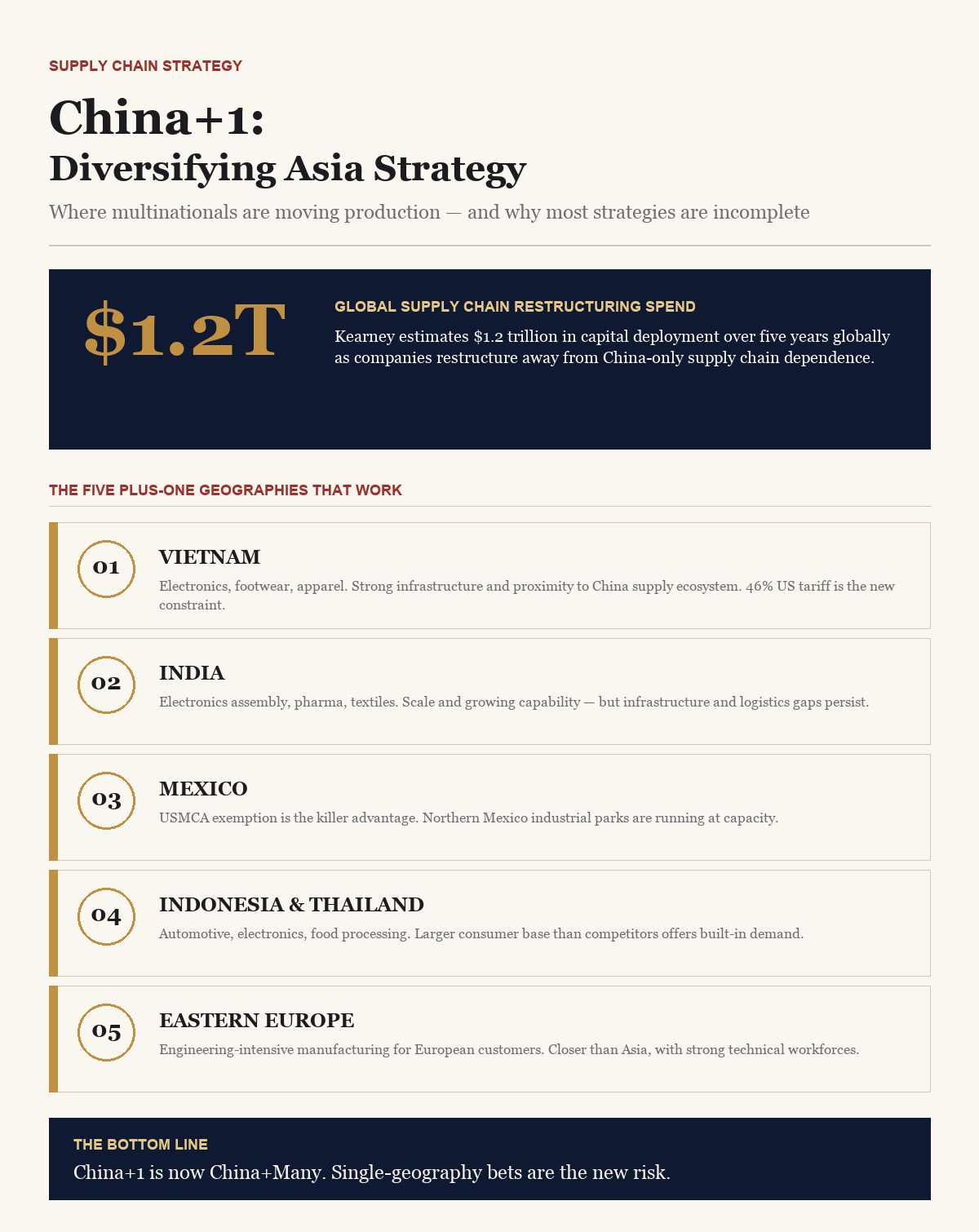
The Vietnamese success was real, but the underlying limitations of the strategy became apparent. The shift in production to Vietnam often involved Chinese components being assembled in Vietnamese facilities rather than genuine local supply chain development. The strategic objective of reducing Chinese exposure was achieved only partially when Vietnamese exports continued to depend on Chinese inputs. The vulnerability to subsequent policy changes affecting Vietnam itself, including the April 2026 Section 301 tariffs that imposed 46 per cent tariffs on Vietnamese goods to the US market, became a critical issue for companies that had concentrated their alternative production in Vietnam.
India received less Chinese-displaced manufacturing investment than Vietnam during the first wave, despite substantial government promotion of India as a manufacturing alternative. The Indian challenges, infrastructure limitations, regulatory complexity, smaller domestic component ecosystem, land acquisition difficulties, proved more binding than the policy messaging suggested. Indian manufacturing growth has been substantial in specific sectors including electronics assembly and pharmaceuticals, but India did not capture the Chinese-displaced manufacturing investment at the scale that the original China Plus One strategy contemplated.
The Mexico Acceleration
Mexico has emerged as the most rapidly expanding manufacturing alternative for goods serving the US market, supported by USMCA trade preferences and by the proximity advantage that allows for faster shipping and lower logistics costs than Asian alternatives. The Mexican manufacturing expansion has accelerated dramatically following the April 2026 US tariff actions that applied substantial tariffs to most Asian production but left USMCA-eligible Mexican production exempt.
The Mexican manufacturing wave is concentrated in northern Mexican states with established industrial infrastructure, Nuevo León, Coahuila, Sonora, Chihuahua, Baja California, that have substantial existing capability in automotive, electronics, and industrial manufacturing. The capacity constraints in these geographies have become significant; the demand for industrial real estate, skilled labour, and supporting infrastructure has exceeded what the regional economy can provide quickly. The pace of Mexican manufacturing expansion is constrained by these capacity factors rather than by the demand for alternative production locations.
The Mexican opportunity is not uniform across product categories. Electronics manufacturing in Mexico faces specific challenges around component supply that has historically come from Asia. Automotive manufacturing in Mexico has the longest history and the strongest supply chain support, with the integrated automotive industry across the US-Mexico border providing capability that newer manufacturing categories cannot easily replicate. The companies that have built successful Mexican manufacturing operations have generally done so over multi-year periods of capability development rather than through rapid relocation.
The Diversification Beyond Asia
The current China Plus One strategy increasingly involves diversification beyond Asia entirely, with manufacturing investment flowing to Mexico, Eastern Europe, Turkey, North African countries, and various other geographies. The diversification reflects the recognition that supply chain resilience requires geographic distribution that goes beyond just adding one or two Asian alternatives to Chinese production. The strategy is more capital-intensive and more operationally complex than the original China Plus One concept, but it provides genuine resilience that single-alternative strategies cannot match.
Eastern European manufacturing has grown substantially for production serving European markets, with Poland, the Czech Republic, Hungary, Slovakia, and Romania all attracting substantial Asian-displaced manufacturing investment. The combination of EU membership benefits, lower cost structures than Western Europe, and proximity to major European consumer markets has made Eastern European manufacturing a competitive option for products that previously came from Asian production for European markets. The pattern is most visible in automotive components, electronics, and various industrial categories (see our analysis in Doing Business in the Age of Sanctions).
Turkey has emerged as a meaningful manufacturing alternative serving European and Middle Eastern markets, with particular strength in textiles, automotive components, and consumer goods. North African countries including Morocco, Tunisia, and Egypt have attracted manufacturing investment serving European markets with lower-cost positions than Eastern European alternatives. The cumulative effect is that European supply chains are diversifying across multiple alternative geographies rather than concentrating in any single replacement for Asian production (see our analysis in Supply Chain Sovereignty).
The Technology Supply Chain Particular Case
Technology supply chain diversification presents particular complexity that goes beyond general manufacturing diversification. The concentration of advanced semiconductor manufacturing in Taiwan, of advanced display manufacturing in South Korea, of advanced battery production in China, and of various other specialised technology capabilities creates dependencies that cannot be addressed through general manufacturing diversification. The development of alternative production capability in these specialised categories requires substantial capital investment, multi-year timelines, and government support that typical commercial actors cannot provide on their own (see our analysis in India’s Manufacturing Moment).
The substantial government investment in technology supply chain diversification, through the US CHIPS Act, the EU Chips Act, and similar programmes in Japan, South Korea, India, and other countries, represents recognition that the technology supply chain concentrations require policy intervention rather than purely commercial response. The progress on these initiatives has been substantial but the timelines for full operation are extended. The supply chain diversification in technology categories will be a multi-year project that progresses through the late 2020s and into the 2030s.
The Supply Chain Software Layer
The China Plus One strategy of 2026 depends substantially on supply chain visibility, planning, and management software that did not exist at sufficient maturity during the earlier waves of supply chain diversification. The capability to manage production across multiple alternative geographies, to optimise inventory positioning to support diversified production, and to coordinate logistics across more complex supply chain networks has improved substantially through the past five years.
Supply chain visibility software, predictive analytics for supply chain disruption, and integrated planning systems that can model alternative supply chain configurations have all matured significantly. The companies that have invested in these capabilities have substantial operational advantages over companies that continue to manage supply chain diversification through spreadsheets and email coordination. The software investment is now an essential complement to the physical investment in alternative manufacturing capacity.
The China Position That Remains
Despite the diversification away from Chinese concentration, China remains the dominant manufacturing location for many product categories and is likely to remain so for years to come. The capability concentration that China has built across multiple industries, supply chain depth, infrastructure quality, skilled workforce, manufacturing scale, cannot be quickly replicated elsewhere, and the strategic position that China occupies in many global supply chains continues to be substantial.
The change in the strategic environment is not that China is being displaced, but that companies are reducing their dependence on Chinese single-source production for products where that dependence creates strategic vulnerability. The Chinese production that continues, and there is enormous Chinese production that continues, represents a deliberate strategic position rather than the default that earlier supply chain decisions had produced. The companies that have diversified well have generally maintained their important Chinese capabilities while reducing their concentration risk through alternative production development.
Strategic Implications for Business Leaders
For business leaders, the China Plus One strategy in 2026 requires several specific elements of capability and investment. The diversification across multiple alternative geographies rather than single replacements provides genuine resilience but requires more substantial investment and more sophisticated supply chain management capability. The supply chain visibility software and analytical capability that supports diversified production is essential rather than optional. The strategic patience to build alternative production capability over multi-year periods, accepting some short-term cost in exchange for long-term resilience, is required given how long it takes to develop genuine production capability in new geographies.
The companies that have executed China Plus One strategy well, building genuine production capability in multiple alternative geographies, investing in the software and management capability to support diversified operations, maintaining strong Chinese capability while reducing concentration risk, are positioned to navigate the continued geopolitical and trade policy volatility that is likely to characterise the next decade. The companies that have addressed the strategy superficially or have concentrated alternative production in single geographies will continue to face the strategic vulnerability that the original China Plus One concept was meant to address.
Supply chain diversification has moved from a hedging strategy to a defining element of corporate operational strategy. The companies that recognise this shift and execute against it deliberately will operate with structural advantages that companies treating supply chain diversification as a peripheral concern cannot match. The strategic reality of the 2026 operating environment is that single-country concentration in any major manufacturing geography carries risks that previous decades of supply chain optimisation did not require companies to consider.
