


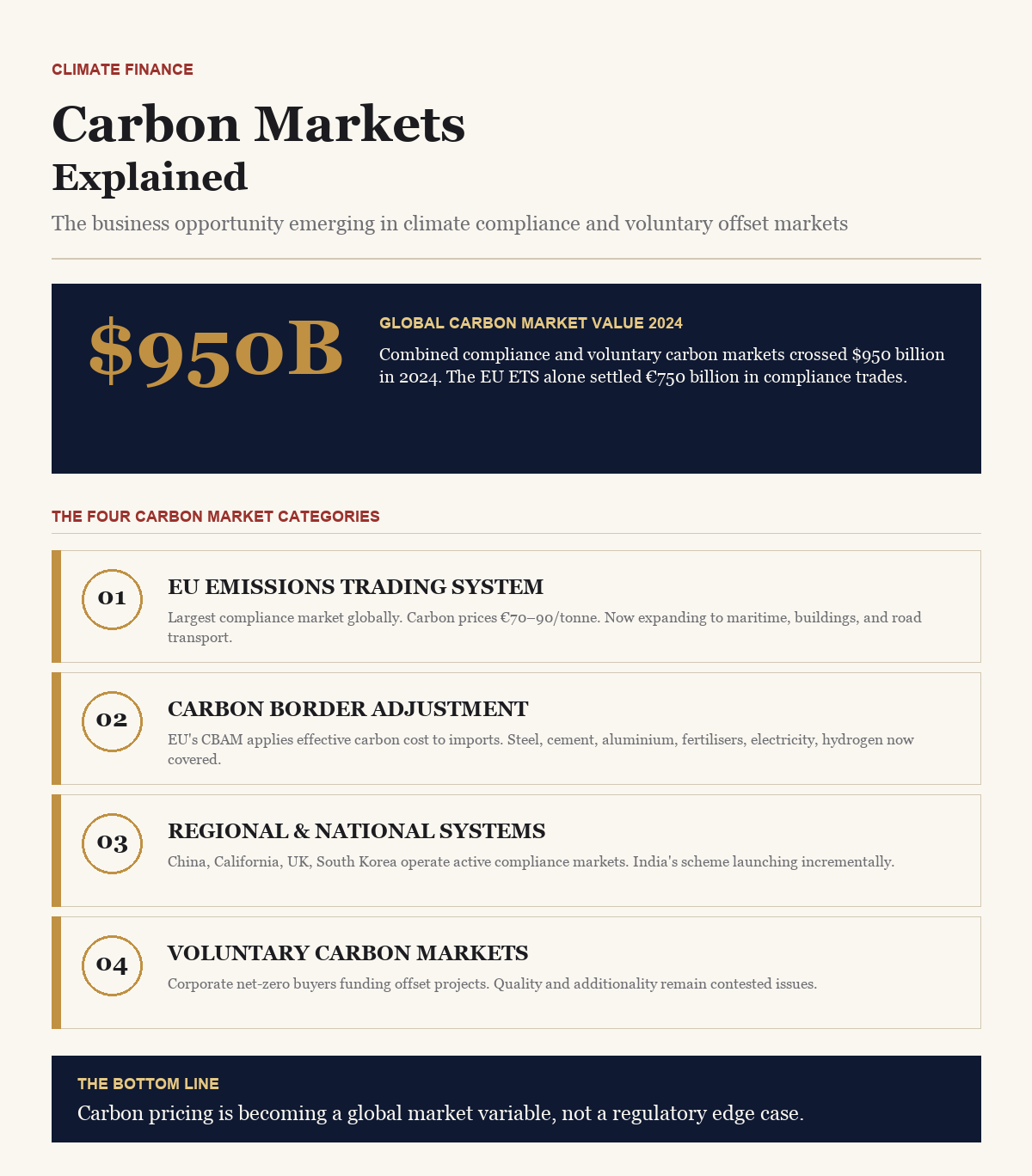
Carbon markets have moved from a specialist regulatory concept to mainstream financial infrastructure in the space of a single decade. The combined value of compliance carbon markets globally exceeded $950 billion in 2025, with annual transaction volumes growing as carbon pricing has expanded to cover larger fractions of global emissions. Voluntary carbon markets, despite the credibility challenges that affected the category in 2023 and 2024, recovered to approximately $14 billion in annual transaction volume in 2025 with strengthened methodologies and verification standards. The combined infrastructure now affects corporate decisions across most major economies, and the financial flows through carbon markets are sufficient to support a growing industry of trading, advisory, verification, and project development services.
Understanding carbon markets is no longer optional for businesses with material carbon exposure, which now includes most companies of meaningful size in most industries. The compliance obligations affect operating costs in important emitting sectors. The voluntary market opportunities affect competitive positioning in categories where customer and investor expectations include carbon performance. And the infrastructure that supports both compliance and voluntary activity is producing commercial opportunities for businesses that provide technology, services, and capital to support carbon market participation.
Compliance Carbon Markets: The Regulatory Foundation
Compliance carbon markets, emissions trading systems where covered entities must surrender allowances corresponding to their emissions, have expanded to cover a growing share of global emissions over the past decade. The EU Emissions Trading System remains the largest and most mature, covering approximately 40 per cent of EU emissions across power generation, energy-intensive industry, and aviation. The carbon price in the EU ETS has stabilised in the range of 70 to 90 euros per tonne of CO2 equivalent, providing meaningful economic signals for emissions reduction across covered sectors.
China’s national emissions trading system, launched in 2021 and gradually expanding, has become the world’s largest carbon market by emissions coverage and has begun to produce price signals that affect Chinese industrial decisions. The Chinese system initially covered only power generation but is expanding to additional sectors. The carbon price in the Chinese system has been substantially lower than EU prices, reflecting both the design of the system and the different policy objectives, but the price has been rising as the system matures.
California’s cap-and-trade programme, linked with Quebec’s similar system, covers approximately 80 per cent of California’s emissions and produces carbon prices in the range of 30 to 40 dollars per tonne. The Regional Greenhouse Gas Initiative covering several US northeastern states operates a power-sector-focused programme. New Zealand, South Korea, and several other countries operate national emissions trading systems with varying coverage and price levels. The cumulative coverage of compliance carbon markets has grown to approximately 25 per cent of global emissions.
The Carbon Border Adjustment Dimension
The European Union’s Carbon Border Adjustment Mechanism, fully effective in 2026, represents one of the most consequential developments in the international policy environment around carbon pricing. The mechanism applies effective carbon prices to imports of cement, iron and steel, aluminium, fertilisers, electricity, and hydrogen, with extensions to additional products planned for subsequent years. The objective is to prevent carbon leakage, the movement of emissions-intensive production from the EU to jurisdictions with weaker carbon pricing, and to support EU industrial competitiveness in the context of the EU’s own carbon pricing regime.
The implications for non-EU producers in covered categories are substantial. Indian steel producers, Chinese cement manufacturers, Russian aluminium smelters, and others exporting to the EU market must now report on the carbon intensity of their products and pay effective carbon prices on emissions that exceed EU benchmarks. The administrative complexity has been significant, and the financial implications are material for producers operating with carbon-intensive production processes.
The UK has implemented its own carbon border adjustment mechanism, beginning in 2027. Canada is developing similar measures. The US has not implemented a federal carbon pricing system, which complicates US discussion of carbon border adjustments, but several proposals have been advanced. The cumulative effect is that international trade in carbon-intensive products is being progressively reshaped by carbon pricing applied at borders, which creates competitive opportunities for low-carbon producers and competitive challenges for high-carbon producers.
Voluntary Carbon Markets: The Recovery
Voluntary carbon markets, where companies and individuals voluntarily purchase carbon credits to offset their emissions, experienced a substantial credibility crisis in 2023 and 2024. Investigative journalism and academic research identified that many high-volume credit categories, particularly forest-based offsets, had been generating credits that did not represent the emission reductions they claimed. The reputational damage to the voluntary market was substantial, and many corporate offset purchasers paused their voluntary market activity pending clarity on methodology improvements.
The response from the voluntary market infrastructure has been significant methodology improvement and standard-strengthening over the subsequent period. The Integrity Council for the Voluntary Carbon Market has developed Core Carbon Principles that establish higher integrity standards for credit issuance. The Voluntary Carbon Markets Integrity Initiative has provided guidance on credible corporate use of voluntary credits. The Verified Carbon Standard, Gold Standard, and other registries have revised their methodologies for problematic credit categories. The market that has emerged from the crisis period is smaller than the peak but operating with substantially higher integrity standards.
The voluntary carbon market that exists in 2026 is more rigorous, more focused on specific high-quality credit categories, and more closely aligned with corporate net-zero strategies than the market that existed before the credibility crisis. Direct air capture credits, biochar credits, ocean-based credits, and certain enhanced rock weathering credits represent the higher-quality end of the market that has continued to grow even during the broader market’s challenges. The price differentiation between high-quality and lower-quality credits has increased substantially, supporting the development of credit categories that produce verifiable emission reductions or removals (see our analysis in Food & Agriculture Tech).
Corporate Strategy in Carbon Markets
Corporate engagement with carbon markets has matured substantially over recent years and is now a routine element of carbon management strategy for most large companies. The strategic frameworks that have emerged distinguish between several different categories of carbon activity that have different financial and strategic implications (see our analysis in The Green Premium).
Compliance carbon strategy addresses the obligations that companies face under the various emissions trading systems where they operate. The strategic decisions include allowance trading approaches, hedging of carbon price exposure, and investment in emissions reduction projects that reduce future compliance costs. Companies operating in covered sectors typically maintain dedicated carbon trading and analysis functions, often integrated with their broader energy procurement and risk management capabilities (see our analysis in ESG Investing).
Voluntary carbon strategy addresses the use of voluntary credits to support corporate climate commitments, particularly net-zero targets that incorporate offsets for residual emissions that cannot be eliminated through operational reduction. The strategy has shifted substantially toward higher-quality credits, more rigorous evaluation of credit claims, and more transparent communication about how credits are used in corporate climate strategy. The reputational risks of using lower-quality credits or making exaggerated claims have made the strategy more conservative than it was during the earlier offset purchasing period.
Carbon project investment provides a different strategic approach for companies seeking to develop their own carbon credit supply or to make direct investments in emissions reduction projects. Microsoft, Stripe, Frontier (the climate buyer’s club that includes Stripe, Shopify, McKinsey, Alphabet, and Meta among others), and various other companies have made substantial commitments to forward purchase of carbon removal credits from emerging technology categories including direct air capture and enhanced rock weathering. These commitments provide market signal that supports the development of new credit categories while securing future credit supply for the purchasers.
The Business Opportunity in Carbon Markets
Carbon markets have created substantial commercial opportunities beyond the participation of emissions-intensive companies. Carbon project development, the creation of projects that produce carbon credits, has become an active commercial activity across multiple categories including reforestation, agricultural soil carbon, methane capture, and various technology-based removal approaches. The capital flowing into carbon project development supports both established credit categories and the development of new credit categories with potentially substantial future supply.
Carbon market services, trading, advisory, verification, registry operation, and the various other functions that support market operation, represent a growing industry. Major commodity trading houses, financial services firms, and specialised carbon trading companies have built substantial commercial activity in carbon markets. The infrastructure that supports voluntary carbon market integrity, including the verification bodies that confirm project performance, represents particularly important capability that is itself a meaningful commercial category.
Technology development for carbon measurement, monitoring, reporting, and verification has emerged as an active venture capital category. Companies developing satellite-based monitoring of emissions, IoT-based monitoring of land-based carbon stocks, and various analytical capabilities supporting carbon market integrity have attracted substantial investment. The technology infrastructure supporting carbon markets is improving in ways that should further support the market’s development.
India’s Carbon Market Development
India’s carbon market development has accelerated through the establishment of the Carbon Credit Trading Scheme, which has been progressively implementing a domestic compliance carbon market for Indian industry. The scheme builds on the earlier Perform Achieve Trade scheme for energy efficiency and represents a structured progression toward more comprehensive carbon market coverage in India. The pace of implementation has been gradual, but the trajectory toward a substantial Indian carbon market is established.
Indian participation in voluntary carbon markets has been significant, with Indian projects representing a substantial share of certain voluntary credit categories including renewable energy credits, biomass-based credits, and various other project types. The challenges that affected the broader voluntary market have affected Indian project developers, who have had to adapt to the methodology and integrity requirements that have strengthened.
What This Means for Business Leaders
For business leaders, the practical implications of the carbon market development are several. The carbon pricing exposure that companies face through compliance markets and through carbon border adjustments has become a significant element of operating cost management for companies in affected sectors. Strategic decisions about carbon emissions reduction, including capital investment in lower-emission technology and operational changes, are increasingly influenced by the carbon price signals that the markets produce.
The voluntary market participation requires more rigorous evaluation and more transparent communication than was common during the earlier voluntary market growth period. Companies using voluntary credits as part of their climate strategy need to invest in the analytical capability to evaluate credit quality, the risk management to address potential credibility issues, and the communications discipline to describe their offset activity accurately to stakeholders.
The business opportunity in carbon markets, both through participation in markets and through provision of services that support market operation, is real and growing. The companies that engage thoughtfully with this developing infrastructure will be positioned for participation in what is becoming a substantial and durable element of the global commercial environment.
