


The Middle East’s relationship with the global economy has been defined for decades by oil. The region’s hydrocarbon resources have funded substantial sovereign wealth accumulation, supported infrastructure development, and provided the export revenues that have shaped both regional and global economic dynamics. But the Middle East of 2026 is engaged in a deliberate and substantial effort to redefine its economic foundations. Saudi Arabia’s Vision 2030, the UAE’s Vision 2071, Qatar’s National Vision 2030, and similar programmes across other Gulf states represent diversification ambitions that involve trillions of dollars in deployment and that are reshaping the commercial landscape of the region in ways that affect global businesses far beyond traditional energy sector engagement.
The scale of the diversification effort is unusual in global economic history. The capital available, through both sovereign wealth funds with assets exceeding $4 trillion across the Gulf states and through direct government investment, provides resources for economic transformation that few other regions have matched. The political will and strategic focus that has been applied to the diversification effort, particularly in Saudi Arabia and the UAE, has produced execution that has exceeded what scepticism of earlier diversification announcements would have predicted. For international businesses, the question is no longer whether the Middle East matters strategically; it is how to engage with the specific opportunities that the diversification programmes are creating.
Saudi Arabia’s Vision 2030
Saudi Arabia’s Vision 2030, announced in 2016 and refined through subsequent updates, represents the largest single economic transformation programme currently underway in any major economy. The programme aims to reduce Saudi dependence on oil from approximately 40 per cent of GDP at its launch to less than 15 per cent by 2030, with the difference made up through development of tourism, entertainment, technology, manufacturing, and financial services sectors. The capital being deployed against these objectives, through the Public Investment Fund, through direct government investment, and through partnerships with international companies, exceeds $1 trillion across the programme period.
The visible expression of Vision 2030 is the giga-projects: NEOM, the planned $500 billion futuristic city in the northwest of Saudi Arabia; The Line, the linear city concept within NEOM; the Red Sea Project, a luxury tourism development along the Red Sea coast; AlUla, the cultural heritage and tourism development around ancient archaeological sites; Qiddiya, the entertainment city outside Riyadh; and several others. These projects represent infrastructure investment at scales that few other economies have attempted, with construction contracts and operational opportunities that have attracted international engineering, construction, hospitality, and technology companies in substantial numbers.
Beyond the giga-projects, Vision 2030 includes sectoral development programmes in tourism, financial services, technology, manufacturing, and entertainment. The opening of Saudi Arabia to international tourism, through new visa regimes, infrastructure development, and the development of tourism destinations, has produced visible early results, with international visitor arrivals growing substantially from a very low base. The development of Riyadh as a regional financial centre, supported by the establishment of the regional headquarters requirement for multinational companies seeking Saudi government contracts, has shifted the regional financial services landscape.
The UAE’s Established Position and Continuing Development
The UAE has been the most successful Middle Eastern economy in terms of diversification, with non-oil sectors now contributing the majority of GDP across the federation and with Dubai specifically operating as one of the most diversified economies in the region. The UAE’s approach has emphasised the development of services sectors, finance, logistics, tourism, real estate, business services, alongside selected manufacturing and technology development. The result has been an economy that is substantially less exposed to oil price volatility than other Gulf economies.
The UAE has continued its diversification with focused initiatives in specific high-priority sectors. The artificial intelligence focus, supported by the establishment of the Ministry of AI in 2017 and substantial investment in AI infrastructure and capability, has positioned the UAE as a regional AI hub. The financial technology development in the Abu Dhabi Global Market and the Dubai International Financial Centre has supported the growth of a substantial fintech ecosystem. The space sector development, including the Emirates Mars Mission and the development of commercial space services, represents an unusual and ambitious investment area.
Dubai’s role as a regional logistics, business, and trading hub has been further strengthened through continued infrastructure investment, regulatory reform, and the development of free zones with specific sectoral focus. The Dubai Multi Commodities Centre, the Dubai Internet City, and various other specialised free zones have created operating environments that have attracted substantial international business establishment in the UAE.
Qatar and the Smaller Gulf Economies
Qatar’s National Vision 2030 has supported a more focused diversification strategy that emphasises specific sectors where the country has natural or strategic advantages. The development of Qatar Airways as a global aviation business, the use of Qatari investment to build international financial positions including the Qatari Investment Authority’s substantial international real estate and equity holdings, and the development of natural gas-related industrial capabilities have produced sustainable diversification within a smaller scale than Saudi Arabia or the UAE.
The 2022 FIFA World Cup hosting represented a substantial infrastructure investment that has supported the country’s tourism, hospitality, and event hosting capabilities beyond the immediate tournament period. The combination of the natural gas economic foundation and the diversified investment portfolio has provided Qatar with a stable economic base that is less exposed to specific commodity price cycles than purely oil-dependent economies.
Bahrain, Kuwait, and Oman have pursued more modest diversification programmes, each shaped by specific economic and political conditions. The diversification opportunities for international businesses in these smaller Gulf economies are more focused but can be significant in specific sectors. Bahrain’s role as a regional banking centre, Kuwait’s substantial sovereign wealth deployment, and Oman’s tourism and logistics development each represent specific engagement opportunities (see our analysis in Strait of Hormuz).
The Sovereign Wealth Fund Dimension
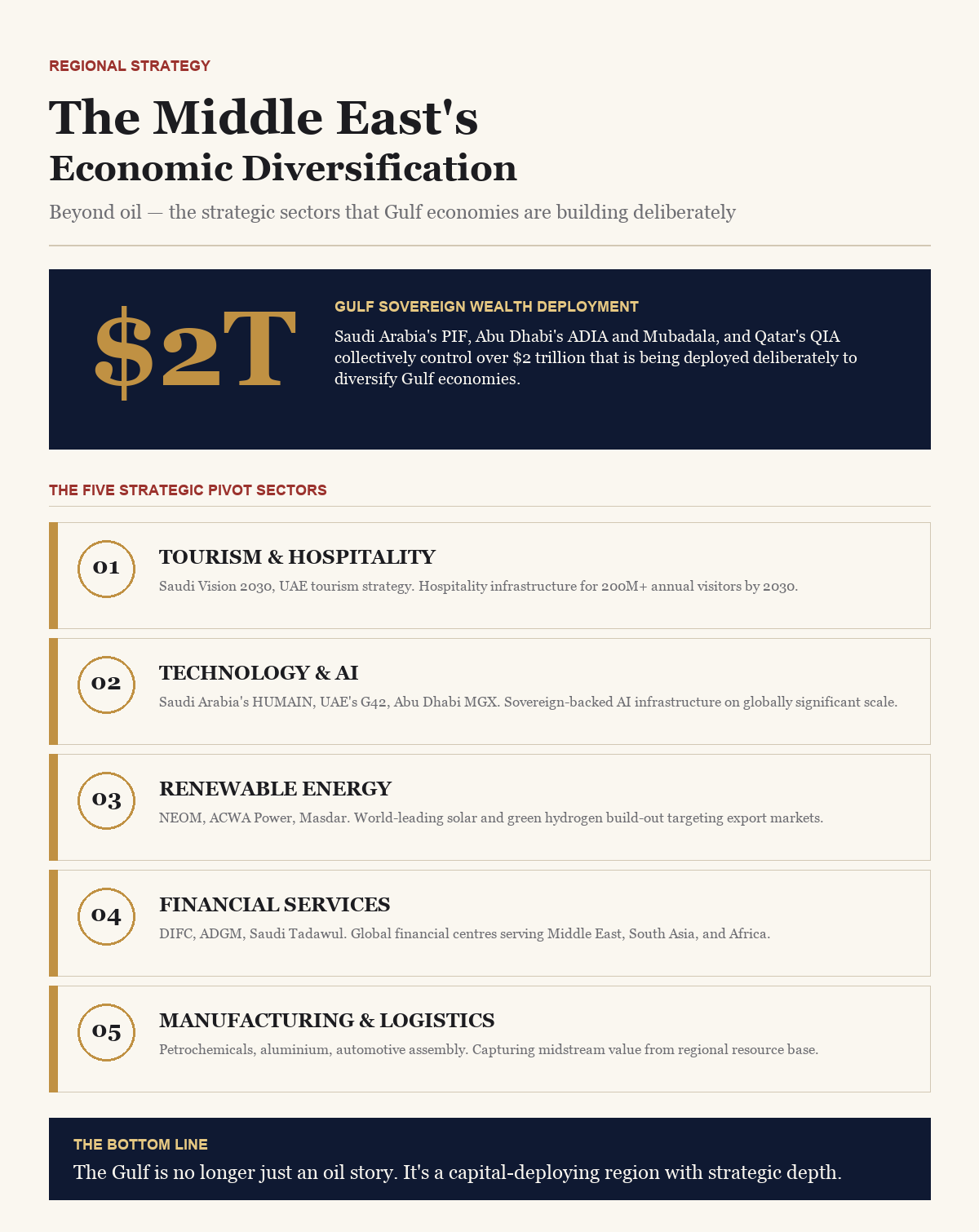
The sovereign wealth funds of the Gulf states have become some of the most consequential pools of investment capital globally, with implications that extend well beyond the region. The Public Investment Fund of Saudi Arabia, the Abu Dhabi Investment Authority, Mubadala, the Investment Corporation of Dubai, the Kuwait Investment Authority, and the Qatar Investment Authority collectively manage over $4 trillion in assets across global markets and across specific Saudi and Emirati domestic investment programmes (see our analysis in Supply Chain Sovereignty).
The investment patterns of these sovereign wealth funds have shifted in recent years toward more direct and strategic investment in specific industries and companies. Public Investment Fund holdings include substantial positions in Lucid Motors, Uber, gaming companies, sports rights including LIV Golf, and various technology investments through partnerships with major global venture capital firms. Mubadala has built a sophisticated technology investment portfolio that includes positions in many leading AI and technology companies. The combination of available capital and strategic intent has made these sovereign wealth funds important counterparties for capital-intensive technology development globally (see our analysis in Africa’s Business Boom).
For technology companies, financial services firms, and various other businesses seeking large-scale capital partnership, the Gulf sovereign wealth funds have become increasingly important investors. The capital is patient, the time horizons are long, and the strategic objectives are often broader than purely financial return optimisation. The engagement requires understanding of the specific objectives of each sovereign wealth fund and the political dynamics that shape investment decisions, but it provides capital partnership opportunities that few other sources can match.
The Technology Sector Focus
Technology sector development has been a particularly focused element of Gulf economic diversification. Saudi Arabia’s investment in technology infrastructure includes substantial commitments to AI infrastructure, semiconductor capability, cloud computing capacity, and the broader digital economy. The Lucid Motors investment, the Magic Leap partnership, and various other technology investments have positioned the country as a meaningful player in specific technology categories.
The UAE’s technology focus has produced operational results that include the establishment of Hub71 as a venture capital and startup ecosystem in Abu Dhabi, the development of significant AI computing infrastructure, and the operating presence of major global technology companies in the country. The G42 group, which includes substantial AI capabilities and has emerged as one of the prominent AI companies in the region, represents the kind of indigenous technology capability that the diversification programmes have sought to build.
The broader trend across the Gulf is toward serious investment in artificial intelligence, semiconductors, advanced manufacturing, biotechnology, and renewable energy technology. The investments will not all succeed, but the scale of commitment is sufficient to produce meaningful regional capability across these technology areas over the next decade.
Tourism and Entertainment Development
Tourism development has been one of the most visible diversification priorities, particularly in Saudi Arabia and the UAE. The development of new tourism destinations, the easing of visa requirements, the development of entertainment and hospitality infrastructure, and the attraction of major international events have all supported substantial growth in tourism-related economic activity. International hotel chains, hospitality service providers, entertainment companies, and aviation businesses have all benefited from this development.
The cultural and entertainment opening in Saudi Arabia has been particularly notable given the country’s previous restrictions on entertainment activities. The development of music festivals, sporting events, cinema, and entertainment districts has created commercial opportunities in categories that did not exist in the country a decade ago. The pace and scope of cultural change has been substantial and has implications for businesses in entertainment, hospitality, and various consumer services sectors.
Strategic Implications for Business Leaders
For business leaders considering Middle East engagement, the regional diversification has created opportunities that did not exist a decade ago and that warrant strategic attention beyond what previous engagement patterns suggest. The opportunities are not uniform across the region, each country has specific priorities, regulatory environments, and operating conditions that affect business strategy, but the cumulative scale of the diversification investment is sufficient to support multiple categories of international business engagement.
The capital availability through sovereign wealth funds and direct government investment provides opportunities for businesses that require substantial capital partnership. Technology companies, infrastructure developers, manufacturing investors, and various other capital-intensive businesses have found terms of capital deployment from Gulf sources that are difficult to match through other sources of patient capital.
The operational engagement opportunities require sustained commitment and local capability development. The Gulf economies are not simple markets to operate in, regulatory environments, cultural considerations, and political dynamics all require thoughtful management, but the businesses that have invested in genuine local engagement have generally produced better results than businesses that have approached the region through occasional visits and arm’s-length partnerships.
The diversification of the Middle East represents one of the more consequential economic transformations underway in the global economy. The companies that engage thoughtfully with the specific opportunities that the transformation is creating will be positioned for participation in a region that will increasingly matter to global business dynamics over the next decade and beyond.
