



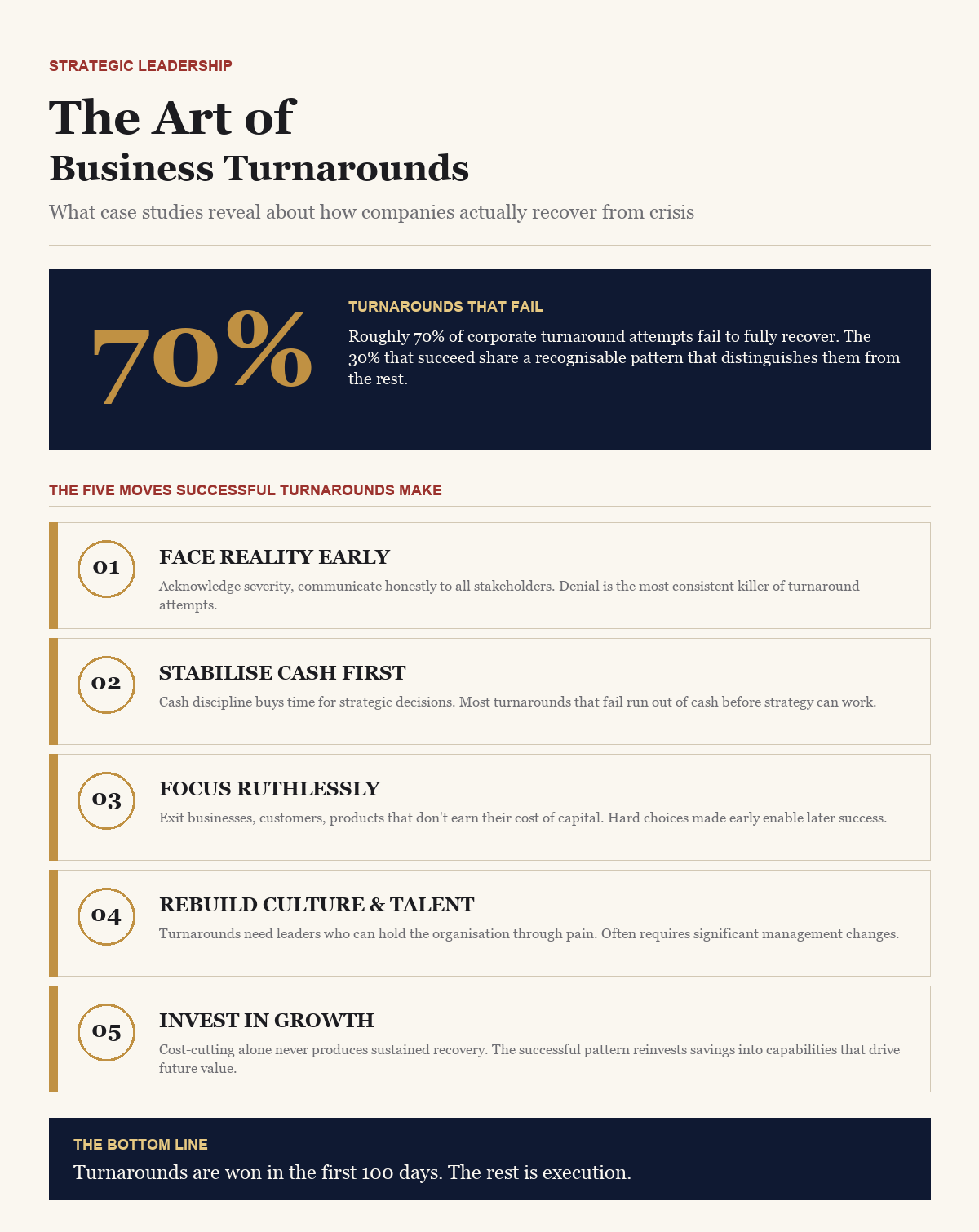
Most business turnarounds fail. The statistics on turnaround attempts across the past three decades suggest that fewer than 30 per cent of distressed companies that pursue active turnaround strategies achieve sustained recovery. The rest either decline further into terminal distress, are acquired at distressed valuations that destroy substantial shareholder value, or stabilise at performance levels well below their previous potential. Despite the low success rate, turnarounds remain one of the most actively pursued strategic responses to corporate distress because the alternatives, sale at distressed valuations or controlled liquidation, typically produce worse outcomes for stakeholders than even partially successful turnarounds.
The minority of successful turnarounds share patterns that distinguish them from the failed majority. These patterns are visible in the case studies of companies that have executed difficult corporate reinventions over recent decades, and they offer instructive principles for leaders who find themselves facing turnaround situations or who want to understand what genuinely transformative change looks like in business contexts.
Microsoft’s Cultural Transformation
Microsoft’s transformation under Satya Nadella, who succeeded Steve Ballmer as CEO in February 2014, is among the most consequential corporate turnarounds of the past decade, though it is unusual in that the company was not in obvious financial distress at the time of the leadership change. Microsoft was financially profitable but strategically adrift, with mobile and cloud strategies that had failed to compete effectively against Apple, Google, and Amazon. The stock had been essentially flat for the previous decade, and the company was widely viewed as a legacy software business unlikely to participate meaningfully in the next phase of technology industry development.
Nadella’s turnaround focused on cultural transformation as much as on strategic repositioning. The ‘growth mindset’ framing he introduced, drawing on the work of Carol Dweck, signalled a shift from the internally competitive culture that had characterised the Ballmer era to a more collaborative and externally focused organisation. The strategic shifts that followed, substantial investment in Azure cloud infrastructure, partnerships with previously competing technology companies, mobile strategy focused on cross-platform productivity rather than Windows Phone, were enabled by the cultural shift rather than the other way around.
The financial results have been remarkable. Microsoft’s market capitalisation has grown from approximately $300 billion at Nadella’s appointment to over $3 trillion in 2026. The company has become a credible leader in cloud computing, artificial intelligence, and enterprise productivity in ways that seemed unlikely from the company’s 2013 position. The Microsoft case demonstrates that turnarounds can succeed even in companies that are not in obvious distress, when leadership recognises strategic positioning issues before they become financial crises.
IBM’s Ongoing Transformation Attempt
IBM provides a different kind of case study, one in which the turnaround attempt has produced mixed results despite substantial leadership and investment. The company has been pursuing strategic transformation toward cloud computing, artificial intelligence, and hybrid IT services for over a decade across multiple CEOs. The transformation has involved substantial business divestitures, including the 2021 spin-off of the Kyndryl managed services business, and large acquisitions including the Red Hat acquisition in 2019.
The IBM case illustrates the difficulty of transforming a company from a legacy core business to new growth categories while continuing to depend on the legacy business for current revenue and profitability. The strategic moves have been substantial, but the financial results have been more modest, with revenue growth that has lagged technology industry peers and stock performance that has underperformed broad technology indices. The IBM case suggests that even substantial transformation investment may not be sufficient when the underlying competitive position has eroded significantly.
Best Buy’s Operational Turnaround
Best Buy’s turnaround under Hubert Joly, who became CEO in August 2012, is one of the most successful operational turnarounds in retail. The company was widely expected to be killed by Amazon and other online competitors, with the trade press regularly comparing Best Buy to Circuit City and other failed electronics retailers. The company’s stock had declined approximately 70 per cent from its 2007 peak, and same-store sales were declining quarter over quarter.
Joly’s turnaround focused on operational improvements rather than dramatic strategic repositioning. Price matching with online competitors, store-level operational discipline, employee engagement initiatives, vendor relationship improvements, and selective real estate optimisation produced measurable improvements in operational performance over several years. The strategic shift toward becoming a ‘technology services’ provider rather than purely a product retailer added a growth dimension that complemented the operational improvements.
Best Buy’s financial recovery was substantial: same-store sales returned to growth within two years, operating margins improved materially, and the stock recovered to multiple times its turnaround-period low. The Best Buy case demonstrates that turnarounds can succeed through disciplined operational execution without requiring dramatic strategic transformation, when the underlying business has structural characteristics that can support recovery.
Apple’s Earlier Reinvention
Apple’s transformation under Steve Jobs, beginning with his return to the company in 1997, is the canonical case study of corporate reinvention. The company at Jobs’s return was within months of bankruptcy, had no clear strategic direction, and had produced a series of failed product launches and management changes over the preceding decade. The transformation that followed, the streamlining of the product line, the focus on design and user experience, the introduction of the iMac, iPod, iPhone, and iPad, created the most valuable company in history (see our analysis in Private Equity & Mid-Market).
The Apple case is so frequently cited that its specific lessons have been somewhat obscured by general celebration. The actual mechanisms of the transformation were operationally precise: reducing the product portfolio dramatically to focus resources, building deep capability in industrial design and user experience as differentiators, restructuring supply chain relationships to enable production at scale, and developing new product categories that extended the company beyond its computer-only legacy. The transformation took years and was not financially apparent for substantial portions of that period, Apple did not produce consistent profitability until several years after Jobs’s return (see our analysis in The CEO Playbook Has Changed).
Common Patterns in Successful Turnarounds
Across the case studies of successful turnarounds, several patterns recur with sufficient consistency to be considered defining characteristics. Leadership change is almost always involved, typically with new leadership brought in from outside the company or from a non-traditional career path within the company. The fresh perspective and the absence of commitment to previous strategic choices appear to be important enablers of substantive change (see our analysis in Middle Management Is Undervalued).
Decisive action on the underperforming or non-strategic elements of the business typically occurs early in successful turnarounds. Business unit divestitures, product line eliminations, geographic exits, and management changes that signal that the new direction is genuine all typically occur in the first 12 to 18 months of a turnaround. The decisive early action serves multiple purposes: it focuses resources on the parts of the business that can be saved, it signals to stakeholders that change is real, and it removes ongoing drains on management attention and financial resources (see our analysis in Culture of Innovation).
Cultural change accompanies operational and strategic change in successful turnarounds, though the cultural component is often less visible from outside than the strategic moves. The shift from defensive postures to confident execution, from internal politics to customer focus, from incremental improvement to substantial reinvention requires cultural elements that cannot be separated from operational elements. The Nadella era at Microsoft is the clearest recent example, but the pattern is consistent across most successful turnarounds.
Sustained execution over multi-year periods is required. Few turnarounds are completed within the timeframes that capital markets initially expect. The companies that have completed successful turnarounds have typically benefited from leadership stability across the transformation period, the same CEO, with broadly consistent strategic direction, executing over five to seven years or more. Turnarounds that have changed leadership multiple times during the transformation period have typically not produced sustained recovery.
Common Patterns in Failed Turnarounds
The failed turnaround attempts also share patterns that distinguish them from the successful ones. Incrementalism, attempting to address performance problems through modest operational adjustments while leaving the fundamental strategic position unchanged, is a common pattern in failed turnarounds. The approach can produce temporary improvements but typically does not address the underlying issues that produced the original distress, and the improvements eventually reverse.
Continued investment in the strategic positions that have produced underperformance is another consistent failure pattern. Companies that recognise the need for change but continue to invest disproportionately in the businesses that have caused the distress typically do not produce sustained recovery. The investment pattern reflects a refusal to accept that previous strategic choices were wrong, which prevents the redirection of resources that successful turnarounds require.
Frequent strategic pivots, with new directions announced and then abandoned before they could be evaluated, characterise some failed turnarounds. The pattern often reflects board or investor pressure to produce visible change quickly, combined with leadership that does not have the conviction or capability to sustain a specific direction through the inevitable difficulties of execution. The strategic instability undermines the conditions for any specific direction to succeed.
The Indian Turnaround Context
Indian corporate turnarounds have specific characteristics shaped by the country’s regulatory environment, corporate structure, and capital market conditions. The Insolvency and Bankruptcy Code, implemented in 2016 and refined through subsequent amendments, has provided a more structured framework for resolving distressed Indian companies than previously existed. The framework has facilitated turnarounds through restructuring processes that combine debt restructuring with operational reorganisation and frequently with changes in ownership.
Successful Indian corporate turnarounds typically combine operational improvements, balance sheet restructuring, and often strategic repositioning to take advantage of Indian market opportunities that the previous strategy had missed. The combination of family business dynamics in many Indian companies and the more recent emergence of professional management has produced varied turnaround dynamics across different segments of Indian business.
What This Means for Leaders
For leaders facing turnaround situations or who want to understand what genuinely transformative change requires, the case studies provide several specific lessons. Decisive action on the most difficult issues, typically including divestitures, management changes, and resource reallocation, produces better outcomes than gradual approaches that attempt to minimise short-term pain. Sustained execution over multi-year periods is required to produce results that capital markets will recognise; the timeline cannot be compressed beyond a certain point regardless of management urgency or stakeholder pressure. Cultural and operational change must accompany strategic change, because strategic moves that are not supported by organisational capability do not produce results.
Turnarounds remain difficult, with most attempts failing despite the lessons from successful cases. But the successful cases demonstrate what is possible when leadership combines strategic clarity, decisive execution, cultural transformation, and sustained commitment over the timeframes that genuine reinvention requires. The pattern is hard to execute, but it is identifiable, and it can be learned from by leaders who recognise that their organisations need substantive change rather than incremental adjustment.
