



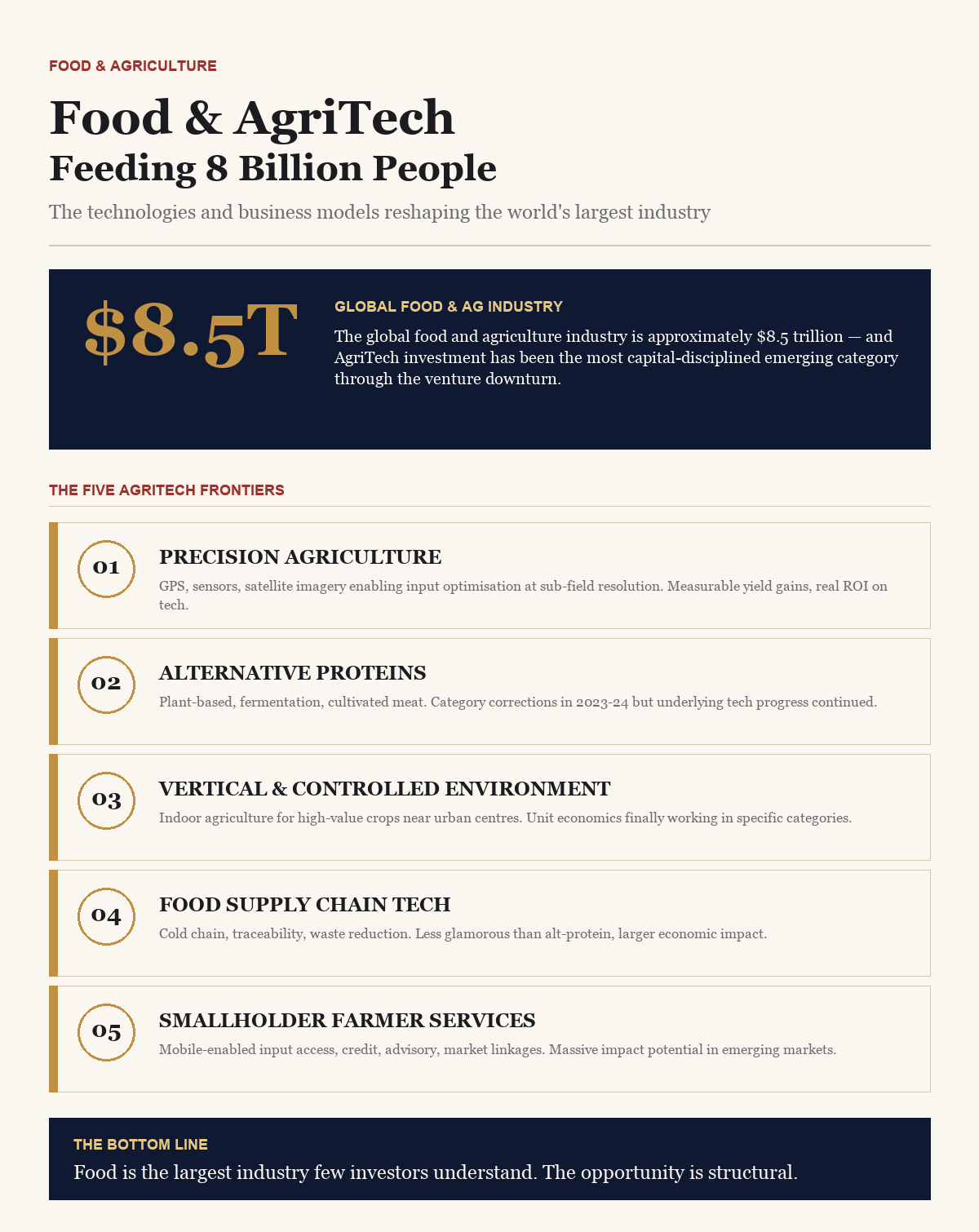
The global food system feeds more than 8 billion people through a network of agricultural production, processing, distribution, and retail activities that collectively represent approximately 10 per cent of global GDP. The system has performed remarkably across recent decades, with global undernourishment rates declining substantially even as population has grown. But the system faces challenges that question whether its historical performance can continue: climate change is affecting agricultural productivity in important growing regions, water scarcity is intensifying in major agricultural geographies, soil degradation reduces productivity in long-cultivated land, and shifting consumer preferences are reshaping demand for animal protein and processed foods in ways that have implications for the entire value chain.
The response has been substantial investment in agricultural and food technology over the past decade, with venture capital deployment in the sector exceeding $50 billion globally during the 2018 to 2025 period. The investment has supported development of technologies across multiple categories: precision agriculture, alternative proteins, agricultural biotechnology, food processing innovation, supply chain technology, and farm management software. The performance of investments in these categories has varied substantially, and understanding which categories have delivered genuine impact versus which have produced more promise than substance is important for anyone with exposure to the sector.
Precision Agriculture: The Quiet Success
Precision agriculture has been the most consistently successful category of agricultural technology over the past decade. The combination of GPS-guided equipment, satellite imagery, soil sensors, and management software has produced measurable productivity improvements in major agricultural operations globally. Yields have increased modestly while input use, fertiliser, pesticides, water, has decreased materially in operations that have adopted precision techniques systematically. The economic returns on precision agriculture investments are substantial enough that adoption has continued through periods when other agricultural categories struggled with profitability.
The leading providers of precision agriculture technology, John Deere, AGCO, CNH Industrial, have built integrated platforms that combine equipment, software, and data services. The complementary ecosystem of agricultural data services, satellite imagery providers (Planet Labs, Maxar), and analytics specialists provides the broader infrastructure that supports precision agriculture deployment. Indian precision agriculture has progressed more slowly than US or European adoption, reflecting smaller farm sizes and different equipment economics, but specific programmes for cotton, sugarcane, and other crops have demonstrated meaningful productivity improvements where adopted.
The next phase of precision agriculture development involves greater integration of artificial intelligence into farm management decisions. AI-enabled weed identification and targeted herbicide application can reduce herbicide use substantially. AI-enabled crop disease detection from satellite imagery can identify problems before they spread. AI-enabled yield forecasting can support better commercial decisions about marketing and storage. The cumulative impact of these capabilities, deployed progressively across global agriculture, will continue to shape productivity outcomes through the late 2020s.
Alternative Proteins: The Promising Disappointment
Alternative protein development has been one of the most heavily invested and most disappointing categories of food technology over the past decade. The thesis was compelling: meeting growing global protein demand through conventional animal agriculture faces resource constraints (water, land, feed) and environmental impacts (greenhouse gas emissions) that suggest a structural shift toward plant-based, fermentation-based, and cultivated meat alternatives would be both necessary and economically valuable. Venture capital deployed approximately $9 billion globally into alternative protein companies during 2020 to 2024.
The commercial results have not matched the investment thesis. Beyond Meat and Impossible Foods, the two highest-profile plant-based meat companies, have both experienced significant commercial difficulties. Beyond Meat’s stock has declined more than 95 per cent from its 2019 peak. Impossible Foods has cut costs and laid off employees as growth has stalled. The category as a whole has experienced flat or declining sales in major markets after a period of strong growth from 2017 to 2021. The reasons reflect a combination of factors: pricing premiums that consumers have proven unwilling to sustain in inflationary periods, taste and texture limitations that have not been fully resolved, and the highly processed nature of plant-based meats that conflicts with consumer preferences for less-processed foods.
Cultivated meat, meat produced from animal cells without raising animals, has faced even greater commercial challenges. The technology has been demonstrated at scale, with regulatory approvals in the United States, Singapore, and other markets, but production costs remain orders of magnitude above conventional meat. The path to commercial-scale cultivated meat at competitive prices requires substantial additional research, capital deployment, and operational scale-up over a timeline that may extend to the 2030s for meaningful market impact.
Agricultural Biotechnology: Steady Progress
Agricultural biotechnology has continued to produce incremental but meaningful improvements in agricultural productivity through genetic modification, gene editing, and other techniques. The major agricultural biotech companies, Bayer (which acquired Monsanto), Corteva, Syngenta, BASF, have developed seed varieties that incorporate traits including drought tolerance, pest resistance, and improved yield characteristics. Gene editing techniques including CRISPR have enabled more precise and faster development of new varieties than was possible with earlier genetic modification techniques (see our analysis in The Future of Energy).
The regulatory environment for agricultural biotechnology varies substantially across major markets. The United States has a relatively permissive framework that has supported widespread adoption of GMO crops. The European Union has historically been more restrictive, though recent regulatory reforms have eased restrictions on gene-edited crops that do not introduce foreign DNA. China has developed substantial domestic agricultural biotechnology capability with regulatory support. India has approved specific GM crops including cotton but has been cautious about food crops, with the regulatory approval process for GM food crops remaining complex and politically contentious (see our analysis in The Green Premium).
Indoor Agriculture: A Mixed Verdict
Indoor agriculture, including vertical farming, controlled environment agriculture, and greenhouse production, attracted substantial investment during 2019 to 2022 based on the thesis that controlled growing environments could produce higher yields per unit of land, reduce water consumption, eliminate pesticide use, and enable production closer to urban consumption centres. The investment has produced impressive technical demonstrations of indoor agriculture capability but more mixed commercial results (see our analysis in Carbon Markets Explained).
The economic challenge of indoor agriculture is that energy costs for lighting and climate control typically exceed the cost advantages of controlled production for most crop categories. Indoor agriculture has demonstrated competitive economics for high-value, fast-growing crops including leafy greens, herbs, and certain berries. Extension to staple crops, wheat, rice, soybeans, faces fundamental energy economics that current technology cannot overcome. The thesis that indoor agriculture would transform food production at scale has not been validated, though specific applications remain commercially relevant.
Supply Chain Technology
Food supply chain technology has been one of the more successful categories of food tech investment. Cold chain logistics improvements, traceability systems that track food through the supply chain, food safety monitoring, and supply chain optimisation software have all delivered measurable operational improvements for food companies and retailers. The transparency requirements emerging from food safety regulations and consumer preferences for product origin information have supported sustained investment in supply chain technology.
Blockchain-based food traceability systems, including IBM’s Food Trust platform and various industry-specific implementations, have moved from pilots to operational use across major retailers and food processors. The systems provide rapid response capability when food safety issues emerge, allowing contaminated product to be traced and removed from the supply chain much faster than legacy systems permitted. The cost savings from faster food safety response and the reduced scope of recalls have justified the investment in many implementations.
India’s Agricultural Technology Trajectory
India’s agricultural technology development has progressed substantially through a combination of public initiatives and private investment. The government’s Digital Agriculture Mission has supported infrastructure development for data services, soil health monitoring, and farm advisory services. Public sector agricultural research institutions have developed crop varieties and farming practices appropriate to Indian conditions. The private sector has built businesses including AgroStar, DeHaat, Ninjacart, and WayCool that provide various services to Indian farmers and food supply chain participants.
Indian agricultural challenges include the predominance of small farm holdings (the average Indian farm is approximately 1.1 hectares, compared to 180 hectares in the United States), water stress in major agricultural regions, dependence on monsoon rainfall that creates significant variability in agricultural output, and post-harvest losses that exceed those in more developed agricultural systems. Technology applications addressing these specific Indian challenges have created commercial opportunities that international companies have generally not focused on, supporting the development of Indian-built agricultural technology capability.
Strategic Implications
For investors evaluating agricultural and food technology, the past decade’s experience suggests several principles. Precision agriculture and supply chain technology have produced more consistent commercial returns than alternative proteins or indoor agriculture. Technologies that incrementally improve existing agricultural and food systems have produced more reliable outcomes than technologies that attempt to displace existing systems entirely. Long-term capital with patient deployment horizons is generally better suited to agricultural technology than short-cycle venture capital, given the time required to validate agricultural technologies in real operating conditions.
For businesses across the food value chain, the technology landscape provides both opportunity and competitive pressure. Companies that have adopted precision agriculture, supply chain visibility, and advanced food processing technologies typically operate with cost and quality advantages that competitors that have not made these investments cannot easily match. The companies that fall behind on technology adoption are likely to face increasing competitive pressure from those that have stayed current.
Feeding 8 billion people through climate stress, water scarcity, and changing consumer preferences will require continued agricultural and food system innovation. The progress to date has been substantial but uneven, with some technologies delivering meaningful impact and others remaining more promising than commercially viable. Continued investment, calibrated to the specific technology categories that have demonstrated genuine impact, is essential for the food system to continue performing as well in the next decades as it has in the past several.
