


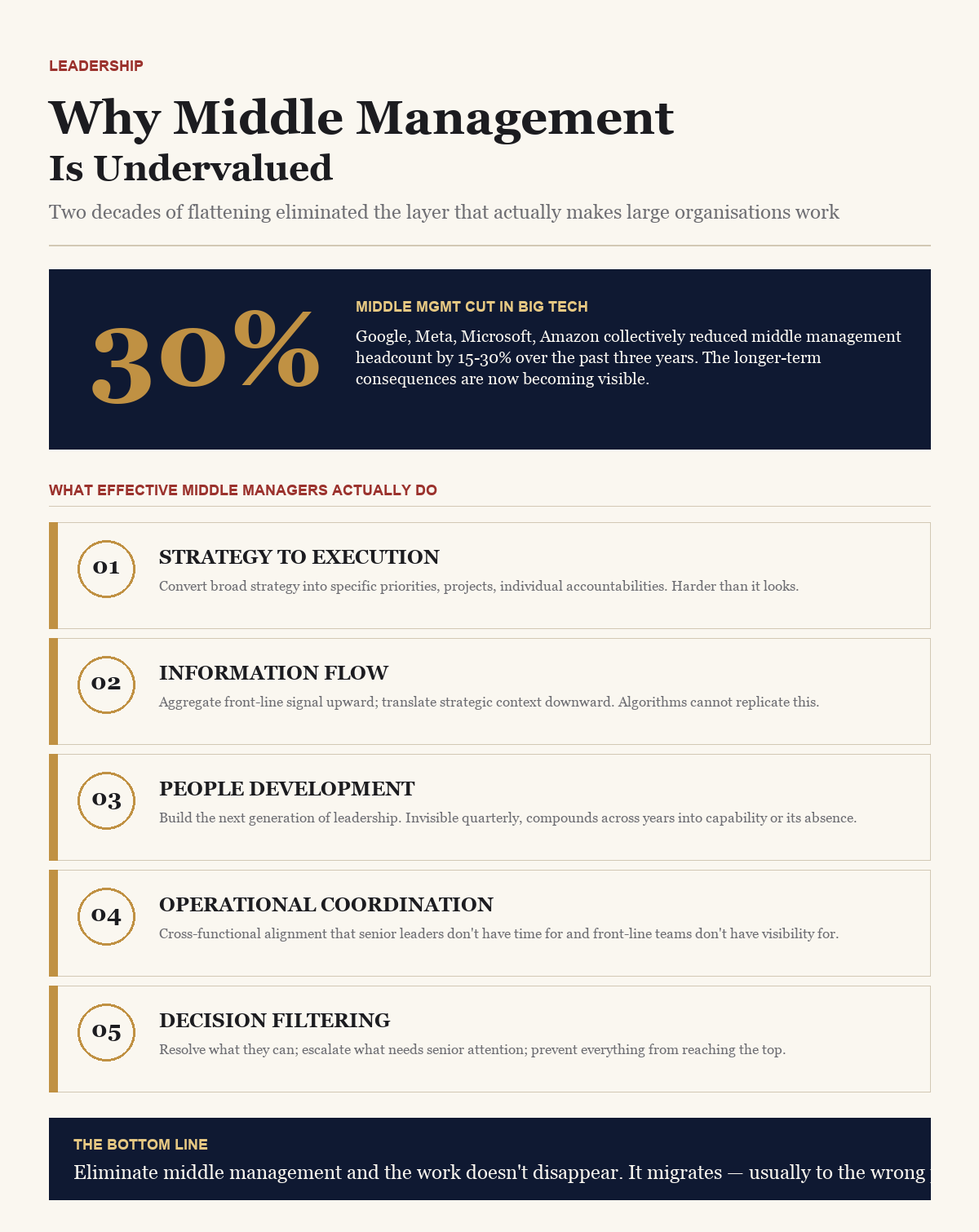
Middle management has been organisationally unfashionable for the better part of a generation. The first wave of delayering, beginning in the 1990s, was driven by re-engineering theory and a belief that flatter organisations would be more responsive and innovative. The pandemic accelerated the trend by demonstrating that remote work could function with less middle supervision than many companies had assumed necessary. The 2023-2024 technology sector layoffs, which deliberately targeted middle management layers as a productivity initiative, completed what had been an extended trend. At Google, Meta, Microsoft, and Amazon, middle management headcount has been reduced by anywhere from 15 to 30 per cent over the past three years through a combination of layoffs, attrition, and reorganisations that consolidated reporting lines.
The strategic rationale was straightforward: middle managers, the argument went, added overhead without adding obvious value. They attended meetings, wrote reports, filtered information, and slowed decisions. Eliminating them would speed up execution, reduce costs, and push accountability to the front lines where the actual work happens. It was a compelling theory, and it produced significant short-term financial returns. The longer-term consequences are now becoming visible, and they are not what the theory predicted.
What Middle Managers Actually Do
To understand why eliminating middle management has produced unexpected difficulties, it helps to revisit what middle managers actually do, not the caricature of meeting attendance and email forwarding, but the substantive work that defines the role when it is performed well. Effective middle managers translate strategy into execution. They take broad organisational direction from senior leadership and convert it into specific priorities, projects, and individual accountabilities for their teams. This translation work is more cognitively demanding than it appears: it requires understanding both the strategic intent and the operational realities, and resolving the gaps between them.
Middle managers manage information flow in ways that algorithms cannot replicate. They aggregate information from front-line teams about what is working, what is failing, and what is changing in the market, and they synthesise that information into a coherent picture that senior leaders can act on. They also translate strategic context downward, helping front-line teams understand why specific priorities matter and how their work connects to broader organisational goals. When this information flow is functioning, organisations adapt to changing conditions; when it breaks down, organisations become rigid and unresponsive.
Perhaps most importantly, middle managers develop people. They identify potential, assign stretch opportunities, give feedback, address performance issues, and build the next generation of leadership. This development work is invisible in any individual quarter but compounds over years into either deep organisational capability or its absence. The companies that have eliminated middle management most aggressively are now confronting the consequence of having fewer people whose explicit job includes developing the people who report to them.
The Productivity Paradox of Flattening
The expectation of flatter organisations was higher productivity per employee through reduced overhead and faster decision-making. The data on what has actually happened is mixed at best. Research from Gartner and McKinsey across companies that have meaningfully reduced middle management headcount finds that employee productivity has often declined modestly, not increased. Senior leader effectiveness has typically declined more substantially, because senior leaders are now spending time on coordination, performance management, and operational decisions that middle managers would have handled.
The pattern in technology companies is particularly instructive. Meta’s ‘Year of Efficiency’ in 2023, which involved aggressive middle management reductions, produced measurable short-term financial returns and a stock price recovery. But by 2025, the company had quietly restored some of the layers it had eliminated, recognising that certain coordination, mentorship, and integration functions were not optional. Similar pattern adjustments have occurred at other technology companies that initially celebrated their flattening campaigns.
Front-line manager burnout is the most pressing operational consequence of the trend. When middle management layers are eliminated or thinned, the work does not disappear, it gets distributed to people for whom it was not the primary responsibility. Front-line managers, whose roles previously included team leadership and operational execution but not necessarily strategic translation and information aggregation, find themselves performing those functions without the time, training, or compensation that would make the additional work sustainable. The burnout rates among front-line managers in companies that have aggressively flattened are documented as substantially higher than in companies that have maintained traditional management structures.
The Specific Failures of Manager-Less Models
Several high-profile experiments with manager-light or manager-free organisational models have provided informative case studies. Zappos’s adoption of holacracy in 2014 was widely covered as a bold organisational experiment; less covered was the company’s quiet retreat from the most radical version of the model after operational and cultural problems emerged. Valve Corporation, the game developer that has long operated without traditional management hierarchies, has been frequently cited as an inspiration for flat organisations, but former employees have described a culture in which informal hierarchies and political dynamics replaced explicit ones, often with worse outcomes for transparency and fairness.
More common than radical experiments are companies that have not formally abandoned middle management but have reduced its scope to the point where the layer cannot function effectively. When a single middle manager is responsible for 25 or 30 direct reports, the development, coaching, and performance management functions that define the role cannot be performed with any depth. The position becomes essentially administrative, and the value it adds collapses, validating the criticism that middle management is overhead, but only because the position has been reduced to one that cannot perform its actual work (see our analysis in The CEO Playbook Has Changed).
What Effective Middle Management Looks Like in 2026
The case for middle management does not require nostalgia for hierarchical organisations of the past. The objective is not to recreate 1990s corporate structures but to identify the functions that middle management performs and ensure they are being performed somewhere, by someone with the time, training, and accountability to perform them well. In modern organisations, this means several things (see our analysis in Culture of Innovation).
Span of control matters and varies by function. Knowledge work that requires substantial coaching, complex coordination, and meaningful performance management cannot be effectively performed with spans of 15 or more direct reports. Different functions and contexts may sustain different spans, but treating span of control as primarily a cost variable rather than a quality variable leads to systematic under-management of teams (see our analysis in Business Turnarounds).
Manager development is a strategic investment, not a training budget line item. The companies that have maintained effective middle management have typically also invested in identifying and developing managerial talent deliberately. Manager-track career paths, formal management training programmes, peer learning communities, and explicit competency frameworks for management roles produce middle managers who can perform the role effectively. The absence of these investments produces middle managers who are essentially senior individual contributors with team responsibilities they were not prepared for.
Compensation and recognition for management performance need to reflect the value of the work. When management roles are compensated similarly to senior individual contributor roles, ambitious employees rationally pursue the path that maximises their compensation and career trajectory. If individual contribution is more rewarded than management, the talent flow into management roles will adverse-select toward people who could not advance further as individual contributors. Building effective middle management requires making management an attractive career path for high-performing talent.
The Indian Context
Indian companies have generally not followed the Western pattern of aggressive middle management reduction. The traditional Indian corporate structure has been hierarchical, with multiple management layers serving coordination and information functions in organisations with large workforces. The Indian IT services sector, which built businesses serving Western enterprise customers with workforce sizes in the hundreds of thousands, has been particularly invested in well-developed management hierarchies as a coordination mechanism.
The Indian startup ecosystem has imported some of the Silicon Valley scepticism of middle management, with mixed results. Companies that have grown rapidly while maintaining flat structures often report the same coordination, development, and burnout challenges that have emerged in US technology companies. Indian companies that have built deliberate middle management capability, promoting from within, investing in management development, and treating management as a discipline, have typically scaled more sustainably than those that have treated management as overhead.
Rebuilding Effective Middle Management
For leaders considering their organisational design in 2026, the practical recommendations are straightforward. Audit the actual work currently performed by middle management layers in your organisation, not the caricature, but the substance. Where work is being performed well, recognise the value and invest in the capability. Where work is being performed poorly, address the underlying issue, which is more often inadequate training, unclear accountability, or insufficient time than insufficient justification for the role.
Where layers have been eliminated, audit where the work has migrated and assess whether the people now performing it have the time, skills, and incentives to perform it well. If front-line managers or individual contributors are now responsible for work that previously belonged to middle managers, ensure that the additional responsibility is reflected in role definitions, compensation, and development support. If the work is simply not being performed, and this is more common than organisations like to acknowledge, the question is whether that gap is acceptable or whether it requires restoration of a management layer.
Middle management is not the most glamorous topic in organisational design, and it has not enjoyed the strategic attention given to topics like AI deployment, remote work, or culture transformation. But the organisations that get middle management right tend to outperform those that get it wrong, regardless of what their other strategic initiatives look like. In a world where AI and remote work are reshaping how work is performed, the human capability of effective management, coaching, coordination, development, is becoming more important, not less. The companies that invest in it will be at an advantage.
