



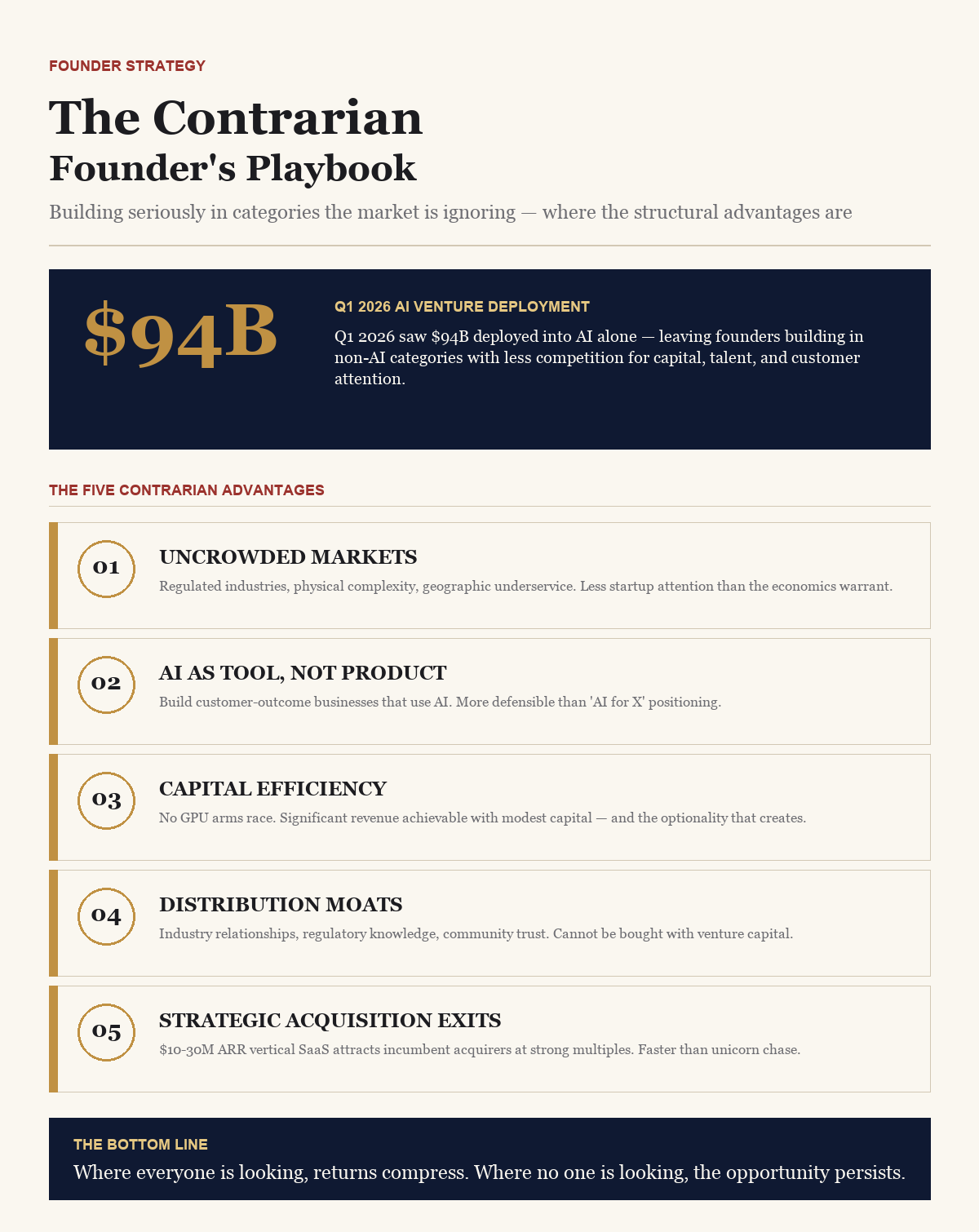
When every investor is chasing the same theme, the returns available in that theme compress and the returns available in everything else improve. This is a basic principle of contrarian investing that applies with particular force to the current AI moment. The 400-plus AI companies that raised seed or Series A rounds in the United States in Q1 2026 are competing for the same customer budgets, the same engineering talent, and the same investor attention. Most of them will not return their investors’ capital. Meanwhile, the founders who are solving unsexy but genuine problems in healthcare administration, agricultural logistics, construction productivity, and financial services compliance are raising capital from a smaller but less competitive investor pool, building in markets with less hype-driven churn, and positioning for exits that do not require becoming a $10 billion company to generate excellent returns.
This is not an argument against building AI-native companies. The AI opportunity is real, and the best AI companies will create extraordinary value. It is an argument that the contrarian founder, the one who ignores the thematic consensus and builds from first principles in a market others are neglecting, has structural advantages in the current environment that are worth understanding and exploiting deliberately.
Why the Herd Instinct Persists and Why It Creates Opportunity
Investors are not irrational when they cluster around AI. The technology is genuinely transformative, the market opportunity is enormous, and the competitive dynamics of foundation model development create genuine first-mover advantages for the companies that establish model and customer relationships early. The clustering reflects real information: AI is important and the capital flowing into it reflects genuine economic value creation potential.
But clustering also reflects the social and professional dynamics of venture capital. Investors are evaluated against each other; missing the defining technology wave of a decade is a career risk that drives herding behaviour. Partners who passed on OpenAI‘s early rounds are not eager to miss the next AI infrastructure company. The fear of being wrong in the non-consensus direction is more professionally threatening than being wrong in the consensus direction. This professional incentive structure produces systematic overcrowding in thematic areas that have achieved consensus status, which is exactly where contrarian founders find the least competition for capital and talent.
The technology investment history of the past 30 years contains multiple examples of extraordinary value creation in categories that were unfashionable at the peak of the preceding technology hype cycle. The greatest enterprise software companies of the 2010s were founded in the years following the dot-com bust, when investor appetite for technology had collapsed. The most successful fintech companies were built during the regulatory aftermath of the 2008 financial crisis, when financial services was universally regarded as a sector in decline. The pattern is consistent: the best companies in a new category are often founded when the category is not yet fashionable, not at the peak of excitement about it.
Finding Genuinely Uncrowded Markets
The contrarian founder’s first task is identifying genuinely uncrowded markets, categories where the problem is significant, the incumbents are complacent, and the investor attention is minimal. Several structural indicators signal these opportunities. Heavy regulation often deters venture investors who prefer fast-moving markets with clear product feedback loops; regulated industries including healthcare, financial services, legal services, and infrastructure therefore receive less startup attention than their economic importance warrants. Physical world complexity, logistics, construction, agriculture, manufacturing, similarly deters software-centric investors and creates barriers to entry for well-capitalised incumbents, but can be addressed by founders willing to engage with operational complexity.
Geographic underservice is another reliable signal. Industries that are large and structurally important in India, Southeast Asia, Africa, or Latin America but have received minimal venture attention relative to equivalent US markets represent genuine opportunity for founders embedded in those geographies with deep domain understanding. The agricultural input supply chain in India, the informal economy in sub-Saharan Africa, the healthcare delivery system in Southeast Asia, each of these is a market of hundreds of billions of dollars with minimal venture-backed innovation relative to its scale.
The healthcare services sector globally exemplifies the contrarian opportunity. The administrative and operational inefficiency of healthcare systems, scheduling, prior authorisation, billing, care coordination, documentation, represents a $400 billion annual cost in the US alone. It is a problem that has been resistant to technological solution for decades, and venture investors have repeatedly been burned by the complexity and slow sales cycles of healthcare IT. That burn history has suppressed investor appetite precisely in a market where AI-enabled process automation could finally deliver the productivity improvements that previous generations of software promised but did not deliver (see our analysis in Why Startups Fail at Scaling).
Building with AI as a Tool, Not as the Product
The most important tactical distinction for the contrarian founder in the current environment is building with AI as a tool rather than positioning AI as the product. A founder building a better construction project management system that uses AI to predict schedule delays and budget overruns is building a construction technology company that happens to use AI. A founder building ‘an AI for construction’ is building an AI company that happens to serve construction. The first framing focuses the product on customer outcomes; the second focuses it on technology inputs. The first is more likely to produce durable customer value; the second is more likely to attract investor attention in the current moment (see our analysis in Bootstrapping vs Fundraising).
This distinction has practical implications for product development, go-to-market strategy, and fundraising. Product development anchored in customer outcomes tends to produce more robust solutions, ones that use whatever technology works, including AI where it genuinely improves the outcome and simpler tools where they suffice. Go-to-market anchored in customer outcomes tends to produce better sales motions, ones focused on the specific value delivered to a specific customer rather than on a capability in search of an application. Fundraising anchored in AI positioning may be easier in the current market, but it attracts investors whose thesis is AI-centric rather than domain-centric, which may not be the right investors for a business where domain expertise is the actual competitive advantage (see our analysis in Seed Stage Is Broken).
The Capital Efficiency Advantage
Contrarian founders building outside the AI infrastructure theme have a structural advantage that the current market undervalues: the ability to build capital-efficiently. AI infrastructure companies face enormous compute costs that require continuous capital deployment to maintain competitive model capability. Application-layer companies built on top of commodity foundation models can build significant revenue with surprisingly modest capital, because the expensive infrastructure is someone else’s problem.
Capital efficiency produces multiple strategic benefits. It extends runway without requiring dilutive fundraising at potentially declining valuations. It allows founders to maintain greater equity ownership through the early stages, when the company is most uncertain and dilution is most expensive. It creates optionality: a capital-efficient company with genuine revenue has choices, it can raise institutional capital, remain independent, or pursue strategic acquisition, that a capital-hungry company burning through runway does not. The bootstrapped or lightly funded company with $3 million in ARR has more negotiating leverage with investors than the well-funded company with $3 million in ARR and three months of runway.
Distribution as the Durable Moat
In markets not dominated by network effects or proprietary data, distribution is often the most defensible competitive advantage. The contrarian founder’s playbook should include an explicit distribution strategy built on channels that are difficult for well-capitalised competitors to replicate quickly. Deep relationships with professional associations, regulatory bodies, or industry trade groups in vertical markets create distribution access that cannot be purchased with venture capital. Content and community strategies that make a company the trusted reference point for a specific professional community build customer acquisition channels with compounding returns. Channel partnerships with incumbent service providers, accounting firms, management consultancies, industry associations, can provide distribution at scale without the customer acquisition cost of paid digital marketing.
The founder who builds a dominant position in a specific, well-defined vertical market, with deep customer relationships, regulatory familiarity, and a distribution network built over years, is more insulated from competition than the founder who builds a horizontal AI tool in a category where the next model update from OpenAI or Anthropic could make the core capability free. Narrowness is a feature, not a limitation, when the vertical is large enough to support a significant business and the domain expertise required to serve it well creates genuine barriers.
The Exit Landscape for Contrarian Companies
The exit landscape for contrarian companies is different from, and often more accessible than, the exits available to AI infrastructure companies. A vertical software company with $10-30 million in ARR, strong retention, and domain expertise in a sector that a large incumbent wants to expand into is an attractive acquisition target at multiples that deliver strong returns to early investors without requiring a public market outcome. Strategic acquirers, large software companies, private equity portfolio companies, professional services firms, pay for distribution, customer relationships, and domain expertise that they cannot build quickly internally.
The contrarian founder who builds with this exit landscape in mind, making strategic choices that increase acquisition attractiveness while building genuine customer value, often reaches a successful outcome faster and with lower capital consumption than the founder chasing the unicorn IPO. In a venture market where the IPO window is narrow and the bar for public market entry is rising, the strategic acquisition exit at a strong but not extraordinary multiple may be the most rational objective function for the majority of startups, regardless of how unfashionable that sounds in a market obsessed with billion-dollar outcomes.
The market’s current obsession with AI is creating extraordinary opportunities for founders willing to look elsewhere. The best contrarian founders have always built where others were not looking, and in 2026, where others are not looking is almost everywhere except AI.
