



In February 2026, OpenAI raised $40 billion at a $300 billion valuation, the largest private financing round in history. The round was led by SoftBank, with participation from Microsoft, Abu Dhabi’s MGX sovereign wealth fund, and a consortium of Middle Eastern institutional investors. At $300 billion, OpenAI was valued at roughly the same level as Visa, more than Goldman Sachs, and approximately eight times its annualised revenue. The round closed oversubscribed.
That single transaction consumed more capital than the entire global venture ecosystem deployed in an average quarter five years ago. It was not an outlier in kind, only in scale. Anthropic raised $4 billion at a $60 billion valuation in late 2025. xAI, Elon Musk’s AI company, raised $6 billion at a $50 billion valuation. Cohere, Mistral, and a dozen other AI infrastructure companies raised rounds that would have been considered extraordinary in any prior era of venture investing. The cumulative effect is a venture market structurally unlike anything that preceded it: concentrated in a single technology theme, dominated by a handful of very large rounds, and relying on sovereign wealth funds and corporate strategics, not traditional venture capital, to provide the bulk of the capital.
How We Got Here
The current venture environment is the product of two distinct cycles that have merged into a single anomalous moment. The first cycle was the 2020-2021 zero-interest-rate bubble, during which cheap capital and surging technology demand pushed startup valuations to historic highs across every sector. That cycle ended badly: the 2022-2023 correction saw global venture deal value fall by more than 50%, and thousands of companies that had raised at inflated valuations were forced to accept down rounds, merge, or shut down. The correction was painful and necessary.
The second cycle, the AI investment supercycle, began in earnest with the release of ChatGPT in November 2022 and accelerated sharply after GPT-4 in early 2023. Unlike the 2020-2021 bubble, which was broadly distributed across consumer apps, crypto, and remote work tools, the AI cycle is concentrated and has genuine technological substance behind it. The capabilities of large language models, multimodal AI systems, and AI agents have improved rapidly and demonstrably. The commercial applications are real. The $300 billion OpenAI valuation is not purely speculative; it reflects genuine competitive advantage in a technology that is reshaping entire industries.
What makes the current environment anomalous is the merging of these two dynamics: genuine AI capability progress on the one hand, and valuation frameworks that have detached from conventional revenue multiples on the other. The result is a market where very large amounts of capital are being deployed at valuations that can only be justified by assumptions about market share, monetisation, and competitive durability that are, at best, highly uncertain.
The Sovereign Wealth Fund Factor
The composition of capital in the current VC supercycle is structurally different from prior cycles in a way that has important implications for founders and for the broader startup ecosystem. Traditional venture capital, partnerships raising $500 million to $2 billion funds from institutional limited partners, cannot write $10 billion cheques. The investors actually writing those cheques are sovereign wealth funds, corporate strategics, and the handful of mega-funds (SoftBank Vision Fund, Tiger Global, a16z Growth) that operate at different scales.
Saudi Arabia’s Public Investment Fund, Abu Dhabi’s MGX and Mubadala, the UAE’s Abu Dhabi Investment Authority, and Japan’s SoftBank have collectively deployed an estimated $80-120 billion into AI and technology companies over the past 18 months. These investors have different return expectations, different time horizons, and different strategic motivations than traditional venture funds. For Saudi Arabia and the UAE, technology investment is partly about economic diversification and access to strategic capabilities, not purely about financial return. That changes the pricing dynamic: investors with non-financial objectives may rationally pay prices that pure financial return calculations would not support.
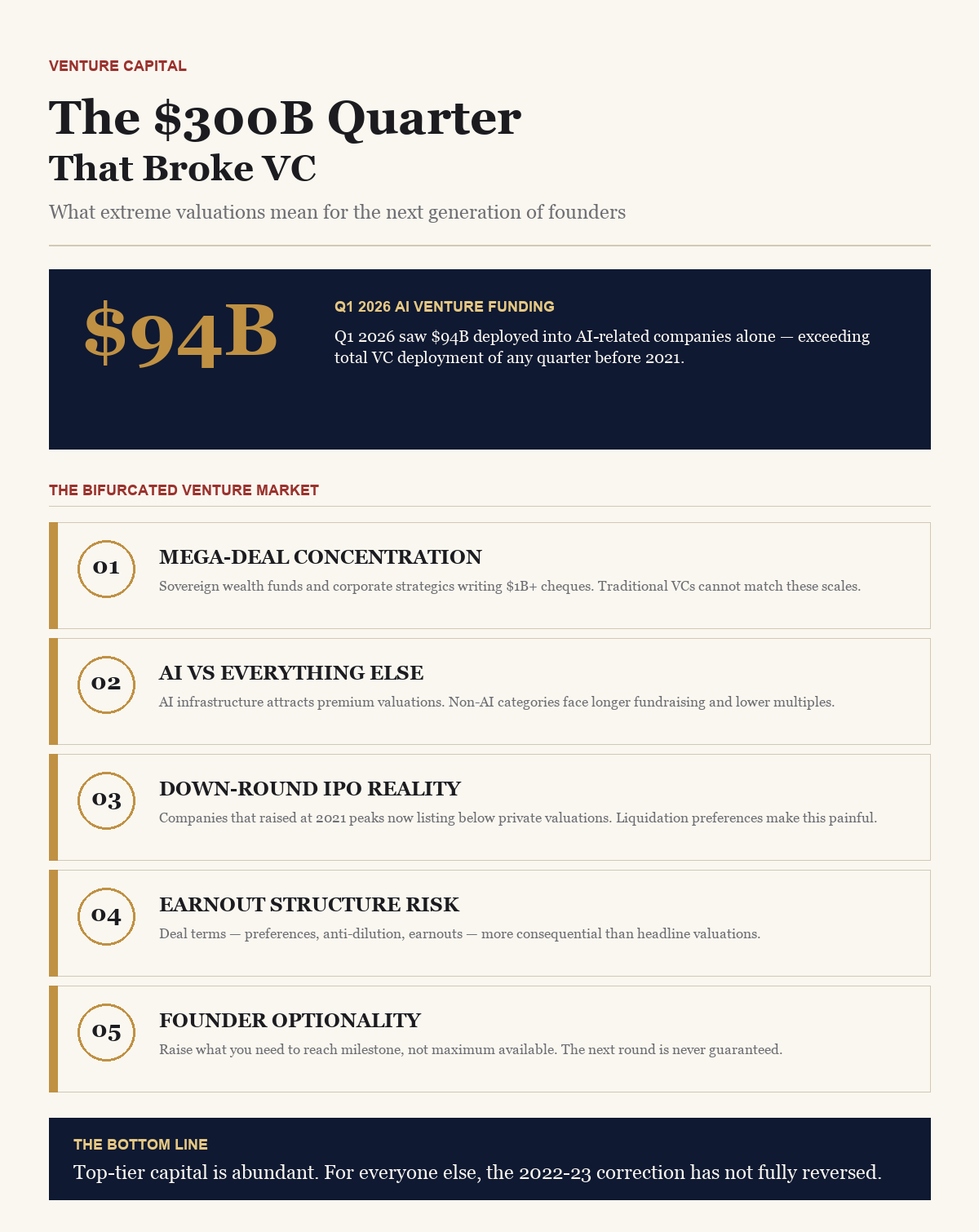
The consequence for founders outside the very top tier of AI infrastructure companies is a bifurcated market. At the very top, the five to ten companies that attract sovereign wealth fund attention, capital is abundant and valuations are extraordinary. For everyone else, the 2022-2023 correction has not fully reversed. Series A and Series B valuations for companies outside the AI infrastructure theme are significantly lower than 2021 peaks and fundraising timelines are longer. The ‘venture market is booming’ headline is accurate for the companies raising $1 billion-plus rounds; it is misleading for the vast majority of startups raising $5-50 million rounds (see our analysis in The AI Valuation Bubble).
What Extreme Valuations Do to the Founder Experience
The practical implications of extreme valuations for founders are less straightforward than they appear. Raising at a very high valuation is not unambiguously good; it creates obligations and constraints that shape the entire subsequent trajectory of the company. A founder who raises $100 million at a $1 billion valuation has implicitly committed to delivering an outcome, an IPO or acquisition, that returns multiples on that $1 billion. The investor’s carry depends on it. The structure of option pools, liquidation preferences, and anti-dilution protections embedded in high-valuation rounds means that in an exit below the last round valuation, founders and employees may receive far less than the headline valuation suggests (see our analysis in The IPO Window Reopens).
The 2021-2023 down round cycle demonstrated this vividly. Companies that had raised at $500 million or $1 billion valuations in 2021, then raised survival rounds at $200 million or $300 million in 2022 and 2023, found that the anti-dilution protections in their 2021 investor agreements dramatically diluted founders, employees, and earlier investors. The concept of a ‘flat round’ or ‘modest down round’ as a benign outcome proved illusory in many cases; the structural terms attached to high-valuation rounds made any downward revision extremely painful for everyone except the investors with the most protective terms (see our analysis in Seed Stage Is Broken).
The Benchmark Problem for Non-AI Founders
The extreme valuations commanded by AI companies have created a benchmarking problem for founders in adjacent sectors. Investors, particularly retail investors, angels, and less sophisticated early-stage funds, have absorbed the message that technology companies should trade at high revenue multiples, without distinguishing between the specific characteristics of AI infrastructure companies that justify premium pricing and the much broader universe of software, consumer tech, and services companies where those characteristics do not apply.
This creates both a pricing illusion and a negotiation challenge. Founders in sectors with genuine but more modest growth profiles, B2B software, marketplace businesses, climate tech, are encountering investors who apply AI-era valuation benchmarks to their businesses, creating overvalued early rounds that become very difficult to raise follow-on capital for. The discipline that a rational valuation framework imposes on company building, forcing genuine product-market fit before large capital deployment, is being bypassed by founders and investors who mistake the current AI excitement for a broadly applicable market condition.
Implications for the Next Generation of Founders
For founders building companies in 2026, the key insight is that the venture market they are navigating is not the market described in most startup advice written before 2020, but it is also not the frothy 2021 market where any credible pitch attracted capital at aggressive valuations. It is a highly bifurcated market where the dynamics at the very top, the AI infrastructure megadeals, are structurally disconnected from the dynamics that will apply to the overwhelming majority of new companies.
The practical guidance this implies: raise the capital you need to reach a meaningful milestone, not the maximum that the market will offer. Choose investors whose return expectations are compatible with your realistic exit scenarios. Understand the structural terms in your term sheet, liquidation preferences, anti-dilution provisions, pay-to-play clauses, as carefully as you understand the headline valuation. Build a business that can survive on the capital you raise; the next round is never guaranteed, regardless of how strong the market appears at the time you close.
The $300 billion quarter is a feature of a specific moment in technology history. It will not persist indefinitely, and the companies and founders who survive the normalisation that follows will be those who built genuine value rather than those who optimised for the peak of the valuation cycle.
