

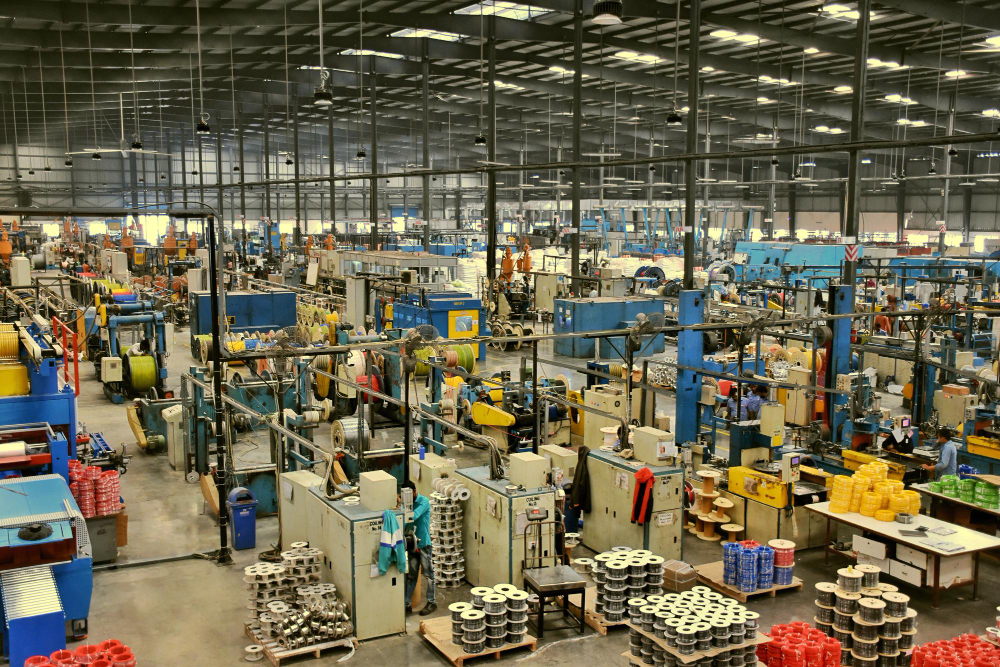

The global supply chain model that dominated the three decades from 1990 to 2020 was built on a simple and powerful logic: manufacture wherever costs are lowest, sell wherever demand is highest, and rely on open trade, stable geopolitics, and efficient logistics to bridge the gap. That model delivered extraordinary price deflation in manufactured goods, lifted hundreds of millions out of poverty in manufacturing economies, and enabled a consumer economy in the developed world that would have been unrecognisable to earlier generations. It also created dependencies that looked like efficiency until they looked like vulnerability.
The COVID-19 pandemic was the stress test that exposed those vulnerabilities at scale: personal protective equipment made in China, active pharmaceutical ingredients concentrated in a handful of Asian facilities, semiconductor wafers for automotive chips that could not be rapidly sourced elsewhere. The political response to those exposures, industrial policy programmes across the United States, Europe, Japan, India, and Australia explicitly designed to reshore manufacturing in strategic sectors, has created a new framework for supply chain decision-making that is reshaping capital allocation globally. The question for business leaders is not whether supply chain sovereignty is a real trend, it is, but which aspects of it represent genuine strategic requirements and which are political noise that will fade when memories of the pandemic recede.
Defining Supply Chain Sovereignty
Supply chain sovereignty is not a single strategy but a spectrum of approaches, each with different cost and resilience profiles. At one end is full reshoring: producing domestically everything that is sold domestically, accepting the full cost premium of local manufacturing in exchange for maximum supply certainty. Few industries or companies adopt this approach in its pure form; the economics rarely justify it except in sectors where national security considerations override commercial logic entirely.
At the other end is selective sovereignty: identifying the specific components, materials, or production steps where supply disruption would be most catastrophic, and investing in local or regional redundancy for those specific nodes while maintaining global sourcing for everything else. This is the approach that most sophisticated manufacturers are actually implementing, not wholesale reshoring, but targeted investment in the critical dependencies identified by supply chain risk analysis.
Between these extremes lies the China-plus-one strategy, diversifying supply away from single-country concentration without necessarily reshoring, which has dominated supply chain thinking since 2018. The April 2026 US tariff measures, by applying significant tariffs to most of the Southeast Asian alternatives that companies had developed as their ‘plus one’, have reduced the effective scope of this approach for US-market-oriented supply chains. Mexico, benefiting from USMCA exemption, has emerged as the most viable plus-one geography for US-destined goods; India, at 26% tariffs, offers partial mitigation. But the original premise of China-plus-one, that low-cost manufacturing in Asia could serve the US market without tariff penalty, has been substantially disrupted.
The Industrial Policy Catalyst
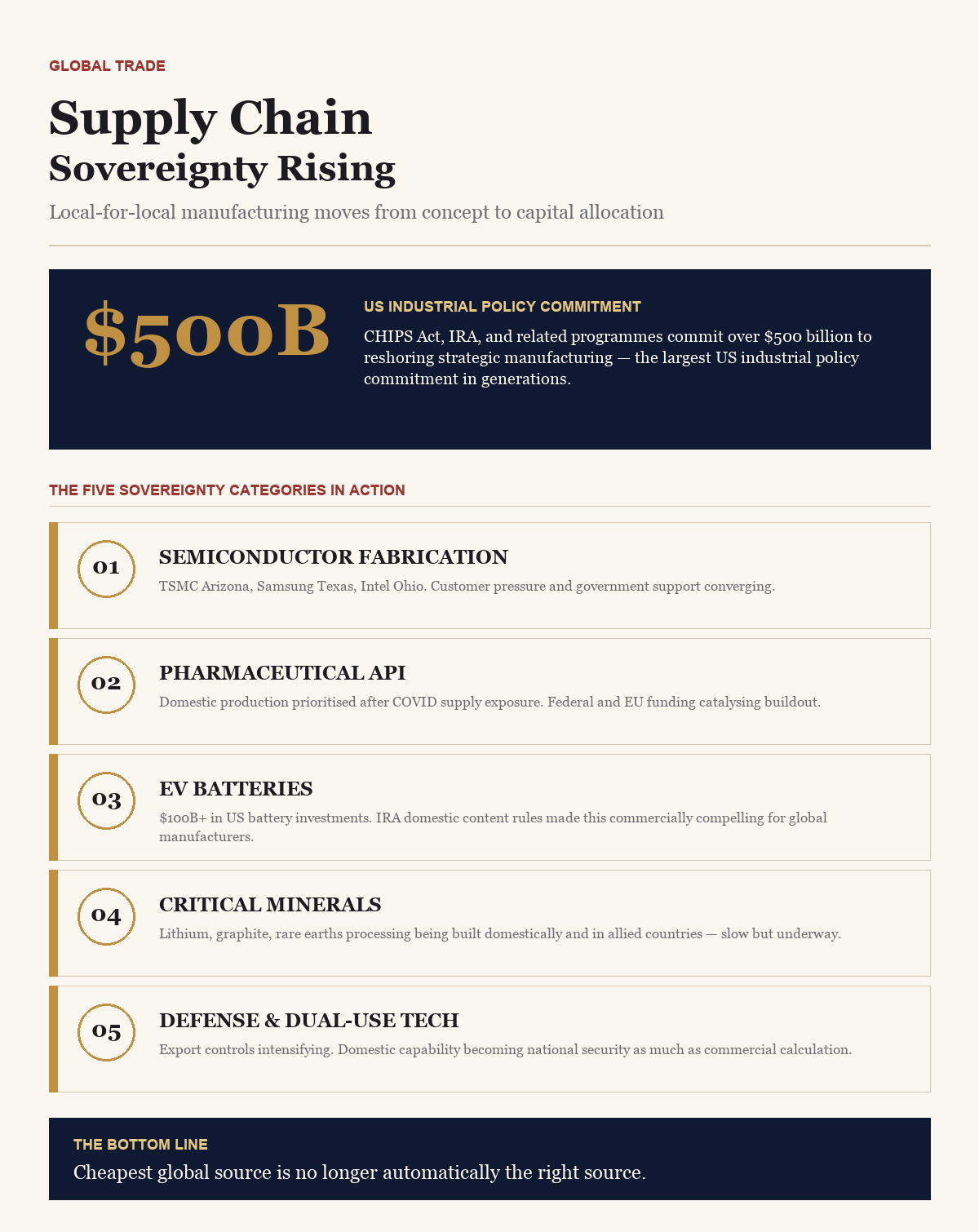
The most important driver of supply chain sovereignty as a business reality, rather than a theoretical concept, is the unprecedented scale of government industrial policy supporting it. The United States CHIPS and Science Act ($52 billion), the Inflation Reduction Act ($369 billion in clean energy and manufacturing incentives), the Infrastructure Investment and Jobs Act, and sector-specific measures have collectively committed over $500 billion to reshoring or nearshoring manufacturing in semiconductors, clean energy, electric vehicles, batteries, and pharmaceutical ingredients.
Europe has deployed comparable resources through the EU Chips Act (€43 billion), the European Green Deal Industrial Plan, and member-state-level programmes. Germany’s €100 billion special infrastructure fund and France’s reindustrialisation programme are adding manufacturing capacity in energy, defence, and advanced materials. Japan’s semiconductor and battery manufacturing subsidies, including significant grants to attract TSMC‘s Kumamoto facility and Toyota’s domestic battery investments, have restarted a manufacturing renaissance in a country that had largely ceded production to lower-cost Asian neighbours.
India’s production-linked incentive programme, while smaller in absolute terms, represents the most significant industrial policy commitment in India’s post-reform history and is specifically designed to attract supply chain investment that would otherwise go to China or Southeast Asia. The PLI scheme covers 14 sectors and has already demonstrated results in electronics, pharmaceuticals, and food processing. The critical question is whether India can move from assembly and testing, where PLI successes are concentrated, to the higher-value fabrication and component manufacturing that supply chain sovereignty in strategic sectors requires.
Sectors Where Local-for-Local Is Already Happening
Semiconductor fabrication is the most visible example of supply chain sovereignty in action. TSMC’s Arizona investment, Samsung‘s Texas facility, and Intel‘s European programme are not primarily market-seeking investments, TSMC could serve the US market from Taiwan more cheaply than from Arizona. They are sovereignty investments, driven by customer requirements, government incentives, and the strategic recognition that sole-sourcing advanced semiconductor production from a geopolitically exposed island is not a sustainable supply chain model for the US economy (see our analysis in India’s Manufacturing Moment).
Pharmaceutical active ingredient manufacturing is following a similar trajectory. The US and EU have both identified domestic API production as a national security requirement after COVID-19 exposed the extent of dependence on Chinese and Indian API supply. Domestic API manufacturing programmes, particularly for medicines on government essential medicines lists, are being supported with public funding and domestic preference requirements that make local production commercially viable even at cost premiums (see our analysis in The Section 301 Salvo).
Electric vehicle battery manufacturing is perhaps the most commercially significant example of supply chain sovereignty investment globally. The IRA’s domestic content requirements for EV tax credits have triggered over $100 billion in battery manufacturing investment in the United States from Korean, Japanese, and Chinese battery manufacturers who would otherwise have served the US market from Asian facilities. The economics of battery manufacturing are improving rapidly as scale increases, making domestic production progressively more competitive with imports even without subsidy support (see our analysis in China+1 Supply Chain).
The True Cost of Local-for-Local
Supply chain sovereignty carries real costs that business leaders need to quantify honestly before making reshoring decisions. Labour costs in high-income manufacturing economies, the United States, Germany, Japan, are typically five to fifteen times higher than in China, India, or Southeast Asia for comparable manufacturing roles. Capital costs for greenfield factory construction in developed economies are higher due to land, permitting, and construction costs. Regulatory compliance costs are generally higher. The unit economics of local manufacturing are rarely as good as offshore alternatives (see our analysis in Doing Business in the Age of Sanctions).
However, the true cost comparison has become more complex in recent years. Energy costs in the United States have declined relative to Europe and parts of Asia as domestic shale production has kept US gas prices structurally lower than European or Asian LNG-priced markets. Automation is reducing the labour cost premium of high-wage locations: a highly automated factory in the American Midwest or northern Italy may have direct labour costs per unit that are not dramatically higher than a labour-intensive facility in Vietnam, once the capital cost of automation is amortised. Logistics costs, which are not trivial for bulky or time-sensitive goods, favour local manufacturing over offshore supply chains.
Tariff costs, now significant for goods sourced from most of Asia to the US market, further shift the economics. A company deciding between a Vietnamese facility (46% US tariff) and a Mexican nearshore facility (USMCA exempt) or a US domestic facility (no tariff) needs to incorporate those costs explicitly. For many product categories, the tariff equalisation has made domestic or nearshore production competitive with offshore on a total landed cost basis for the first time in decades.
The Indian Opportunity in a Sovereign Supply Chain World
For India, the supply chain sovereignty trend presents a specific and time-limited opportunity. The combination of tariff pressure on China and Southeast Asia, the active search for manufacturing alternatives by global multinationals, and India’s PLI programme creates a window for attracting manufacturing investment that is larger than at any previous point in India’s economic history. The sectors where that opportunity is most concrete, pharmaceuticals, electronics assembly, renewable energy equipment, textiles and apparel, align reasonably well with India’s existing industrial capabilities.
Capturing that opportunity requires addressing the infrastructure and regulatory constraints that have historically prevented India from converting manufacturing ambition into manufacturing output at scale. Power supply reliability, logistics costs, land availability, and labour flexibility are the variables most frequently cited by multinationals evaluating India against competing locations. These are solvable problems with sustained policy attention, and there is evidence that state governments competing for investment, Gujarat, Tamil Nadu, Karnataka, Maharashtra, are competing on ease of doing business in ways that are producing real improvements.
Building a Sovereign Supply Chain Strategy
For business leaders, supply chain sovereignty strategy requires moving beyond the general principle to specific decisions about which supply chain nodes warrant sovereignty investment and which can remain globally sourced. The framework should be risk-weighted: high-consequence, low-substitutability supply chain nodes, the components or materials whose disruption would halt production with no near-term alternative, justify sovereignty investment even at significant cost premium. Low-consequence, easily substitutable inputs can remain globally sourced.
The investment horizon matters too. Supply chain sovereignty investments, factory construction, supplier qualification, workforce development, take two to five years from decision to operational. Businesses making those investments now are positioning for the supply chain environment of 2027-2030, not 2024. The tariff and geopolitical environments of that future period are uncertain; the investment needs to be robust to multiple scenarios, not optimised for the current moment.
The era of assuming that the cheapest global source is the right source is over. The era of supply chain decisions that explicitly incorporate resilience, geopolitical exposure, and sovereign risk alongside unit cost is here. The businesses that build that capability into their strategic planning now will be better positioned than those that are still optimising for a supply chain world that no longer exists.
