



A Shortage Hidden in Plain Sight
In February 2026, Ford Motor Company quietly revised its annual cost outlook upward by approximately $1 billion, citing a single line item: memory chip inflation. The figure attracted little of the fanfare that typically accompanies a billion-dollar earnings revision. It was, in the parlance of Detroit, simply “the cost of doing business” in an era when the silicon inside a modern vehicle, up to 3,000 individual chips in some models, has become as strategically critical as steel or aluminium.
Ford’s predicament is neither unique nor exceptional. It is, rather, emblematic of a structural shift that has been building since 2024 and that will fundamentally alter corporate cost structures, competitive dynamics, and strategic planning horizons well into the latter part of this decade. The global semiconductor industry is in the grip of what analysts are calling a super-cycle, a prolonged period of elevated demand, constrained supply, and, above all, price inflation that is spreading far beyond the technology sector into the very marrow of the industrial economy.
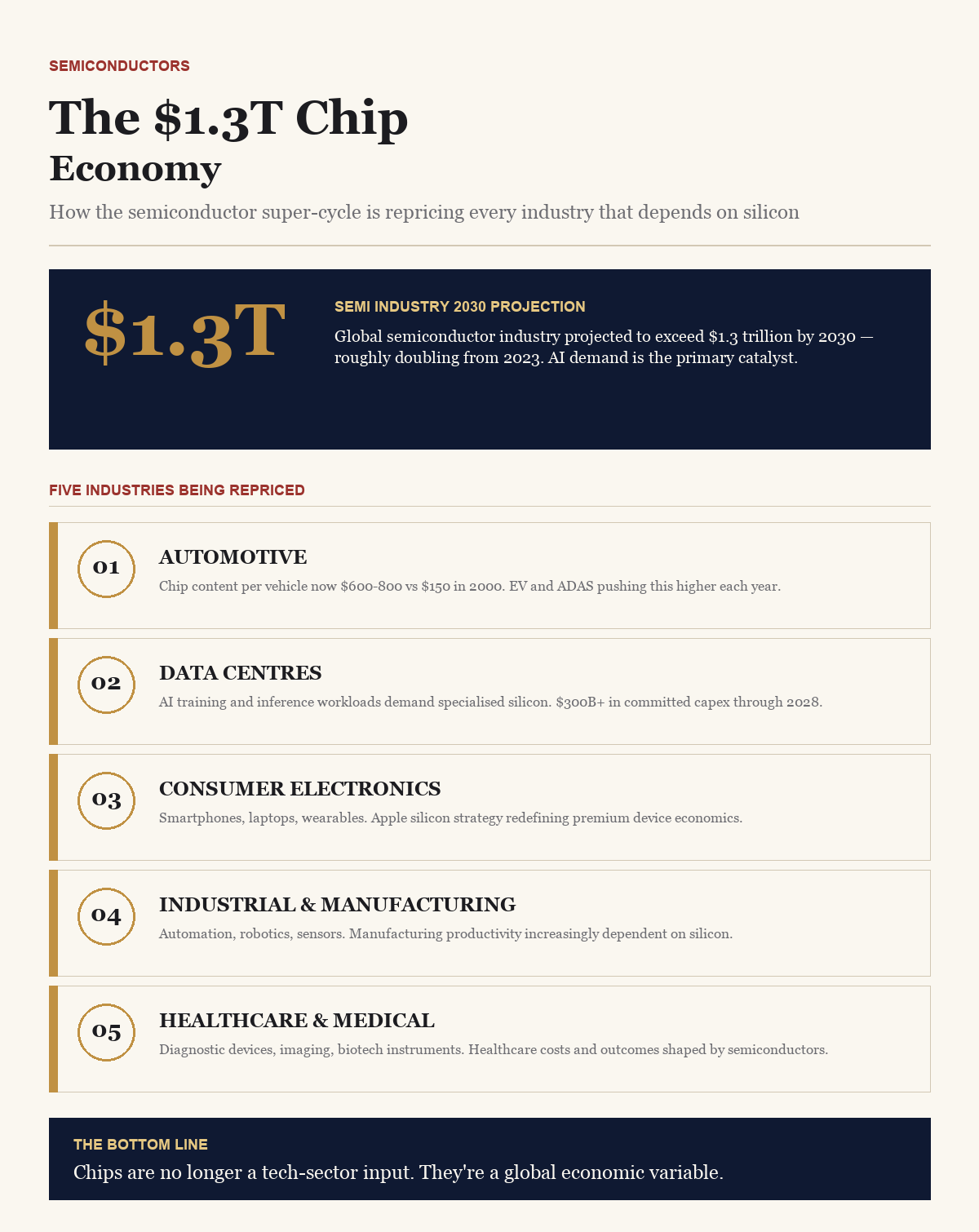
Gartner‘s April 2026 forecast is unambiguous: worldwide semiconductor revenue will exceed $1.3 trillion this year, representing the highest growth rate in roughly two decades and the third consecutive year of double-digit expansion.
Memflation: When Memory Becomes a Balance-Sheet Problem
The headline revenue figure obscures the mechanism driving the current cycle. This is a story about memory, specifically, about the catastrophic misalignment between supply and demand in DRAM and NAND flash markets. DRAM contract prices rose approximately 125% year-on-year through early 2026. NAND flash prices increased by a staggering 234% over the same period. TrendForce’s Q1 2026 analysis confirmed that enterprise SSD prices, the memory that sits inside every corporate server, cloud data centre, and AI training cluster, showed no signs of retreat, with Q2 2026 pricing expected to hold at Q1 levels or rise further.
The immediate driver is well understood: the AI infrastructure boom. Every large language model, every AI training run, every inference cluster consumes memory at a scale that was almost inconceivable three years ago. NVIDIA‘s H100 and H200 GPU clusters, the workhorses of AI training, use high-bandwidth memory whose production is controlled by three companies: SK Hynix, Samsung, and Micron. When hyperscalers and AI labs compete for finite HBM capacity, everything else in the memory supply chain gets repriced.
The relief timeline is the most important number for business planners: TrendForce and Gartner both project that meaningful price normalisation in DRAM and NAND markets will not arrive until late 2027 at the earliest. For CFOs building three-year cost models, this is not a blip to be smoothed away. It is a structural input that must be priced into every hardware-dependent investment decision.
Who Gets Hit Hardest
The automotive industry is experiencing the sharpest pain. Tesla flagged memory chip costs as a direct threat to production economics for its next-generation vehicle platforms. Ford’s billion-dollar revision has already been noted. Stellantis, BMW, and several Asian OEMs have similarly flagged semiconductor cost inflation as a margin pressure in recent earnings communications. The irony is acute: the industry that spent 2021 and 2022 suffering from chip shortages, when it could not get enough units, is now suffering from chip super-pricing, when it can get units but cannot afford them at the new price point.
Healthcare is the second most exposed sector. Medical devices, from MRI machines to continuous glucose monitors, depend on specialised memory and logic chips. Unlike automotive or consumer electronics, medical device manufacturers cannot easily substitute components due to regulatory approval requirements. A chip that has been certified for a specific medical application cannot simply be swapped for a cheaper alternative; the recertification process takes years. This regulatory lock-in turns chip inflation into a fixed cost that device manufacturers have limited ability to pass through to hospital systems operating under fixed reimbursement rates.
For mid-market and enterprise technology buyers, companies that purchase servers, storage systems, and networking equipment rather than manufacture them, the impact is arriving with a lag. Dell, HPE, and Lenovo have already communicated price increases on server and storage product lines of between 12% and 28%, depending on the memory intensity of the configuration. IT procurement teams that locked in multi-year hardware contracts at pre-super-cycle prices are sitting on significant value; those renewing contracts in 2026 are discovering a markedly different market.
The Hyperscaler Moat, and What It Means for Everyone Else
Not all organisations are equally exposed to the super-cycle. The hyperscalers, AWS, Microsoft Azure, Google Cloud, and Meta, have a structural procurement advantage that insulates them, partially, from spot-market chip inflation. Their combined capital expenditure for 2026 is projected at $660 billion to $690 billion, a figure that gives them the negotiating power to lock in multi-year supply agreements at terms unavailable to smaller buyers (see our analysis in Edge Computing and IoT).
NVIDIA, AMD, and Intel, the primary suppliers of AI accelerators, have signed forward supply commitments with hyperscalers that guarantee allocation priority in exchange for volume and pricing certainty. This is rational for both parties, but its consequence for the rest of the market is a constrained spot pool. Mid-market companies competing with hyperscalers for GPU and memory allocation are, in effect, competing with organisations that have a ten-to-one spending advantage and contracts already in place (see our analysis in From GPU Monoculture to Chiplets).
The strategic implication is uncomfortable but important: for most organisations below the scale of a large enterprise, owning AI infrastructure is becoming economically irrational relative to renting it from cloud providers who have secured supply at better prices. The exception is organisations with genuine data sovereignty requirements, where regulatory constraints or competitive sensitivity make cloud dependency untenable. For everyone else, the super-cycle is a powerful argument for cloud-first AI infrastructure strategy (see our analysis in The Taiwan Chokepoint).
The Geopolitical Dimension
No analysis of the semiconductor super-cycle is complete without confronting the geopolitical layer. Taiwan Semiconductor Manufacturing Company, TSMC, produces approximately 90% of the world’s most advanced chips and a majority of all AI accelerators. This concentration is not a recent development, but the AI boom has made it acutely consequential in a way that previous generations of chip dependency did not (see our analysis in Quantum Computing).
The US CHIPS Act, the EU Chips Act, and Japan’s semiconductor sovereignty initiatives are all attempts to diversify this concentration. Progress has been slower than political announcements suggested. Intel’s new US fabs are behind schedule. TSMC’s Arizona facility has faced yield and cost challenges. The EU’s ambition to reach 20% of global chip production by 2030 looks, to most industry analysts, like an aspiration rather than a forecast.
For Indian businesses, the picture is evolving rapidly. The India Semiconductor Mission 2.0 has attracted commitments from Micron Technology (a $2.75 billion assembly and testing facility in Sanand, Gujarat) and from Tata Electronics (a fabrication facility in Dholera). These are meaningful investments, but they represent assembly and packaging operations, not leading-edge fabrication. The DRAM prices that Indian manufacturers are paying for server memory, automotive electronics, and consumer devices have tripled in rupee terms since 2023, given both chip inflation and rupee depreciation. The strategic case for domestic semiconductor capability is now a balance-sheet argument as much as a national security one.
The Strategic Playbook for Business Leaders
The first imperative is visibility. Most organisations lack accurate data on their total semiconductor exposure, not just the chips they buy directly, but the chip content embedded in every piece of equipment, every finished good, and every service they purchase. Building a semiconductor cost map is tedious but necessary. It is the prerequisite for every other decision in this environment.
Second, extend contract horizons. Spot-market chip procurement is the most expensive strategy in a super-cycle. Organisations with the volume and creditworthiness to negotiate multi-year supply agreements should do so now, before the next demand surge. For smaller organisations that lack direct procurement leverage, this means consolidating around fewer hardware vendors who themselves have better supply terms, rather than spreading procurement across multiple suppliers.
Third, stress-test product economics. Any product, service, or infrastructure investment that relies on hardware should be modelled at current chip prices and at prices 20% higher, sustained through 2028. Projects that are marginal at current prices should not be initiated. Projects that are robust at higher prices deserve priority capital allocation.
Fourth, reconsider the build-versus-rent decision for AI infrastructure. The hyperscaler procurement advantage is real and growing. For organisations without compelling sovereignty or latency arguments for on-premise AI, the economics of renting GPU capacity from cloud providers, who have locked in supply at better prices, are likely to outperform self-managed infrastructure through at least 2027.
Looking Ahead
The semiconductor super-cycle will eventually end. Capacity expansions take three to five years to come online, but they do come online. Samsung is expanding HBM production. SK Hynix is investing heavily in next-generation memory. New entrants, including Chinese memory producers operating outside the US export control framework, are adding capacity that will eventually reach global markets.
When the cycle turns, prices will fall, potentially sharply, as they have in every previous memory cycle. The organisations that will be best positioned are those that have used the current period of scarcity and inflation to build procurement intelligence, extend supply relationships, and make infrastructure decisions based on durable economics rather than a return to the anomalously cheap memory prices of 2023. The $1.3 trillion chip economy is here. The question for every business leader is not whether it affects them, it does, but how deliberately they are managing their exposure to it.
