
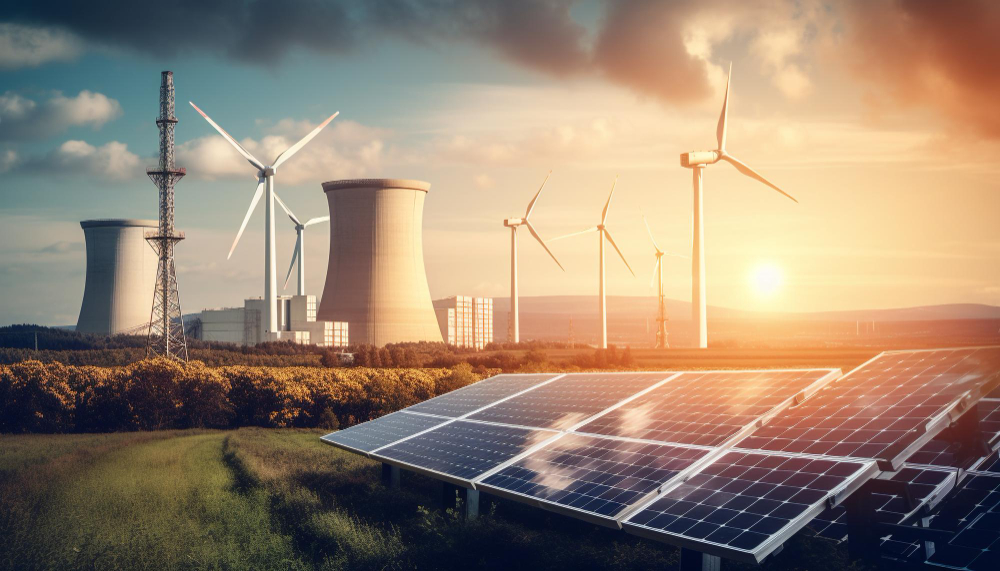

In 2023, the world added more solar power capacity in a single year than the entire global installed base of nuclear energy accumulated over sixty years. That figure — 447 gigawatts of new solar, according to the International Energy Agency — is the kind of statistic that forces a recalibration of assumptions about how fast the energy system actually changes. The transition is not approaching. It is already the dominant story in global capital markets, industrial policy, and corporate strategy.
But the transition is not uniform, not painless, and not guaranteed. It is creating enormous wealth for companies and investors positioned correctly, and stranding enormous assets for those who aren’t. Understanding the specific dynamics — which technologies are scaling, which business models are winning, and where the next decade of value creation lies — is the operating question for any business leader whose operations touch energy costs, supply chains, or capital markets.
Solar and Wind: The Cost Curve Has Won
The most important economic fact about solar energy is that its cost has declined 90% since 2010. Utility-scale solar now generates electricity more cheaply than any other source in history in most of the world. The same trajectory, with a roughly five-year lag, describes onshore wind. Offshore wind is following, though at a slower pace and with more complex economics tied to installation costs and grid connection.
This cost collapse has made solar and wind the default choice for new generation capacity in every major economy — not because of policy mandates, but because they are the cheapest option. The IEA projects that renewables will account for 35% of global electricity generation by 2025, up from 22% in 2015. By 2030, the projection is above 45%.
The business empires being built on this foundation are not primarily in manufacturing (China dominates solar panel production with roughly 80% global market share and has effectively established permanent cost leadership). They are in project development, grid services, and energy management. NextEra Energy, now one of the ten largest companies in the US by market capitalisation, built its position through a systematic assembly of renewable generation assets and grid infrastructure. Its FPL subsidiary in Florida and its NextEra Energy Resources development arm together represent the largest wind and solar operator in the world.
Battery Storage: The Missing Piece Arriving
The intermittency of solar and wind — they generate power when the sun shines and wind blows, not necessarily when demand peaks — has been the persistent objection to a renewable-dominated grid. Battery storage is the answer to that objection, and the economics are shifting fast enough that the objection is becoming less valid by the year.
Grid-scale battery storage capacity in the US more than doubled in 2023 and is doubling again in 2024-2025. The cost of lithium-ion battery storage has declined 97% since 1991. Tesla’s Megapack business, often underappreciated relative to its vehicle business, has become a major revenue contributor and is operating with a multi-year order backlog. Fluence (a joint venture of Siemens and AES), Powin, and Form Energy are building significant businesses in grid-scale storage.
Beyond lithium-ion, the race for long-duration energy storage — systems capable of storing energy for days rather than hours — is attracting significant investment. Form Energy’s iron-air battery, Ambri’s liquid metal battery, and various pumped hydro and compressed air projects are competing to solve the multi-day storage problem that lithium-ion cannot economically address. The company that cracks affordable long-duration storage at scale will capture enormous value in a grid increasingly dependent on variable renewable generation.
Green Hydrogen: The Industrial Decarbonisation Bet
Green hydrogen — hydrogen produced by electrolyser-splitting water using renewable electricity — is the most debated technology in the energy transition. Proponents argue it is essential for decarbonising sectors that cannot be directly electrified: steel production, cement, shipping, aviation, and certain chemical processes. Sceptics argue its energy losses make it inherently inefficient and that direct electrification will outcompete it in most applications.
The investment community has placed a hedged but significant bet on the proponent side. Global green hydrogen investment exceeded $300 billion in announced projects by 2024, with major commitments from the EU’s Hydrogen Strategy, Australia’s National Hydrogen Strategy, and the US Inflation Reduction Act’s $3 per kilogram production tax credit for clean hydrogen.
The leading companies are a mix of established energy majors (BP, Shell, Equinor all have green hydrogen divisions), industrial gases companies (Air Products, Linde, Air Liquide), and purpose-built startups (Plug Power, Bloom Energy, Nel Hydrogen). The realistic near-term market is industrial process heat and feedstock replacement in facilities adjacent to cheap renewable power — not the passenger vehicle application that captured public imagination a decade ago.
The Grid: The Boring Asset Creating the Most Value
The most underappreciated opportunity in the energy transition is the power grid itself. The US grid was largely built in the 1960s-1980s and was not designed for distributed renewable generation, bidirectional power flows, or electric vehicle charging at scale. Upgrading it is estimated to require $2-4 trillion of investment globally over the next two decades.
This is not a glamorous investment thesis. Grid infrastructure is slow, regulated, and unglamorous compared to battery gigafactories or hydrogen electrolysers. But it is highly predictable, essential, and protected by the monopoly economics of regulated utilities.
Beyond physical infrastructure, grid software and services are creating new businesses at speed. AutoGrid, Itron, and Virtual Peaker are building demand-response platforms that aggregate distributed energy resources — rooftop solar, batteries, EV chargers, smart thermostats — into virtual power plants that can respond to grid signals. GE Vernova, recently spun off from GE, has positioned itself as the dominant provider of grid hardware and software for the energy transition. Its wind turbine, grid automation, and electrification businesses collectively address the transition infrastructure market.
The Business Strategy Implications
For corporate leaders, the energy transition creates both risk and opportunity in the near term, regardless of whether your company is in the energy sector.
On the cost side, the declining cost of renewable energy is creating a genuine strategic advantage for companies that have locked in long-term power purchase agreements at sub-$30/MWh rates — now available in high-irradiance markets — while competitors continue paying higher grid prices. Google, Microsoft, Amazon, and Meta have all signed multi-gigawatt PPAs and are aggressively pursuing 24/7 carbon-free energy commitments that require storage and grid optimisation alongside generation.
On the supply chain side, the energy transition is reshuffling industrial geography. Countries with abundant renewable resources and mineral deposits — Chile, Australia, Canada, Morocco — are positioning as strategic suppliers of the green economy. Companies that understand these geographic shifts in the supply chains for copper, lithium, cobalt, and nickel will have operational advantages that compound over the next decade.
On the competitive side, the transition is creating genuine disruption in industries that depend on fossil fuels — not just energy companies, but automotive, shipping, aviation, steel, and cement. The business leaders who treat the energy transition as a compliance issue rather than a strategic reality are making a category error that will be visible in their cost structures and market positions within five years.
The Decade Ahead
The energy transition is the largest reallocation of industrial capital in human history. The IEA estimates that clean energy investment needs to reach $4.5 trillion annually by 2030 to stay on a path consistent with net zero by 2050. Current investment is running at roughly $1.8 trillion per year — a significant gap, but also a significant opportunity for capital and companies that understand where the demand is going.
The companies building durable positions in this transition share a common characteristic: they are treating energy not as a cost to manage but as a strategic asset to optimise. The new business empires of the energy transition will not be built by companies that generate electrons. They will be built by companies that intelligently manage, store, trade, and deploy energy across an increasingly complex and interconnected grid.
The corner office of 2035 will not have a CFO asking whether the company has a sustainability strategy. It will have a CFO asking whether the company’s energy strategy is a source of competitive advantage. That shift in framing — from compliance to competition — is the real signal that the transition has arrived.
