


Novo Nordisk’s Ozempic was approved by the US Food and Drug Administration in 2017 as a treatment for type 2 diabetes. Nobody involved in that approval, not the FDA reviewers, not the Novo commercial team, and not the wider pharmaceutical industry, anticipated that eight years later the drug and its GLP-1 receptor agonist siblings would become one of the most consequential commercial forces in global consumer economics. Yet by 2026, the GLP-1 class had achieved a market position that few pharmaceutical categories have ever reached: mass adoption across a healthy population, reshaping demand patterns in categories from snack foods to alcoholic beverages, and forcing insurance and healthcare systems into strategic decisions that will define their next decade.
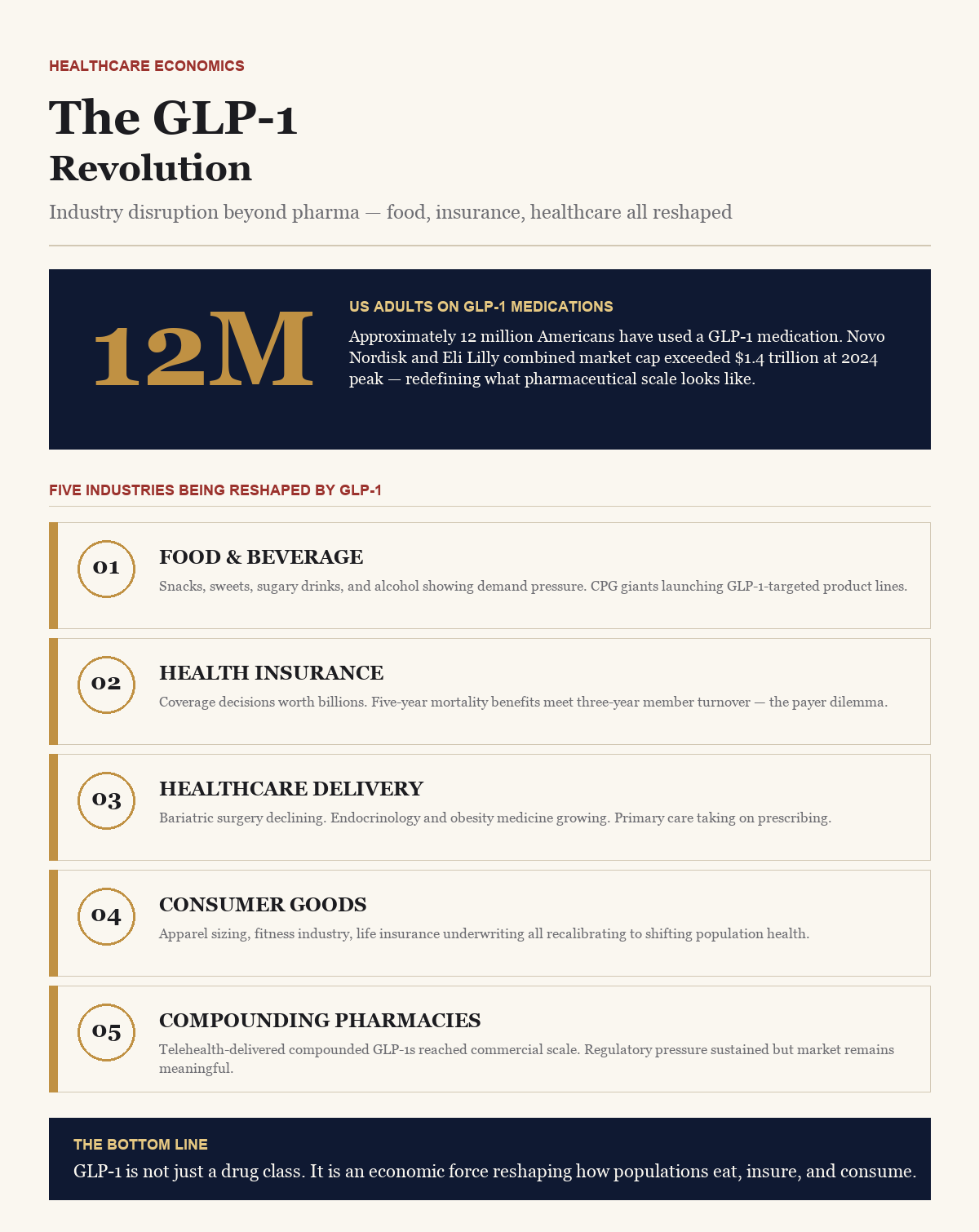
The commercial numbers tell only part of the story. Novo Nordisk and Eli Lilly, the two dominant GLP-1 manufacturers, collectively surpassed a combined market capitalisation of $1.4 trillion at the peak of the 2024 GLP-1 enthusiasm cycle. Even after the moderate correction that followed, the pair remain among the twenty most valuable listed companies in the world, a position that no pharmaceutical company had previously held. The category has redefined what pharmaceutical scale looks like, and it has done so by tapping into a demand pattern that the industry had traditionally treated as adjacent to medicine rather than central to it: the persistent difficulty of achieving sustained weight loss through behavioural means alone.
The Adoption Curve That Is Redefining the Market
US prescription data from IQVIA and Symphony Health indicates that approximately 12 million Americans had used a GLP-1 medication at some point by early 2026, with roughly 6 million active monthly users. The trajectory has been steeper than any previous chronic medication category. Statins, the last pharmaceutical class to achieve comparable population penetration, took roughly two decades to reach current utilisation levels. GLP-1s have compressed that adoption curve into approximately five years.
The demographic profile of GLP-1 users differs materially from what pharmaceutical categories typically see. The average patient is younger, more affluent, and more likely to be paying out of pocket than would be true for cardiovascular, oncology, or chronic disease medications. This has produced a commercial dynamic that resembles consumer goods more than traditional pharmaceuticals: brand recognition matters, direct-to-consumer marketing has driven demand, and the willingness to pay premium prices has held up better than the standard pharmaceutical price sensitivity would predict.
International expansion has been slower but is accelerating. The UK’s NHS has expanded GLP-1 access through both diabetes prescriptions and weight management programmes, though supply constraints have limited the pace. India’s regulatory approval of tirzepatide in 2024 opened a market of hundreds of millions of potential patients, though pricing at levels sustainable for the local market remains a fundamental challenge. China’s regulatory environment for weight management pharmaceuticals is evolving, with domestic biopharma companies rapidly developing GLP-1 alternatives that will change the competitive landscape by 2028.
The Food and Beverage Industry Faces Structural Change
The most surprising commercial impact of GLP-1 adoption has been visible in food and beverage consumption patterns. GLP-1 medications produce dramatic reductions in appetite, cravings for high-calorie processed foods, and desire for alcohol. When 6 million American adults experience these effects simultaneously, the aggregate demand impact on food and beverage categories is measurable in industry data.
Snack food companies including PepsiCo, Mondelez, and General Mills have reported category volume pressures in specific segments that industry analysts attribute in part to GLP-1 adoption. Salted snacks, sweet baked goods, and sugar-sweetened beverages have shown demand softness that predates broader economic slowdowns. Alcoholic beverage companies, particularly in premium spirits and beer categories, have similarly noted consumption pattern changes among younger consumers that align with GLP-1 usage patterns.
The strategic response from major consumer companies has been telling. Nestlé launched a dedicated GLP-1 support product line in 2024, focusing on nutrient-dense meal replacements and hydration products for GLP-1 users experiencing appetite suppression. Danone has expanded its high-protein product portfolio with GLP-1 patients as an explicit target segment. Even Coca-Cola has repositioned aspects of its zero-sugar product marketing to engage with GLP-1-associated consumption shifts. The industry that has spent decades optimising for maximum caloric consumption is now recalibrating for a customer base that is deliberately eating less.
The Insurance and Healthcare Payer Dilemma
The economic decision facing US health insurers and employer-sponsored health plans is one of the most consequential in the sector’s history. GLP-1 medications for weight management currently cost approximately $12,000 to $18,000 per patient annually at list prices. If deployed at population scale, even just to the 40% of American adults classified as obese, the direct pharmaceutical spend would exceed the total current US spend on all diabetes medications combined.
The clinical case for coverage is strong: obesity is a driver of cardiovascular disease, type 2 diabetes, sleep apnea, joint disease, and multiple cancers, all of which produce healthcare costs substantially higher than the pharmaceutical costs of GLP-1 treatment. The Cleveland Clinic’s 2024 study of GLP-1 treated patients showed 25 to 40% reductions in cardiovascular events, hospital admissions, and specialty medication utilisation across a five-year window. From a strict actuarial perspective, aggressive GLP-1 coverage produces measurable healthcare cost savings for stable member populations over five to ten year horizons.
The practical challenge is that most US health insurance members change plans every three to five years due to job changes, life events, or plan restructuring. This creates a mismatch between which payer bears the pharmaceutical cost of GLP-1 treatment and which payer captures the downstream savings from reduced disease burden. It also creates strong incentives for individual payers to under-invest in GLP-1 coverage even when the aggregate healthcare system would benefit from broader access. The Centers for Medicare and Medicaid Services’ 2024 decision to permit Medicare Part D coverage of GLP-1 medications for members with cardiovascular disease was a significant expansion but stopped short of general obesity coverage.
The Supply Chain and Manufacturing Question
The supply-side story of GLP-1 medications has been almost as consequential as the demand side. Peptide manufacturing at the scale required to serve current demand has stretched pharmaceutical supply chains in ways that have exposed structural fragility. Novo Nordisk has invested over $12 billion in additional peptide manufacturing capacity since 2022. Eli Lilly’s manufacturing expansion programme has been comparable in scale. Both companies have relied on contract manufacturing partnerships with organisations including Catalent, Thermo Fisher, and Cambrex to support the scale-up.
The compounding pharmacy loophole that developed during 2023 and 2024 supply shortages produced a shadow GLP-1 market that reached commercial scale before the FDA moved to constrain it in 2025. Compounded versions of semaglutide and tirzepatide, sold through telehealth platforms including Hims, Ro, and dozens of smaller providers, have introduced competitive pressure that the branded pharmaceutical industry had not previously experienced at this scale. The regulatory response has been sustained but incomplete, and compounded GLP-1s remain a meaningful component of the total market.
The next phase of the manufacturing story involves oral GLP-1 formulations, longer-acting weekly and monthly injectable versions, and next-generation dual and triple agonists that produce even greater weight loss with reduced side effects. Novo Nordisk’s oral semaglutide (Rybelsus) has been in the market for diabetes but is expected to gain weight management approval in 2026. Eli Lilly’s retatrutide, a triple agonist in phase 3 trials, has shown weight loss efficacy substantially exceeding current GLP-1 offerings. The competitive dynamics of the next three years will be shaped by these product launches and by the entry of Chinese and Indian generic competitors as patent protection begins to expire.
Adjacent Industry Impacts
The economic footprint of GLP-1 adoption extends into industries that are only beginning to recognise their exposure. Bariatric surgery volumes have declined significantly since GLP-1 mass adoption began, with implications for hospital surgical revenue, surgical device manufacturers, and the specialty medical practices that had built businesses around surgical weight loss interventions. Fitness and weight loss programme industries have shown mixed impact, some segments have benefited from users seeking exercise programmes complementary to GLP-1 treatment while others have seen customer base declines.
Apparel and fashion retailers have observed shifts in customer body composition that are affecting sizing distributions and category mix. Life insurance underwriting is being updated to reflect the potential mortality impact of GLP-1 population health improvements. Airline seat design, restaurant portion planning, and even home furniture design have all begun to reflect assumptions about population weight distribution that GLP-1 adoption may materially change over a decade.
The healthcare workforce implications are only beginning to be understood. Endocrinology and obesity medicine practices have seen dramatic patient volume increases. Primary care physicians have taken on increased GLP-1 prescribing responsibility, altering their patient management workflows. Behavioural weight management programmes have shifted from primary interventions to adjunct services. The training pipelines that supply these specialties are adjusting to demand patterns that were unpredictable five years ago.
Strategic Implications for Business Leaders
For business leaders in industries adjacent to healthcare, three implications warrant explicit strategic attention. First, consumer goods and food industries need to model demand scenarios that incorporate continued GLP-1 adoption growth, not as a fringe scenario but as a base case. The population share of GLP-1 users is likely to exceed 15% of US adults by 2028 based on current adoption trajectories, and the consumption pattern effects at that penetration level will be materially different from what companies have modelled to date.
Second, healthcare payers, employer benefit designers, and healthcare delivery organisations face strategic decisions about GLP-1 coverage and utilisation management that will shape competitive position for the next decade. The plans and providers that manage GLP-1 access effectively, providing appropriate coverage while managing cost trajectories, will build member relationships and cost positions that lower-quality competitors cannot easily replicate.
Third, investors and corporate strategists need to think about GLP-1 as a technology platform rather than a single drug class. The mechanism of action extends beyond weight management to potential applications in addiction medicine, cardiovascular disease prevention, kidney disease progression, and cognitive health. The pipeline of GLP-1-adjacent therapeutic areas is deep, and the companies that have built manufacturing scale and clinical expertise in this class are positioned for a decade of category expansion. The GLP-1 revolution is not ending, it is entering a broader phase.
