



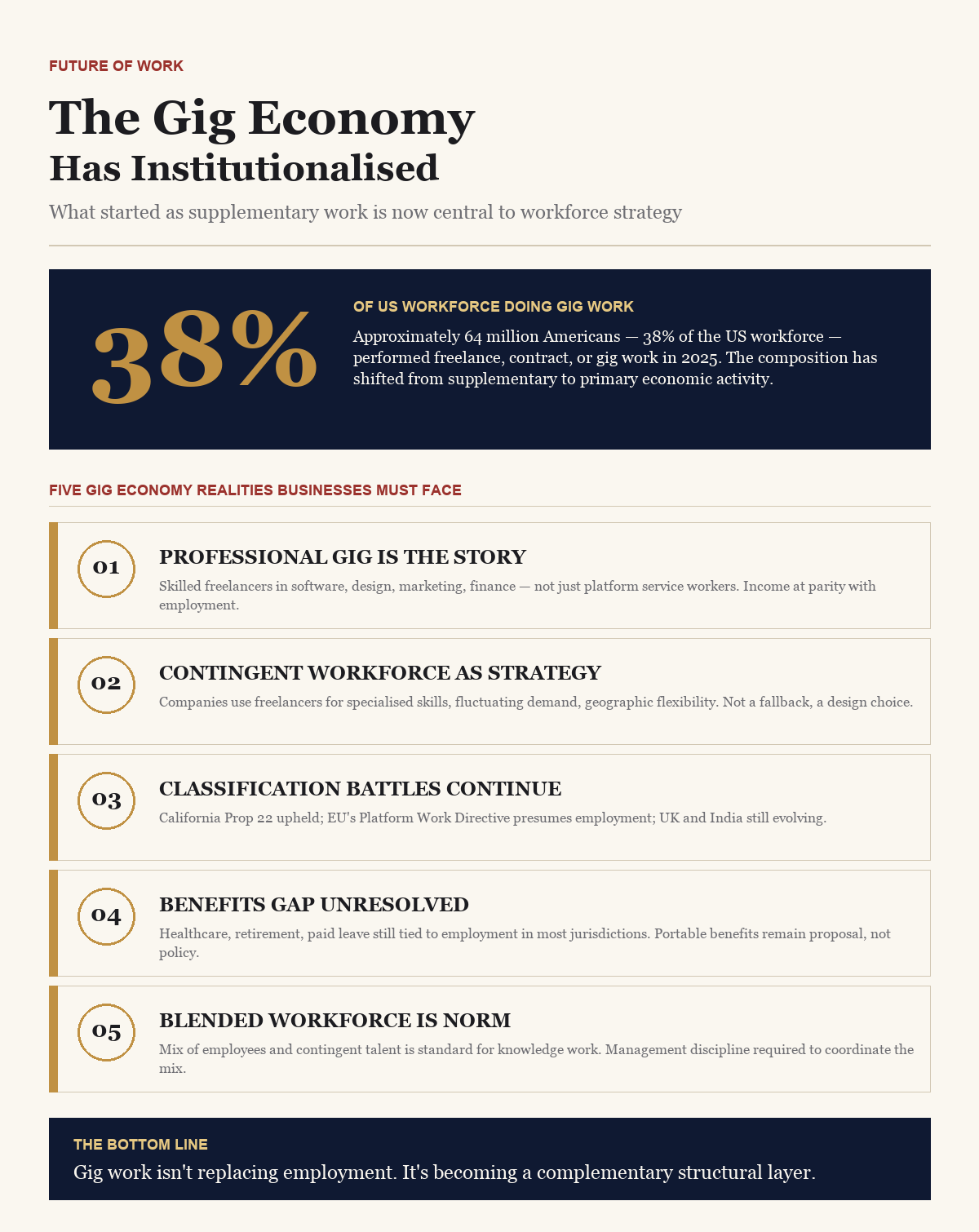
Approximately 64 million Americans, roughly 38 per cent of the US workforce, performed some form of freelance, contract, or gig work in 2025, according to Upwork‘s annual freelance economy report. The figure has grown each year since 2020, and the composition has shifted from primarily supplementary work performed alongside traditional employment to increasingly substantial fractions of the workforce who are independent workers as their primary economic activity. The pattern is not unique to the United States. The UK, Australia, the EU, and India all report substantial and growing populations of independent workers, with India’s gig workforce alone estimated at 8 million and projected by NITI Aayog to reach 23 million by 2030.
This is not the gig economy as it was originally framed, Uber drivers and TaskRabbit handymen performing low-skill services through platform intermediaries. That segment continues to exist, but the more consequential growth has been at the higher end: software developers, designers, marketing professionals, financial analysts, lawyers, and other knowledge workers who have chosen independent work over traditional employment, often with incomes that match or exceed what they would earn in comparable employed positions. Understanding this professional gig economy, its drivers, its sustainability, and its implications, is now a core element of workforce strategy for any large business.
What Is Actually Driving the Growth
The conventional narrative is that the gig economy is the product of platform technology, Uber, Upwork, Toptal, and similar marketplaces creating new forms of work that did not previously exist. Platforms are part of the story, but they are more accurately understood as accelerants of a deeper structural shift in labour markets rather than the original cause of it. The underlying drivers are economic, generational, and technological in ways that extend well beyond platform business models.
On the worker side, two dynamics have been particularly important. The flexibility advantage of independent work has become more valuable as workers have prioritised work-life integration, location independence, and control over their schedules. The pandemic substantially accelerated this preference shift, and surveys consistently find that the option to work flexibly remains a high priority for a substantial fraction of the professional workforce, particularly younger cohorts. Independent work, when it can be sustained at attractive income levels, provides the flexibility that traditional employment often does not.
Income optimisation is the second worker-side driver. Skilled professionals with strong networks and clear value propositions can often earn more as independent workers than in employed roles, because they capture the margin that employers would otherwise take and because they can serve multiple clients simultaneously. The economics work for a specific population, typically professionals with skills in high demand, established client relationships or strong personal brands, and the temperament to manage business development alongside delivery work. For this population, independent work is not a fallback; it is a choice that produces better outcomes.
The Corporate Side: Why Companies Use Gig Workers
On the demand side, the growth of professional gig work reflects deliberate corporate strategy as much as platform innovation. Large companies have substantially increased their use of contingent workforce, independent contractors, agency temporaries, consultants, and freelancers, over the past decade, and the trend has continued through both growth periods and downturns. The drivers reflect both opportunity and pressure.
Capability access is a major driver. Specialised skills that are not needed on a full-time basis, AI implementation expertise, specific regulatory knowledge, niche technical capabilities, can be more efficiently accessed through contingent arrangements than through full-time hiring. The unit economics of full-time employment include not just salary but benefits, infrastructure, management time, and ongoing development cost. For specialised needs, contingent arrangements often produce better outcomes at lower total cost.
Workforce flexibility is the second major driver. The 2022-2024 cycle, in which companies hired aggressively in 2021-2022 and then conducted significant layoffs in 2023-2024, has made many executives sceptical of the wisdom of building large permanent workforces in functions where demand can fluctuate. A contingent workforce strategy that scales up and down with business need offers genuine financial and operational advantages over headcount strategies that produce hiring booms followed by painful corrections.
Geographic flexibility is the third driver, particularly important in technology and knowledge work. The talent pool for any given specialised role is global, but employment regulations, payroll obligations, and benefits administration vary substantially across countries. Contingent arrangements provide simpler legal mechanisms for accessing talent across borders, and platforms have proliferated to facilitate exactly this cross-border professional work.
The Risks That Have Not Been Fully Resolved
The shift toward gig and contingent work has produced real benefits for some workers and substantial efficiency gains for many businesses, but it has not resolved several structural problems that traditional employment addressed. Income volatility is the most direct issue affecting independent workers, even successful freelancers experience irregular income that complicates financial planning, mortgage qualification, and long-term wealth building. The economic stability that traditional employment provides for many workers is not replaceable purely through higher freelance rates (see our analysis in The Solopreneur Economy).
Benefits access remains the most significant policy challenge. Health insurance, retirement savings, paid time off, and unemployment insurance are largely tied to traditional employment in most jurisdictions. Independent workers typically pay out of pocket for healthcare, lack employer matches on retirement savings, and have no paid leave or unemployment safety net. Various policy responses have been proposed, portable benefits accounts, classification reforms, mandatory benefits for platform workers, but no jurisdiction has implemented a comprehensive solution that fully addresses the gap (see our analysis in Remote vs Hybrid vs Office).
Career development for independent workers is more variable and uncertain than for employed workers. Companies invest in their employees’ development through training, mentorship, and assignment to challenging work. Independent workers are responsible for their own development, which works well for some individuals but produces uneven outcomes across the population. Long-term career trajectory data is still emerging, given how recently large-scale professional gig work has developed, but early indications suggest that independent workers must be more deliberate about skill investment to avoid stagnation (see our analysis in $5 Trillion Logistics Industry).
Worker Classification: The Legal Battle
The classification of gig workers as independent contractors rather than employees has been one of the most contested legal and regulatory issues of the past decade. The economic stakes are substantial: classifying workers as employees triggers benefits obligations, payroll tax responsibilities, and various labour law protections that do not apply to independent contractors. Companies that have built their business models on contractor classifications face existential risk if courts or regulators reclassify their workers.
California’s Proposition 22, which exempted certain platform workers from employee classification, was upheld by the state Supreme Court in 2024, preserving the independent contractor model for platform-based gig work in California. The EU’s Platform Work Directive, which took effect in 2024, takes a different approach, creating a presumption of employment for platform workers that companies must rebut. The UK has gone through multiple legal battles over the classification of Uber drivers and similar workers, with mixed outcomes that have created ongoing uncertainty.
For knowledge workers operating through marketplaces like Upwork, Toptal, or directly as independent consultants, the classification questions are typically less acute, because these workers more clearly meet the traditional tests for independent contractor status, multiple clients, control over their work methods, investment in their own equipment and infrastructure. The professional gig economy at the higher end has not been the focus of classification disputes, which have concentrated on platform-based service work where the platforms exert significant operational control.
The India Dimension
India’s gig economy has grown rapidly and has unique characteristics shaped by the country’s labour market dynamics. The platform-based service economy, Ola, Uber, Swiggy, Zomato, and Urban Company, has created millions of livelihoods for workers who would otherwise be in unorganised employment with even fewer protections. The Code on Social Security 2020 established a framework for extending some social security benefits to gig and platform workers, though implementation has been gradual.
The professional gig economy is also expanding rapidly in India, driven by the same dynamics visible in Western markets but with the additional factor of Indian professionals serving global clients remotely. The combination of Indian technical and professional talent serving North American and European clients through platforms or direct relationships has created income opportunities that did not previously exist at scale. This cross-border professional work is one of the most economically significant dimensions of India’s participation in the global gig economy.
Implications for Workforce Strategy
For executives considering workforce strategy in the late 2020s, several principles emerge from how the gig economy has evolved. A blended workforce, combining employed talent for core capability and continuity with contingent talent for specialised, fluctuating, or geographically distributed work, has become standard for most large knowledge-economy businesses. The strategic question is no longer whether to use contingent workers but how to manage the blend effectively, and how to build the management capability to coordinate workforces that include multiple employment categories.
Skills strategy needs to be designed for a labour market in which much of the most specialised talent operates as independent workers. Companies that build deliberate relationships with skilled freelancers, repeat engagements, fair pricing, clear scope definitions, develop a flexible talent pool that complements their permanent workforce. Companies that treat freelance relationships transactionally, taking advantage of independent workers’ weaker bargaining position to extract value at the expense of fair compensation, find that the talent they actually want to engage moves to competitors who treat the relationship more sustainably.
The gig economy is no longer a temporary trend. It is a structural feature of modern labour markets that will continue to evolve but is unlikely to reverse. The companies that have integrated contingent workforce as a strategic capability, with the management discipline, sourcing infrastructure, and cultural integration to make it work, have built workforce flexibility that is genuinely valuable in markets that change rapidly. The companies that have not are likely to be more constrained, both in the talent they can access and in the workforce flexibility they can deploy when conditions shift.
